
If you enjoy independent indie game coverage, consider supporting Indie-Games.eu on Patreon. It helps keep the site independent.
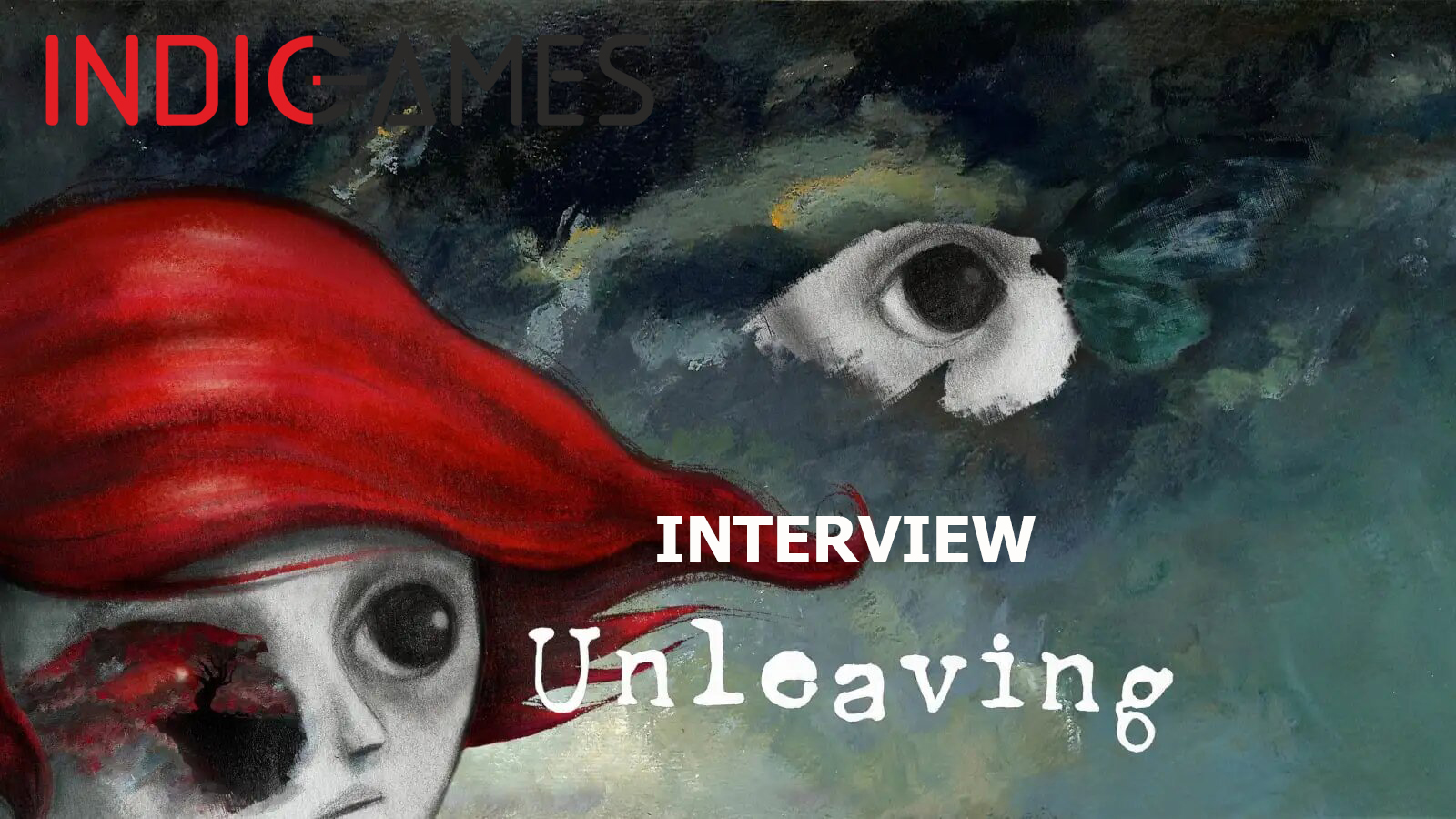
Every now and then, a true hidden gem suddenly appears on the indie scene. We recently came across Unleaving, a game that completely fascinated us with its artistry, music, and puzzles. We had the opportunity to interview Sura Karnawi, the developer behind this extraordinary game, where we delved into key aspects of the development process, including the creation of animations, sources of motivation, studio goals, and much more.
Unleaving is a narrative puzzle platformer where every challenge unfolds within a hand-painted landscape, exploring the perception and meaning of the world. It is full of symbols, and everything is up to you to interpret. The game has very impressive graphics, sounds, and various puzzles and platforming segments. It continuously revolves around solving these puzzles while enjoying the beautiful colors, animations, and a not-so-clear story. Should you get stuck on a section, help is offered, which will point you in the right direction but will not directly give the solution.
Unleaving transcends traditional boundaries, bringing something original by merging an impressive video game experience with engaging multimedia imagery and drawings, as elements of pencil and graphite are used in creating the puzzle elements. Every scene is new, meaning there is no repetition. Also, each chapter is based on a specific theme that guides the mood, emotions, and story, and affects the colors and style.
If this title has sparked your curiosity, you can find it on Steam.
I’m Sura, and I represent our studio in Toronto. We did the majority of Unleaving‘s work here. My husband and I co-founded the studio. It all started in Manchester, England, but we moved to earn a living in Toronto. It started, I would say, in different phases, but it was officially registered when we began working on this game full-time in February 2021. That was exactly three years ago. Before that, we went through various phases, including prototyping while working on the project from our home in England for about two to three years, just to get the idea, put it together, and everything else.
As for our backgrounds, I was a software engineer for the BBC, while my husband was a pharmacist. So, completely different backgrounds, but we share a common passion for art and games, and we see video games as a cultural medium. It’s a medium where we can express stories, and each of us brought something different, but I always wanted more art in games. Growing up, I loved games like Braid, Limbo, as well as classics like Sonic and Mario. I always imagined what if I could make a painting and play it. I was obviously able to bring this vision to life at Orangutan Matter, where we can turn literal paintings into a video game.
We both worked from home throughout the project. I, being a software engineer, with all my training and computer science studies, had practiced hard my whole life, which prepared me for this. We both did everything; he worked with me on the artwork and the majority of the development. I also did some of that, but I was involved in every engineering decision. So, we both did almost everything together, but mostly the artistic direction fell to me. There were three other artists who collaborated with me on the project.
On Unleaving, we collaborated with various individuals at different times. The core team was my husband and me, the two of us, but with collaborators, there were about seven people who came and went at different times. They contributed to the creation of Unleaving, from character art, environment, level design, development, technical decisions, and also the music. We used music from the musician Alicia Enstrom. There were different layers, but about seven people worked on the game.


It all really stemmed from a love and passion for art and games; telling stories about vulnerability and raw human emotions through the medium of video games. I push for it to be more of a cultural medium. There are so many beautiful games that tell very powerful stories, and I want to contribute even more to that. The inspiration came, for example, from England when I was visiting galleries and saw the incredible paintings of [William] Turner as one of the inspirations for the art style. When you visit an art gallery, you are given permission, in a way, to make your own interpretation.
You can observe the art for one sentence or one thing, and then, as a visitor, you can say, “Oh, I guess this can be about this, or it can be about that.” We are so open in the art world to discuss that meaning. But in games, I see you are kind of limited because there’s only one way to interpret things. We wanted to convey that art gallery experience into video games. In Unleaving, there is minimal narrative, and then the player is invited to give it their own meaning. So, that’s one of the key inspirations for creating Unleaving, that feeling of inviting the player to come up with their own meaning and simply share it.
Limbo is a huge inspiration for the game mechanics and the creepy style itself; that’s a game that really inspired us. The actual development took three years, but before that, there were a couple of years of prototyping and just exploring. It was very intense, I have to admit. It was an obsession. It wasn’t normal because, when you’re so involved in something, sometimes you work for a very, very long time. I would be painting, I’m not sure how many paintings—creating a large number of them, and then I would lose track of time. I would wake up at 4 or 5 AM to paint or develop, doing things. So, I would say three years, but if you extrapolate that to normal people, how they usually work, it might be seven years.
The game was originally called Jack. We just wanted to give the character any name, a very generic name, actually, because it’s a story for anyone. Anyone can be that child. But then, as the story matured, as we grew with the development, we decided to change the name to be more reflective, because we didn’t want to name it just to be an extension of any player.
It can’t be that there is no concrete story behind it. It’s more like a self-reflection, and then when we came across the poem, it resonated with the story. It resonated with everything we wanted to do because it talks about the transient sense of life, and that’s kind of the story in Unleaving. You’re just confronting the transient sense of life, uncertainty, and some questions about mortality and various things.
We took that part on Unleaving. That’s the most interesting part of the game for us. And there’s also the part about the child in the poem named Margaret. So, it felt like either talking to a child or understanding things from the perspective of a child. It really all aligned with Unleaving; as you can see, the protagonist is a child, but that can be a metaphor.
It was like a trial-and-error process. Moreover, it was a process of testing and learning. Because the game is very atmospheric, it has paintings and all of that, but at the same time, it’s a brush-painted puzzle platformer that is very detailed. So we wanted to “marry” the two. The environment is very chaotic, with very precise details. They put an emphasis on the puzzle platformer elements, because there is that precise element, that kind of almost clear-cut terrain. We explored Unity.
Obviously, there is a large number of engines, but we settled on Unity because there is a C sharp element, where you can make things very precise. It is also physics-based, so it worked out very well. You take the paintings and just cut them the way you want. We create the paintings, and then we go through the process of prepping them for Unity.
We call it painterly animation, which can have different names in different places. Where you have moments where you have one background, and then something happens, and then the background completely changes to something else, or moments where you have a background and then you see subtle changes. So, that’s called painterly animation.
When you capture one frame of a painting, you can then capture other frames, as well as other versions of that painting. That really happened by just scanning multiple versions of that painting. For example, you scan it, make some brushstrokes, and then go and scan it again. In the end, the accumulation of scanning those paintings made it the painterly animation.
This is mostly for the background, but the same applied to the ground. You would take a piece of ground, then scan and add some brushstrokes. By the end of the day, you’re transitioning between these different scans, which will make the space feel alive and breathing. It’s almost like you’re giving the painting breath in a way.
It leans a lot on art and painting, but Unleaving is a video game first, and video game rules dictated everything, like the puzzle elements. We followed the principles of level design. Say, having a clear goal, having consistency, and making sure all interactive elements looked the same—that dictated anything else in the game, like the art style, and that kind of constrained us. So, the puzzle elements came first. Everything started from the story, from the emotions; what emotions we want to capture.
For example, there is a scene that depicts the warmth of the sun where our protagonist is chasing a cricket. We always had in mind what feeling we wanted to capture, and from that, we went into choosing the artwork for the puzzle elements, and also how we want to approach the game. We would also then choose the colors or the painting, or
The aspect of trial-and-error came quickly, because the game is a kind of reflection on self and life in general. Mistakes are a very familiar theme in life; we just need to add attempts to that. We saw this in Limbo, which we love so much and wanted to include. And I understand there’s another layer to it, which is the timing and making things somehow come together in a certain sequence.
For example, the bison. You can approach that puzzle in many ways, or you can approach it coming in with the expectation that this game is going to be difficult. It might be a little less frustrating. But if you come to it, just looking at it as a pure game with no story behind it, maybe it will be a bit more challenging. So, it depends on the player and their experience. They are free to take it from whatever aspect they want.
I am aware of that. We hear comments talking about the perfect timing of the puzzles. That’s why the game is not so simple. You have to be precise. We heard players say, coming from their expectation, they knew it would be like this, and they felt unsurprised and somehow almost ready for the experience. So, every player is different. They can approach it however they want. It is their own experience.
We’ve heard so many different things about the game, and that makes us very happy as creators, because there is no negative or positive way to look at the game. Just sharing that experience is what excites us as creators, because people approach it differently, see it differently from their perspective, without us as creators imposing any interpretation.
I would say, like any creator, you hope for the best, right? But just embracing the spirit of Unleaving, in the sense that it brings relaxed gameplay, you kind of let go of high expectation. I had to approach the launch in the same way. I think my biggest hope was for people to connect on a deeper level and to extract their own meaning from the game. It helped me, but also approaching the reviews or approaching people’s perception in a way that is not connected in a negative or positive way. For me, there is no negative or positive.
I know how Steam works. There is either positive or negative. And I know, some people even mentioned when they were leaving reviews, they didn’t want to leave either. They just wanted to talk about their experience. We hope that this kind of approach will exist on Steam and other platforms in the future. Players can just share their own experiences without putting them into black or white, negative or positive. You experience something the way you see it, and you just want to share it. And that’s really what the game is about, learning about approaching things from a different perspective and just being curious.
So, as creators, we have to adapt to the same mentality somehow. It actually became more of a personal habit for me while developing the game. To always somehow detach yourself from judging things, good or bad, and just look at things as a learning experience. So, there are a lot of different reviews, different opinions, and that’s what really makes me happy as a creator, when I see how many different perceptions there are.
And that’s what we wanted as creators, just to see how people connect on a deeper level. That they were willing to say they enjoyed the artistic aspect. They were willing to talk about how they experienced other parts, without labeling them as bad or good. It’s an experience, and that’s it.


The whole theme of Unleaving is about just being open, and also there’s always a status quo with expectations. The game is not about measurement. It’s not about fitting into a box. What is success? Is it black or white or what is negative or positive or this or that? Our goal is for people to take that away from Unleaving, embracing the unknown. Not everything can be quantified and numbered and known.
That’s what we always talk about; how much are you selling, what is the wishlist? But I didn’t even approach it from that perspective as a creator. I wouldn’t personally check it all the time because I didn’t approach the game in any way from a perspective of quantifying success. Quantifying failure. For me, there is no failure or success. It’s all an experience. And we are not here to label it, but to experience it.
I get goosebumps from that question. Thank you for asking that. I would definitely say to lose the fear of judgment as early as possible, because if you remove that, you are free to be creative. You are so free to do amazing things and achieve your vision, assuming others will also support and help you.
I believe the gaming community was a big part of my journey. As I mentioned, PAX East was one of them. Also, COVID, being online and talking to other developers and players. Personally, I felt very supported, and I encourage people to trust more, trust their community because they will see beautiful things. Trusting the community, maybe. That’s what I would say.

We had the opportunity to sit down with the brilliant minds behind Business Goose Studios: Beau Vankemenade, Sander Ambroos, and…
![[EXCLUSIVE] Like a Bloody Storm – Interview with Kazusou Oda (Coda)](https://www.indie-games.eu/wp-content/uploads/2025/12/Oda-Kazusou-Interview-300x169.jpg)
We had an opportunity to talk with Oda Kazusou, a theme song artist for JoJo's Bizarre Adventure.
Once inside, visitors will find a fully immersive world where exhibitor booths are crafted using real in-game assets.
We talked to Tomasz Janicki about the details regarding Cult of Shadows.
We talked to Piotr Ruszczak, one of the creators of Mad Bang Bang, about the details of this production.
We asked Kiryl, Marek, and Jakub to reveal the secrets of their work to us.
Will Valor Mortis become the hit of 2026?
We had the chance to ask Yannick Audéoud, developer behind Orbyss, some questions about the game.

Maričak actively works to grow and promote the Croatian gaming industry while simultaneously fostering collaboration with the film industry.

During our interview, Jan revealed the secrets of composing music for both KCD games.

In this interview, we asked Paweł Charzyński about his experience working on Frostpunk 2 as VFX coordinator.
![[A BIG INTERVIEW] Toukana Interactive Co-Founder Zwi Zausch on the Gaming Industry](https://www.indie-games.eu/wp-content/uploads/2025/09/Dizajn-bez-naslova-2-300x169.jpg)
Zwi Zausch provided a deep dive into the gaming industry from an indie developer's perspective.
![[A BIG INTERVIEW] Deep Dive into Star Birds with Toukana Interactive’s Co-Founder](https://www.indie-games.eu/wp-content/uploads/2025/09/star-birds-300x169.jpg)
Ever wondered what it takes to build a relaxing base on an asteroid? We spoke with Zwi Zausch, who gave…
Playtonic has upgraded every aspect of the game, not just the visuals, also the core gameplay experience.

You'll mine resources, craft ship parts, and automate planetary bases with drones and cargo ships to create logistics networks.
We interviewed co-founder of Unfinished Pixel Marcos Torrecillas at Gamescom.
Frostrail centers on the Eden Engine, a steam-powered train that serves as your mobile base and lifeline in a frozen…
We took a deeper dive into the game's inspiration, mechanics, and Serenity Forge's role as both a publisher and developer.
Directed and designed by Pietro Polsinelli, the game combines historical inspiration with a mix of roguelike strategy.
We had the chance to chat with Daphnée Portheault, developer at Tsukumogami Software behind Dice n' Goblins.
We had the opportunity to sit down with the brilliant minds behind Business Goose Studios: Beau Vankemenade, Sander Ambroos, and…
We had an opportunity to talk with Oda Kazusou, a theme song artist for JoJo's Bizarre Adventure.
Once inside, visitors will find a fully immersive world where exhibitor booths are crafted using real in-game assets.
We talked to Tomasz Janicki about the details regarding Cult of Shadows.
We talked to Piotr Ruszczak, one of the creators of Mad Bang Bang, about the details of this production.
We asked Kiryl, Marek, and Jakub to reveal the secrets of their work to us.
Will Valor Mortis become the hit of 2026?
We had the chance to ask Yannick Audéoud, developer behind Orbyss, some questions about the game.
Maričak actively works to grow and promote the Croatian gaming industry while simultaneously fostering collaboration with the film industry.
During our interview, Jan revealed the secrets of composing music for both KCD games.
In this interview, we asked Paweł Charzyński about his experience working on Frostpunk 2 as VFX coordinator.
Zwi Zausch provided a deep dive into the gaming industry from an indie developer's perspective.
Ever wondered what it takes to build a relaxing base on an asteroid? We spoke with Zwi Zausch, who gave…
Playtonic has upgraded every aspect of the game, not just the visuals, also the core gameplay experience.
You'll mine resources, craft ship parts, and automate planetary bases with drones and cargo ships to create logistics networks.
We interviewed co-founder of Unfinished Pixel Marcos Torrecillas at Gamescom.
Frostrail centers on the Eden Engine, a steam-powered train that serves as your mobile base and lifeline in a frozen…
We took a deeper dive into the game's inspiration, mechanics, and Serenity Forge's role as both a publisher and developer.
Directed and designed by Pietro Polsinelli, the game combines historical inspiration with a mix of roguelike strategy.
We had the chance to chat with Daphnée Portheault, developer at Tsukumogami Software behind Dice n' Goblins.
