
If you enjoy independent indie game coverage, consider supporting Indie-Games.eu on Patreon. It helps keep the site independent.
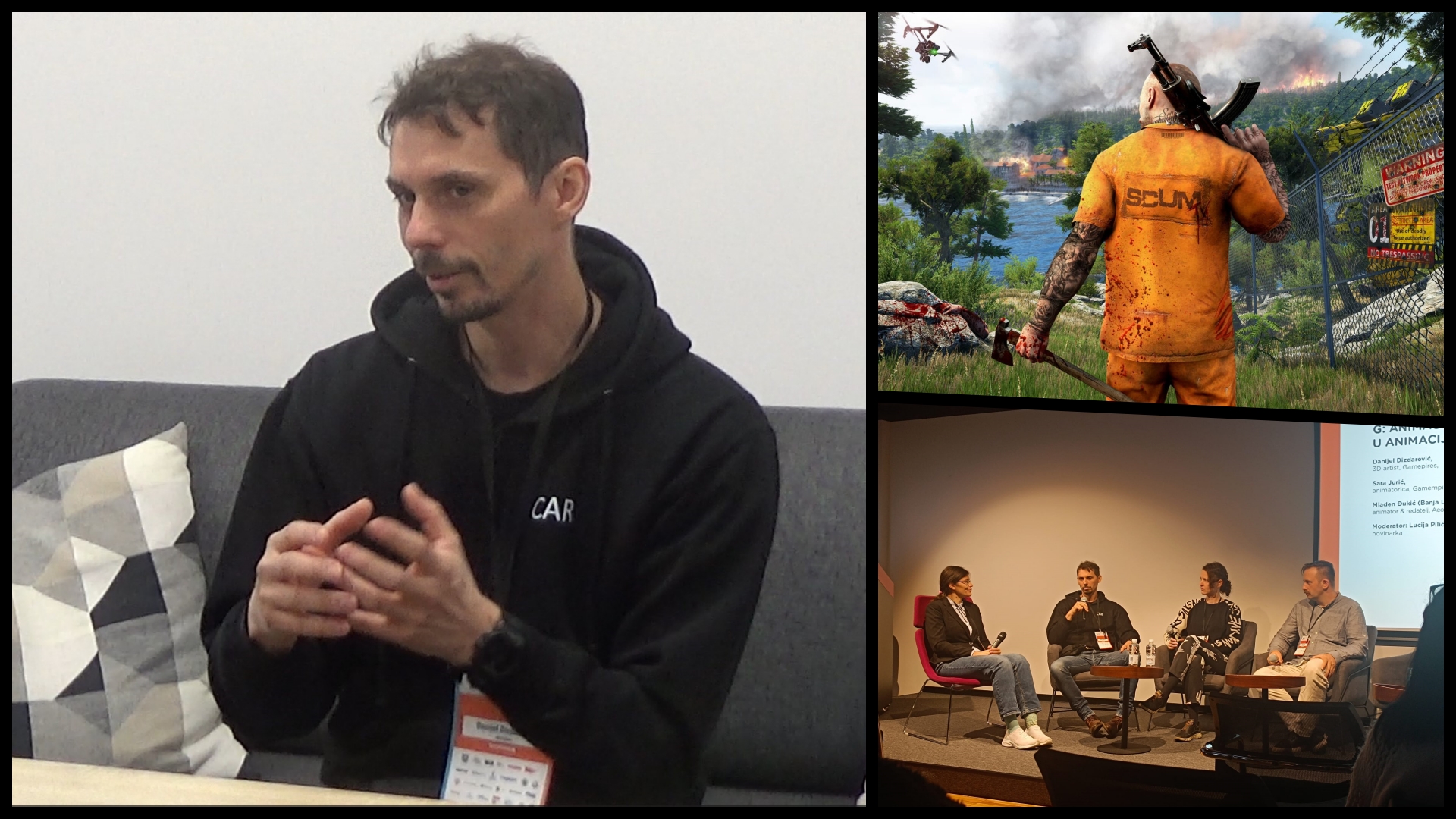
Danijel Dizdarević is the lead character designer at the Croatian studio Gamepires, best known for the game SCUM, now under Jagex, the company that acquired the rights to this IP. We met him during the Blender: Film & Games conference in Zagreb. Although SCUM is a live-service game that continuously receives new content and updates, it still attracts around 20,000 active players.
Danijel also appeared as a speaker on the panel Animation – Similarities and Differences Between Film and Video Game Animation, alongside his colleague Sara Jurić. We talked with him about the role of a character designer, his view on the gaming industry in Croatia, the situation in the studio after the Jagex acquisition, and many other topics.
SCUM is a game that offers exploration, looting, crafting, outfit customization, and character personalization. It provides an extremely immersive and hyper-realistic survival experience, giving players full control over their progress. Gamepires also participated in this year’s Infogamer, so we highly recommend keeping an eye on this title.
I’m currently the lead character designer, which means I manage my team and pass on the entire system we use in the game. Besides sharing knowledge and experience, I maintain their workflow, and I’m the go-to person for any issues or challenges that arise. We work with quite a complex system that has been developed over many years, and it takes a lot of time for each new team member to get familiar with all the processes. In short, my job is to maintain, train, and lead the team.
From the initial character creation to the final product, we use various tools. For example, for high-poly models we use Marvelous Designer for clothing and ZBrush for sculpting animals. We also frequently use 3D scans, which we clean up in ZBrush. We use Blender as well, while the animators mainly work in Maya. Sometimes we use 3D Coat, although not very often. After that comes Substance Painter and Photoshop, all from the Adobe suite.
It depends on the complexity. If it’s an NPC that doesn’t need to meet specific requirements, it can be done in about two weeks. However, complex characters can take up to half a year because work is often interrupted by other tasks, like trailer production or fixing previously completed assets. Some characters require special specifications due to the nature of our game, for example, our system allows characters to lose or gain weight, which means each character needs four different body states: skinny, fat, muscular, and normal.
Yes, I’d say the character from the Danny Trejo DLC. He was our first DLC character, and I did most of the work on him. We had some clothing prepared by a former colleague, and I handled the head, body scan adjustments, textures, and everything else. Danny Trejo was my first DLC, and later other team members continued the development under my supervision. This project is especially dear to me because it involved many technical challenges. I enjoyed working on it more than on the early characters, where the whole process was still being defined and adjusted.


Yes, the changes are noticeable, especially in the pace and the overall process of implementing content. Before, we worked intensely and released updates every two weeks. With Jagex’s involvement, development has slowed down because everything we produce has to undergo additional review and receive their approval. Jagex is now the owner of the IP, so they need to approve every new piece of content before it goes into the game. This additional communication definitely slows things down.
We are currently focused exclusively on SCUM. We’re not working on their projects, although something like that might happen in the future. They already have enough people on their teams, and our models are more complex and high-poly compared to theirs, which are more low-poly. For now, we have plenty of work on our own project due to the complexity of our tasks.
Honestly, even though people often comment that game models have improved thanks to new technology, in my case that’s not really true. I work with almost the same tools as nine years ago, with only minor updates. What has truly changed is my experience and my ability to achieve better results with the same tools. People often think advanced technology makes the job easier, but the increased quality actually comes from my growth as an artist.
It’s hard to find experienced character designers, because most applicants are still at junior or beginner level. While we were searching for new team members, it became obvious how rare experienced designers are in Croatia. Even though it’s not difficult to find a job in this industry, success depends on how much individuals work on themselves. It’s important to go through the entire model creation process from start to finish to understand what makes a model good and useful for a game.
When candidates receive feedback, we appreciate when they apply it in future applications because it shows a willingness to learn and improve. Besides technical knowledge, communication and the ability to accept suggestions are crucial for teamwork and production in general.


Since I have three children and a family life, I don’t have much time to consider new jobs or starting my own projects. After nearly nine years in this role, I don’t plan to leave. I used to think about it, but I realized that my departure could cause problems because certain workflows and knowledge still only exist in my head. To take over those tasks, someone would need a detailed guide, so for now, I don’t plan to make any changes.
My main focus is creating clothing for playable characters. When we work on NPCs like monsters, tribes, or savages, there can be some backstory, but ultimately we focus more on technical aspects. For example, if an NPC wears long clothing such as a coat, it must be adapted to technical limitations, like Unreal Engine 4 not supporting a combination of cloth physics and body shape changes. This means that clothing needs to be weighted to bones to function properly, but players cannot equip and use that outfit due to technical constraints. So, while lore exists, our priority is fitting within the technical requirements of the game.
From what I’ve heard so far, switching to Unreal Engine 5 would involve many challenges and potential issues, possibly more than benefits. However, you never know what the future holds; if the programming team finds a way to make the transition without major problems, we might consider it. But for now, there are no concrete plans.
Actually, I discovered design a bit later. I always loved drawing, especially graffiti and sketches on paper. At one point, I thought I’d become a concept artist, and I was even interested in airbrush painting of motorcycles, cars, and helmets. However, for financial stability, I started exploring digital tools and moved to drawing in Photoshop. Then I gradually switched from 2D to 3D to help myself with perspective, and over time I became more focused on 3D modeling. After several years of practice, I applied for a job, and that’s how it all began.
I think it’s a great idea! There has long been a connection between films and games, and I’m glad that conferences like this encourage discussions about it. I only recently learned about the event and began preparing for my participation, but I believe it’s a useful space for sharing knowledge and experience.


Clipping, especially with character clothing, is something we simply have to accept. With hard surface elements like weapon parts, mistakes are unacceptable because we know exactly how those components should behave. But with soft surface elements like clothing, things are far more complex. We have morphs for different body types: skinny, fat, muscular, and normal which makes perfect adjustments difficult. Adding too much detail or too many morphs would increase hardware requirements and reduce game performance, which players would complain about far more than occasional clipping.
We have hundreds of clothing items, including shoes, pants, shirts, gloves, full-body outfits, and male and female variations of each piece. Every item needs to be created in four versions due to different body types. This means each piece requires many morphs and adjustments, which increases complexity even further.
We always try to optimize the game so it runs on a wide range of hardware, including low-end systems. Textures and models are often reduced on consoles to achieve better performance. Sometimes players don’t understand why certain features, like texture details, need to be adjusted, but our goal is to strike a balance between visual quality and technical feasibility.
We’re satisfied with what we’ve achieved, but we believe SCUM deserves an even larger player base, especially compared to competing titles. Many competitor games don’t have nearly as many complex systems as SCUM, but their long presence on the market and player nostalgia give them an advantage. Still, we continue to build on what we have and believe that over time we’ll attract a wider audience.

We had the opportunity to sit down with the brilliant minds behind Business Goose Studios: Beau Vankemenade, Sander Ambroos, and…
![[EXCLUSIVE] Like a Bloody Storm – Interview with Kazusou Oda (Coda)](https://www.indie-games.eu/wp-content/uploads/2025/12/Oda-Kazusou-Interview-300x169.jpg)
We had an opportunity to talk with Oda Kazusou, a theme song artist for JoJo's Bizarre Adventure.
Once inside, visitors will find a fully immersive world where exhibitor booths are crafted using real in-game assets.
We talked to Tomasz Janicki about the details regarding Cult of Shadows.
We talked to Piotr Ruszczak, one of the creators of Mad Bang Bang, about the details of this production.
We asked Kiryl, Marek, and Jakub to reveal the secrets of their work to us.
Will Valor Mortis become the hit of 2026?
We had the chance to ask Yannick Audéoud, developer behind Orbyss, some questions about the game.

Maričak actively works to grow and promote the Croatian gaming industry while simultaneously fostering collaboration with the film industry.
During our interview, Jan revealed the secrets of composing music for both KCD games.

In this interview, we asked Paweł Charzyński about his experience working on Frostpunk 2 as VFX coordinator.
![[A BIG INTERVIEW] Toukana Interactive Co-Founder Zwi Zausch on the Gaming Industry](https://www.indie-games.eu/wp-content/uploads/2025/09/Dizajn-bez-naslova-2-300x169.jpg)
Zwi Zausch provided a deep dive into the gaming industry from an indie developer's perspective.
![[A BIG INTERVIEW] Deep Dive into Star Birds with Toukana Interactive’s Co-Founder](https://www.indie-games.eu/wp-content/uploads/2025/09/star-birds-300x169.jpg)
Ever wondered what it takes to build a relaxing base on an asteroid? We spoke with Zwi Zausch, who gave…
Playtonic has upgraded every aspect of the game, not just the visuals, also the core gameplay experience.

You'll mine resources, craft ship parts, and automate planetary bases with drones and cargo ships to create logistics networks.
We interviewed co-founder of Unfinished Pixel Marcos Torrecillas at Gamescom.

Frostrail centers on the Eden Engine, a steam-powered train that serves as your mobile base and lifeline in a frozen…
We took a deeper dive into the game's inspiration, mechanics, and Serenity Forge's role as both a publisher and developer.
Directed and designed by Pietro Polsinelli, the game combines historical inspiration with a mix of roguelike strategy.
We had the chance to chat with Daphnée Portheault, developer at Tsukumogami Software behind Dice n' Goblins.
We had the opportunity to sit down with the brilliant minds behind Business Goose Studios: Beau Vankemenade, Sander Ambroos, and…
We had an opportunity to talk with Oda Kazusou, a theme song artist for JoJo's Bizarre Adventure.
Once inside, visitors will find a fully immersive world where exhibitor booths are crafted using real in-game assets.
We talked to Tomasz Janicki about the details regarding Cult of Shadows.
We talked to Piotr Ruszczak, one of the creators of Mad Bang Bang, about the details of this production.
We asked Kiryl, Marek, and Jakub to reveal the secrets of their work to us.
Will Valor Mortis become the hit of 2026?
We had the chance to ask Yannick Audéoud, developer behind Orbyss, some questions about the game.
Maričak actively works to grow and promote the Croatian gaming industry while simultaneously fostering collaboration with the film industry.
During our interview, Jan revealed the secrets of composing music for both KCD games.
In this interview, we asked Paweł Charzyński about his experience working on Frostpunk 2 as VFX coordinator.
Zwi Zausch provided a deep dive into the gaming industry from an indie developer's perspective.
Ever wondered what it takes to build a relaxing base on an asteroid? We spoke with Zwi Zausch, who gave…
Playtonic has upgraded every aspect of the game, not just the visuals, also the core gameplay experience.
You'll mine resources, craft ship parts, and automate planetary bases with drones and cargo ships to create logistics networks.
We interviewed co-founder of Unfinished Pixel Marcos Torrecillas at Gamescom.
Frostrail centers on the Eden Engine, a steam-powered train that serves as your mobile base and lifeline in a frozen…
We took a deeper dive into the game's inspiration, mechanics, and Serenity Forge's role as both a publisher and developer.
Directed and designed by Pietro Polsinelli, the game combines historical inspiration with a mix of roguelike strategy.
We had the chance to chat with Daphnée Portheault, developer at Tsukumogami Software behind Dice n' Goblins.
