![[GAMESCOM 2026] Clive Barker’s Hellraiser: Revival Preview – Ready to Open the Box](https://www.indie-games.eu/wp-content/uploads/2026/09/Clive-Barkers-Hellraiser-Revival-08-30-26-1-1024x576.jpg)
[GAMESCOM 2026] Clive Barker’s Hellraiser: Revival Preview – Ready to Open the Box
Hellraiser: Revival preserves the franchise’s sex, gore and psychological horror while delivering approachable survival-horror gameplay.

If you enjoy independent indie game coverage, consider supporting Indie-Games.eu on Patreon. It helps keep the site independent.
Whenever I see Aerosoft GmbH attached to a game, I already have a pretty good idea of what to expect. Usually it’s a realistic simulation with an interesting premise, decent visuals, questionable optimization, and a gameplay loop that starts wearing thin after a few hours. Unfortunately, Forensics: Crime Scene Detective follows that exact pattern.
Unlike traditional detective games where you interrogate suspects or chase criminals, Forensics: Crime Scene Detective casts you as a forensic specialist. Your work begins after the police have already secured the crime scene. Rather than relying on intuition, you’re tasked with collecting scientific evidence, analyzing it in a laboratory, and determining exactly what happened. Not every investigation revolves around murder either, with some cases involving accidents, self-defense, or carefully staged crime scenes designed to mislead investigators.
Before tackling actual crime scenes, you’ll first go through four tutorial stages that introduce the core gameplay mechanics. These cover collecting samples, photographing evidence, examining weapons and bullets, operating various laboratory machines and computers, and reviewing evidence on the investigation board. You’ll also learn how to analyze documents and clues in an effort to piece together what happened at each scene.
The core gameplay is divided into two parts. The first takes place at the crime scene, where you’ll photograph evidence, collect blood samples, dust for fingerprints, recover DNA, inspect bullet trajectories, and search for clues that might otherwise go unnoticed. Once you’ve gathered everything, you return to your laboratory to compare fingerprints, analyze DNA, recover data from electronic devices, and piece together the collected evidence. However, the problem is that none of these mechanics ever become particularly interesting.
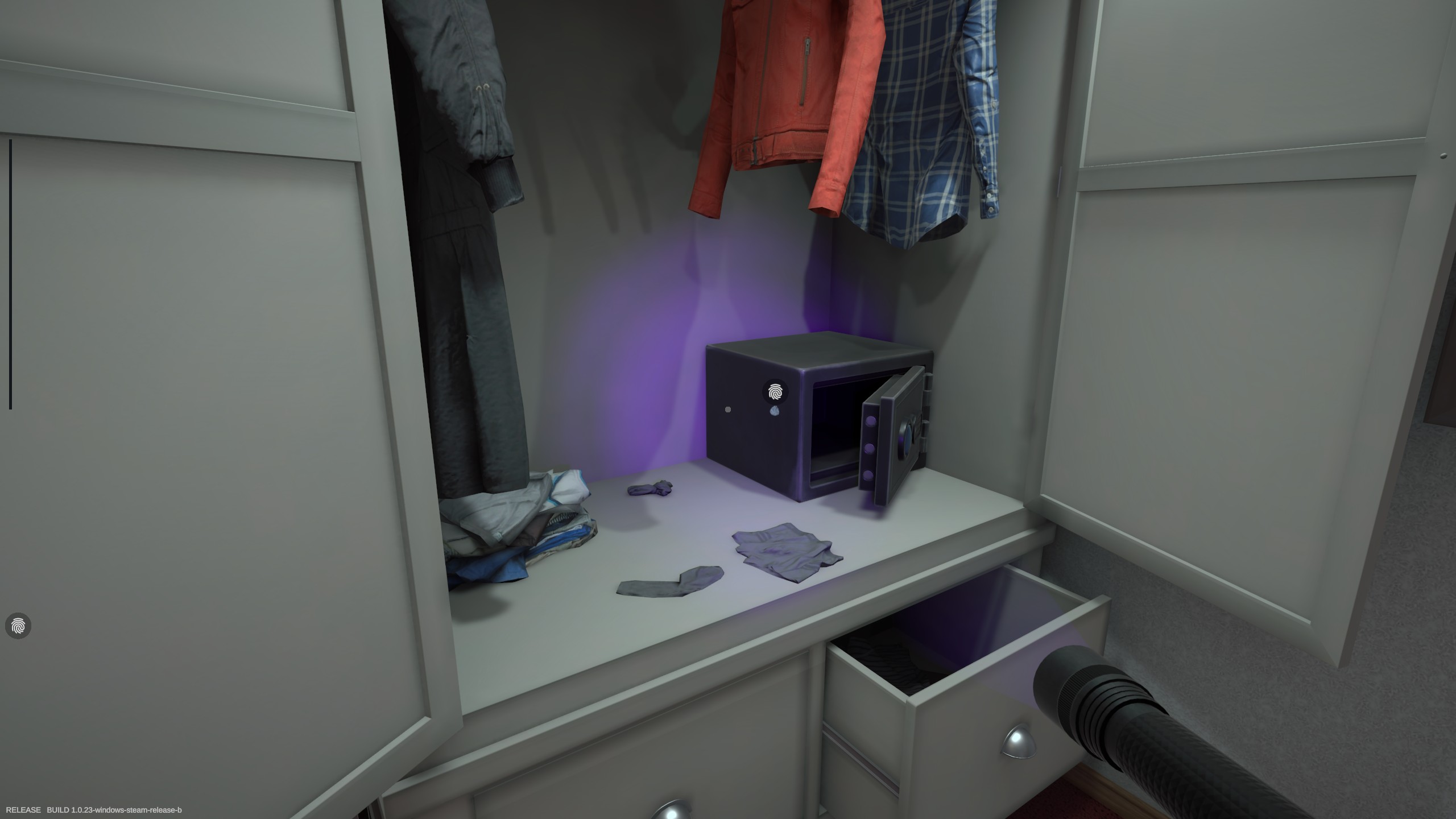
Collecting evidence quickly turns into little more than holding the mouse button until a progress bar fills up. Taking blood samples, gathering DNA, photographing evidence, or analyzing clues rarely requires any thought or skill. Even fingerprint collection, which initially feels satisfying, boils down to shining a UV light, applying powder, placing tape over the print, and watching it magically transfer without any proper animation.
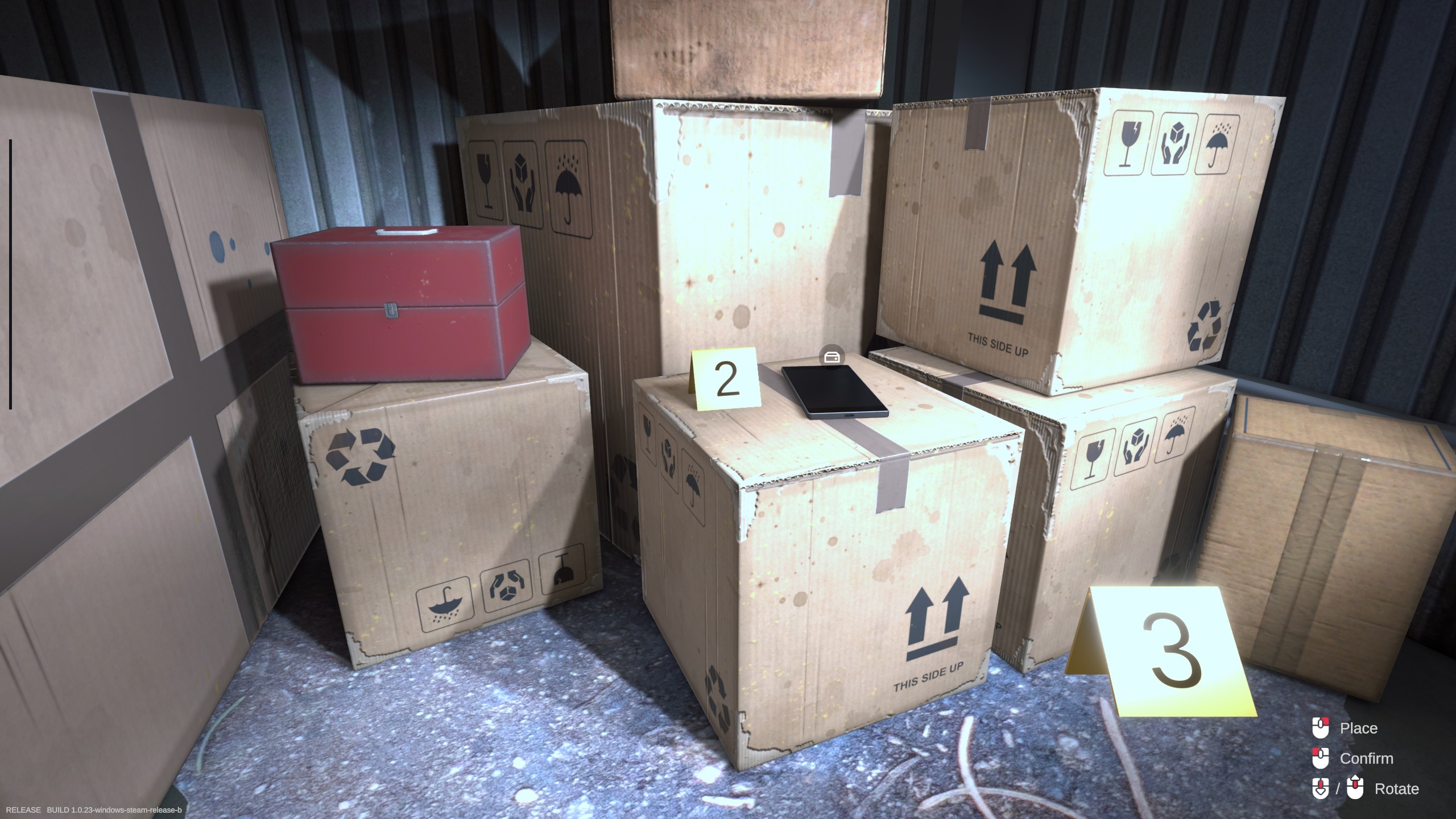
The investigations themselves also lack complexity. Cases gradually introduce additional forensic techniques, but the actual crime scenes remain surprisingly small and simplistic. Most consist of one or two cramped rooms with only a handful of obvious clues. Evidence is rarely hidden, and there’s very little room for genuine deduction because the game almost always points you toward what matters.
After only a few hours, the repetition becomes impossible to ignore. The world itself feels strangely lifeless too. Crime scenes lack even the most basic sense of urgency. There are no police officers securing the area, no emergency vehicles outside, no detectives discussing the case, and often not even a visible victim. You’re left wandering through quiet, empty environments that feel abandoned rather than tense.
I kept asking myself who this game is actually made for. Is it targeting simulation fans, aspiring forensic investigators, or regular gamers? Whatever the answer, it never fully commits to creating an immersive atmosphere. That lack of atmosphere extends to the presentation as well. Visually, the environments aren’t ugly, but they’re incredibly plain. Most locations rely on simple assets without much artistic direction.
Even the investigations themselves often feel illogical. During one hotel room case that clearly showed signs of a violent struggle, I naturally began checking doors, furniture, and surrounding objects for fingerprints to reconstruct the suspect’s movements. Instead, the only fingerprints in the entire room were found on a safe. That was the whole puzzle. Moments like these make the investigative process feel scripted rather than rewarding.
What disappointed me most is how much unrealized potential there is. The game briefly touches on DNA analysis, fingerprint matching, and ballistic reconstruction, but it never expands much beyond those basics. Hair analysis, footwear impressions, blood spatter interpretation, broken glass patterns, footprint tracking, or more complex crime scene reconstruction could have made every investigation feel unique. Instead, every case eventually boils down to repeating the exact same routine with slightly different objects.
To its credit, the game does attempt to portray forensic work authentically. The developers worked alongside experts from Germany’s State Criminal Police Office (LKA Rhineland-Palatinate), and many investigative procedures are inspired by real forensic techniques rather than Hollywood-style detective work. You can clearly see the effort that went into making the science believable. Unfortunately, realism alone isn’t enough to carry a game if the actual gameplay isn’t engaging.
At the end of the day, Forensics: Crime Scene Detective is one of those games where the concept is far stronger than the execution. The idea of solving crimes through scientific investigation is genuinely interesting, and I still believe there’s an excellent forensic simulator waiting to be made. Unfortunately, repetitive interactions, shallow investigations, awkward inventory management, lifeless environments, and a complete lack of atmosphere prevent this one from reaching its potential.
If you’re deeply interested in forensic science, you might still appreciate seeing some of the investigative procedures recreated in game form. Everyone else, however, will probably find themselves wishing there was far more detective work and far less repeatedly walking back to an equipment case.
Forensics: Crime Scene Detective is a perfect example of a game built around an excellent idea that never fully realizes its potential. Its realistic forensic approach and scientific authenticity deserve praise, but repetitive gameplay, shallow investigations and lifeless environments prevent it from becoming the immersive crime-solving simulator it could have been. If you have a strong interest in forensic science, there’s still some enjoyment to be found, but most players will likely lose interest long before the final case.
Ending Thoughts
Review copy provided by the publisher
Hellraiser: Revival preserves the franchise’s sex, gore and psychological horror while delivering approachable survival-horror gameplay.

Swan Song creates a peaceful and forgiving puzzle space without removing the challenge that makes solving a difficult puzzle rewarding.

Mortal Shell II starts brilliantly but grows repetitive and exhausting, while remaining a rewarding and ambitious Soulslike sequel.
![[GAMESCOM 2026] Terranigma Preview – A Lost SNES Classic Returns in 2027](https://www.indie-games.eu/wp-content/uploads/2026/08/Terranigma-1-1024x576.jpg)
After more than three decades of limited availability, Terranigma is returning in 2027. We played its enhanced re-release at Gamescom…

Reading another person’s mind is often presented as a desirable superpower, but Sister Other Paranoia immediately understands why it could…

Forsaken Realms: Vahrin’s Call is exactly the kind of ambitious, slightly clumsy fantasy RPG that used to be far more…
![[Early Access] 2nd EVE – Sci-Fi Action RPG That Lacks a Sense of Stakes](https://www.indie-games.eu/wp-content/uploads/2026/08/2ND-EVE-1024x576.jpg)
2nd Eve is a space-set action RPG in which we strive to save humanity.
![[PREVIEW] Dreamcards – Strategic Exploration of Consciousness](https://www.indie-games.eu/wp-content/uploads/2026/08/Dreamcards_20260810_233631_0000-1024x576.jpg)
Dreamcards is a roguelike deckbuilder centered around dreams and nightmares.
![[Early Access] OFFBEAT – Incredibly Fun Way to Start a Music Career](https://www.indie-games.eu/wp-content/uploads/2026/08/Offbeat_20260808_201446_0000-1024x576.jpg)
In OFFBEAT, we play the role of a jobbing composer who is launching their music career.

HellSlave II retains the original’s oppressive atmosphere, morally grey world and striking art while adding a larger world, randomized loot…

Beast of Reincarnation is an ambitious but uneven action RPG elevated by satisfying parry combat, beautiful art direction and the…

K-pop Idol Stories: Road to Debut captures the pressure of building idol group, but its management systems never explore that…

Hooded Horse keeps finding strategy games that know their audience, and Corsair Cove extends its impressive run of excellent city-builders.

Teeto is a warm, cozy, creative and highly enjoyable 3D platformer that understands why classic collectathons remain so appealing.

Turnip Mountain stands out for its combination of a unique control system and a minimalist approach.
Dystopicon is an imaginative and memorable narrative experiment with sharp social commentary, engaging world-building and several wonderfully absurd scenarios.

Maneki Mania is an incremental game centered around petting a lucky cat.

XeGrader Plus delivers colorful retro shooting, but basic mechanics, a short campaign and paid retro modes make its €20 price…

It has been roughly two and a half years since Palworld first entered Early Access, and quite a lot has…
![[EARLY ACCESS] The Last Caretaker – Survival Game I Cannot Stop Playing](https://www.indie-games.eu/wp-content/uploads/2026/07/The-last-Caretaker-Key-Art-1024x587.jpg)
The Last Caretaker is a compelling survival crafter with a flooded world and mobile base, but weak combat and performance…
