![[GAMESCOM 2026] Clive Barker’s Hellraiser: Revival Preview – Ready to Open the Box](https://www.indie-games.eu/wp-content/uploads/2026/09/Clive-Barkers-Hellraiser-Revival-08-30-26-1-1024x576.jpg)
[GAMESCOM 2026] Clive Barker’s Hellraiser: Revival Preview – Ready to Open the Box
Hellraiser: Revival preserves the franchise’s sex, gore and psychological horror while delivering approachable survival-horror gameplay.


If you enjoy independent indie game coverage, consider supporting Indie-Games.eu on Patreon. It helps keep the site independent.
70s-style Robot Anime Geppy-X is one of the coolest games I had never heard about. I first discovered it through the demo released during this summer’s Steam Next Fest, and what I played immediately convinced me to return for the full release. Now that I have experienced the complete game, I can confidently say that Geppy-X is a good game and an unforgettable audiovisual experience.
However, despite everything, €39 is difficult to accept for a port of a relatively short PS1 shooter, especially when the core gameplay is not particularly remarkable. A huge amount of restoration and localization work clearly went into this release, and it deserves recognition. But, that does not automatically make the price reasonable for everyone.
Geppy-X is a love letter to Japanese super-robot anime from the 1970s, drawing particularly strong inspiration from Getter Robo and, to a lesser extent, Mazinger Z. Its combining robot, three pilots, different transformations, attacks, and later upgrade all deliberately reference familiar parts of the genre. Set during the mysterious year of 197X, the story follows three young pilots fighting against the invading Cosmic Demon Empire.
The plot embraces nearly every familiar super-robot idea imaginable. There are dramatic transformations, oversized villains, heroic speeches, increasingly powerful enemies, and even the expected mid-season upgrade. However, the game is more affectionate tribute than simple parody. It can make fun of the genre through absurd fictional advertisements before immediately treating its next dramatic confrontation with complete sincerity.
You do not need extensive knowledge of classic anime to understand the story. Anyone familiar with shows such as Getter Robo and Mazinger Z will naturally recognise more of the references and deliberate exaggerations.
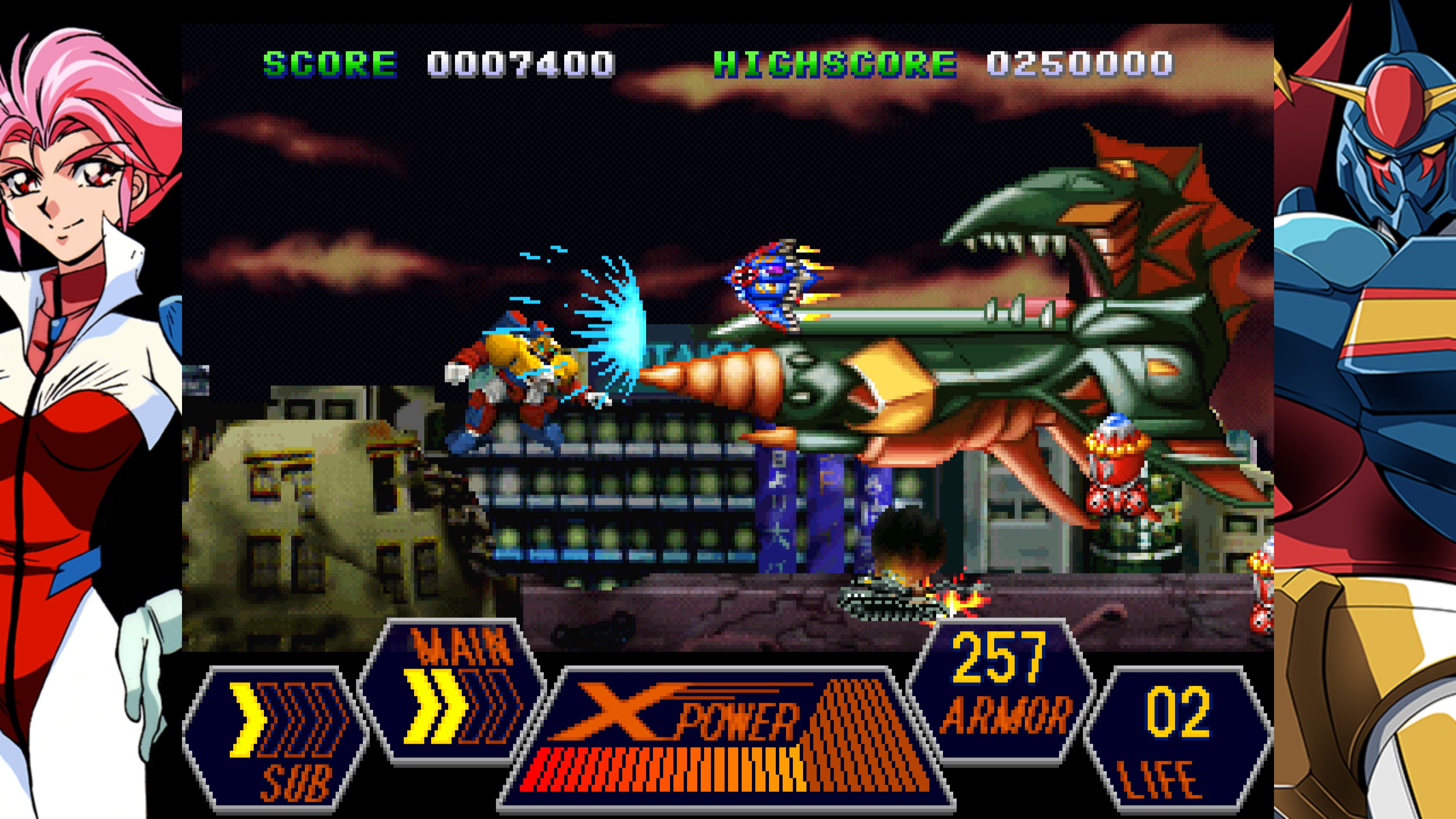
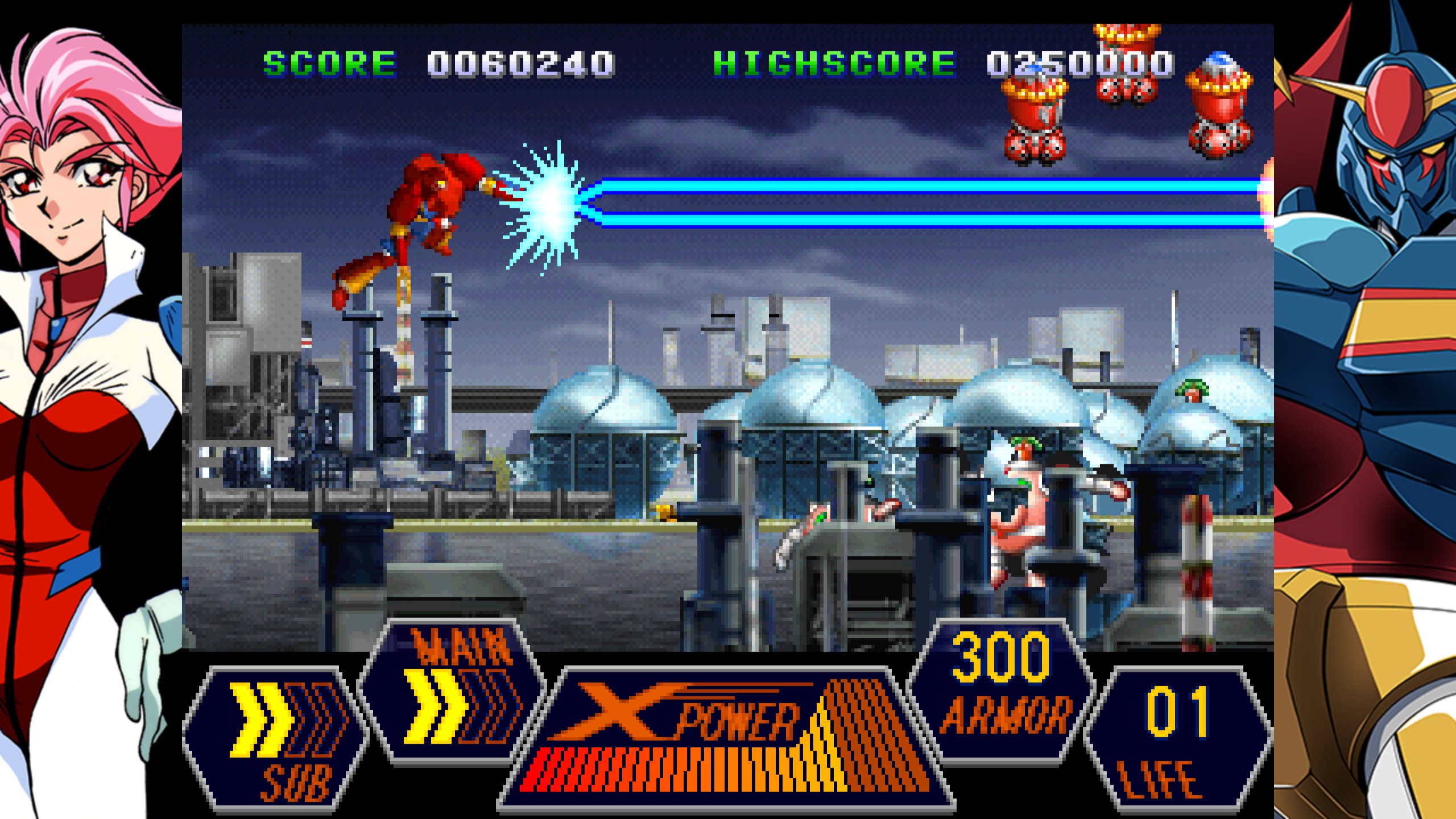
Underneath its anime production, Geppy-X is a traditional side-scrolling shooter. You travel through short stages, destroy waves of enemies, avoid incoming attacks, and eventually fight a large boss. Geppy-X can transform between three forms during combat. X1 is the balanced form, offering reliable movement and weapons. X2 is faster and has access to the screen-clearing X Seeker, while X3 focuses on strength, close-range attacks, and heavier weapons such as the X Cannon.
Changing forms adds variety, but the shooting remains fairly basic. The different configurations have clear strengths, although the game rarely places you in situations where you must constantly move between all three. It is possible to find one form that feels comfortable and use it for much of a stage.
That is where the game shows its age. This is an average PS1-era side-scrolling shooter surrounded by an extraordinary production. The mechanics are functional and enjoyable, but movement and hit detection can sometimes feel awkward. Enemy patterns and stage designs also lack the mechanical depth offered by stronger games in the genre. Fortunately, I was never interested in Geppy-X solely because of its shooting. The real attraction is everything happening around it.
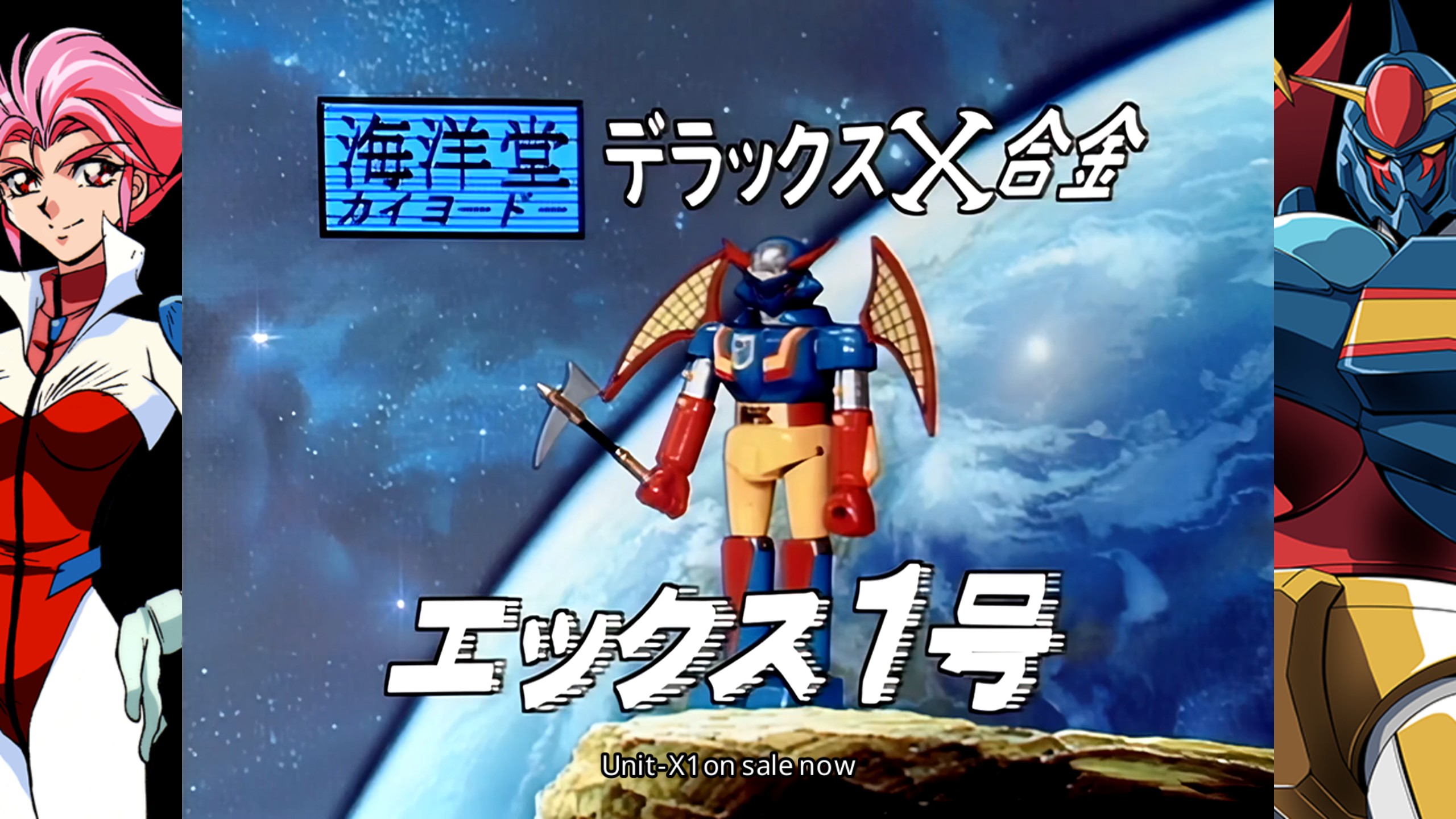
The original Geppy-X launched across four PlayStation discs. That was not because it contained an enormous campaign, but because it was filled with animation, voice acting, and music. Its creators effectively produced an entire fictional television series and placed a shooter inside it.
Every stage is presented like an anime episode. You get an opening sequence, story scenes, an eyecatch, fake television commercials, an ending theme, and a preview of the next episode. These are not simply menus decorated to resemble an old anime. They are fully animated and voiced sequences woven into the game.
Almost every stage also has its own vocal music. The soundtrack features major names from the Japanese anime and mecha music scene, including Isao Sasaki, Akira Kushida, and Hironobu Kageyama. The original voice cast is equally impressive, featuring performers such as Akira Kamiya, Shō Hayami, Shūichi Ikeda, Ichirō Nagai, and Gorō Naya.
The remaster restores more than 8,000 hand-drawn animation frames from the original Betacam masters. Sequences previously compressed to 320×240 and 15 frames per second now play at their intended 24fps. Faster loading, English subtitles, save states, rewind, rapid-fire controls, CRT filters, achievements, and a digital manual have also been added.

Unfortunately, we cannot discuss Geppy-X without talking about its price. I understand why this remaster costs more than a basic emulated rerelease. It targets a small audience, the original material required extensive restoration, and the entire game had to be translated for its first official international launch. There are also six unlockable modes, including boss challenges, alternate timelines, and experimental episode variations.
However, €39 is still a considerable amount for a 27-year-old PS1 game whose shooting mechanics are decent. For comparison, Palworld normally costs around €28,99. These are completely different games, but customers will inevitably compare how much entertainment they receive for their money. There simply is not enough traditional gameplay here to make Geppy-X an easy recommendation at full price. You are not buying it because it is one of the greatest shooters ever created. You are buying it because it is a playable piece of anime history.
I personally understand paying a premium to support projects like this. Without publishers taking risks on obscure games, Geppy-X might have remained an expensive Japanese curiosity inaccessible to most Western players. Understanding the price and believing it represents good value are not necessarily the same thing.
Geppy-X is a shining example of quality over quantity. Even after completing the full game, I was left impressed by the extraordinary amount of animation, music, voice acting, and personality packed into it. I understand why some players will pay a premium to support such an ambitious localization and preservation effort.
At the same time, €39 is simply too much for the amount of gameplay on offer, especially when the underlying shooter is fairly decent. It is worth experiencing, but unless you are already passionate about classic mecha anime, waiting for a discount is the more sensible choice.
70s-style Robot Anime Geppy-X is much more than a simple remaster, it’s an outstanding preservation project that finally allows Western audiences to experience one of the PlayStation’s most fascinating hidden gems. While the underlying shooter is only good rather than great, the phenomenal restoration, unforgettable anime presentation, stellar soundtrack and excellent localization make it a unique experience unlike almost anything else available today. The only major obstacle is its premium price. Fans of classic mecha anime will likely consider it money well spent, but for everyone else, waiting for a discount is the more sensible choice.
Ending Thoughts
Review copy provided by the publisher
Hellraiser: Revival preserves the franchise’s sex, gore and psychological horror while delivering approachable survival-horror gameplay.

Swan Song creates a peaceful and forgiving puzzle space without removing the challenge that makes solving a difficult puzzle rewarding.
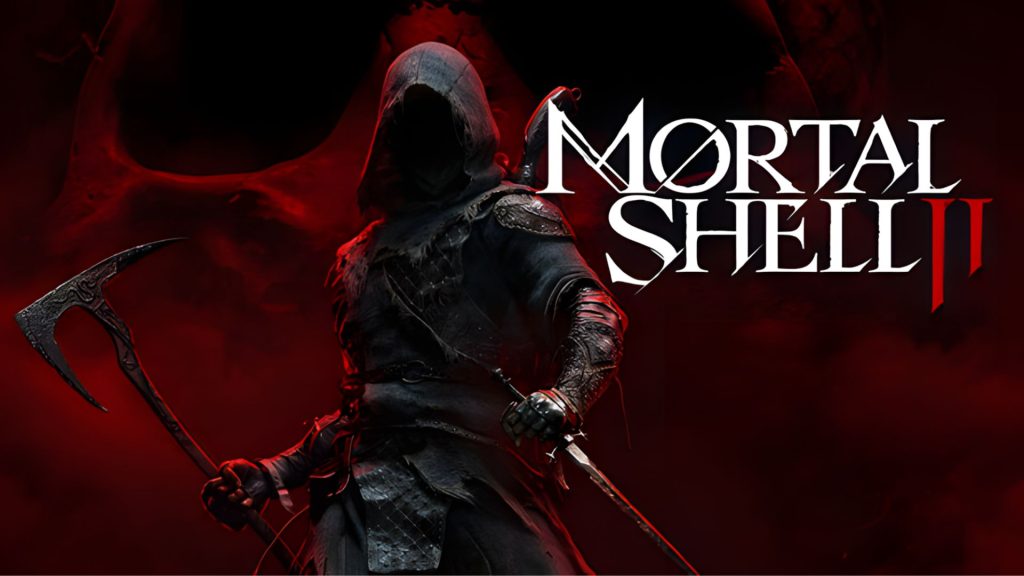
Mortal Shell II starts brilliantly but grows repetitive and exhausting, while remaining a rewarding and ambitious Soulslike sequel.
![[GAMESCOM 2026] Terranigma Preview – A Lost SNES Classic Returns in 2027](https://www.indie-games.eu/wp-content/uploads/2026/08/Terranigma-1-1024x576.jpg)
After more than three decades of limited availability, Terranigma is returning in 2027. We played its enhanced re-release at Gamescom…
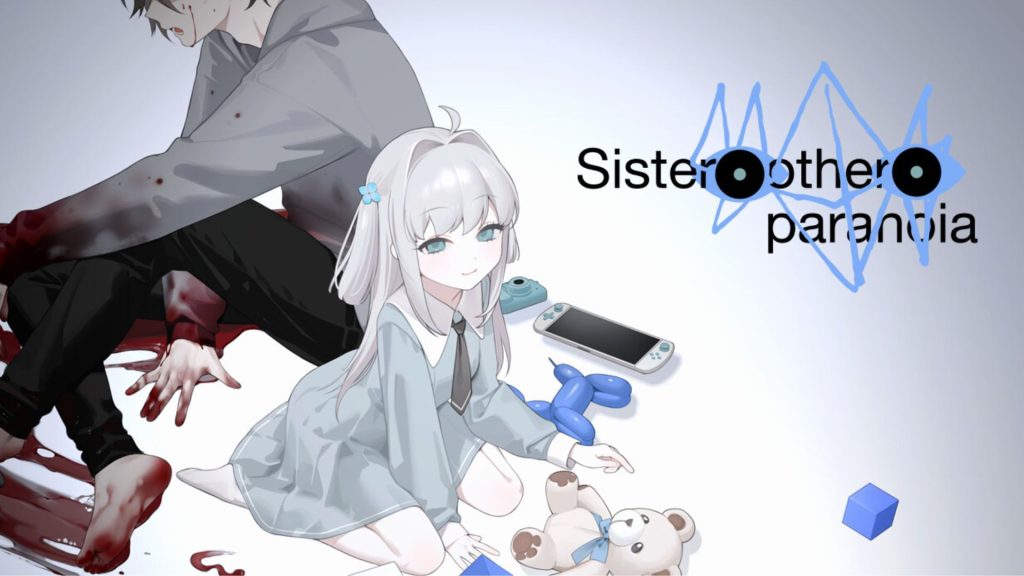
Reading another person’s mind is often presented as a desirable superpower, but Sister Other Paranoia immediately understands why it could…
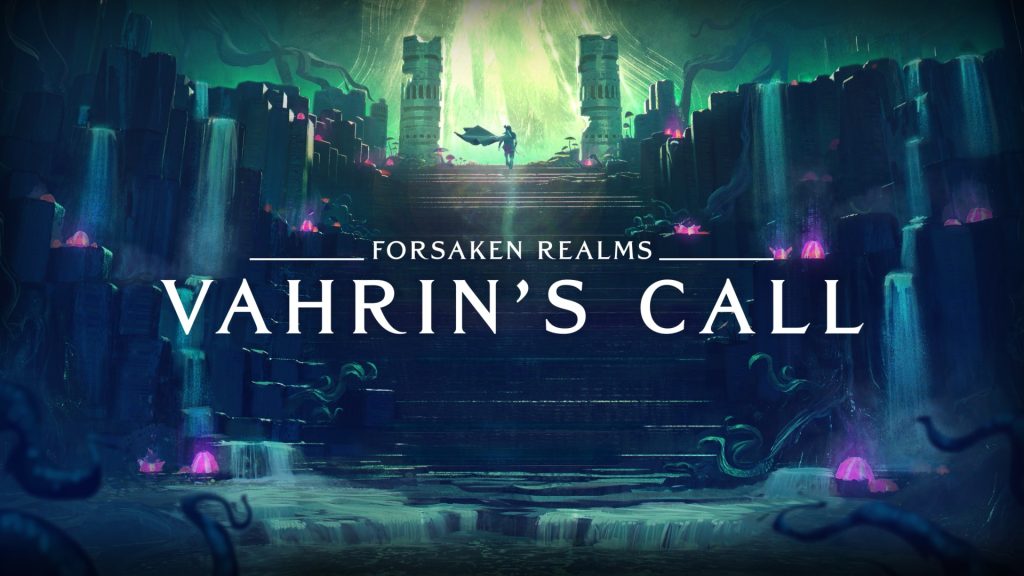
Forsaken Realms: Vahrin’s Call is exactly the kind of ambitious, slightly clumsy fantasy RPG that used to be far more…
![[Early Access] 2nd EVE – Sci-Fi Action RPG That Lacks a Sense of Stakes](https://www.indie-games.eu/wp-content/uploads/2026/08/2ND-EVE-1024x576.jpg)
2nd Eve is a space-set action RPG in which we strive to save humanity.
![[PREVIEW] Dreamcards – Strategic Exploration of Consciousness](https://www.indie-games.eu/wp-content/uploads/2026/08/Dreamcards_20260810_233631_0000-1024x576.jpg)
Dreamcards is a roguelike deckbuilder centered around dreams and nightmares.
![[Early Access] OFFBEAT – Incredibly Fun Way to Start a Music Career](https://www.indie-games.eu/wp-content/uploads/2026/08/Offbeat_20260808_201446_0000-1024x576.jpg)
In OFFBEAT, we play the role of a jobbing composer who is launching their music career.
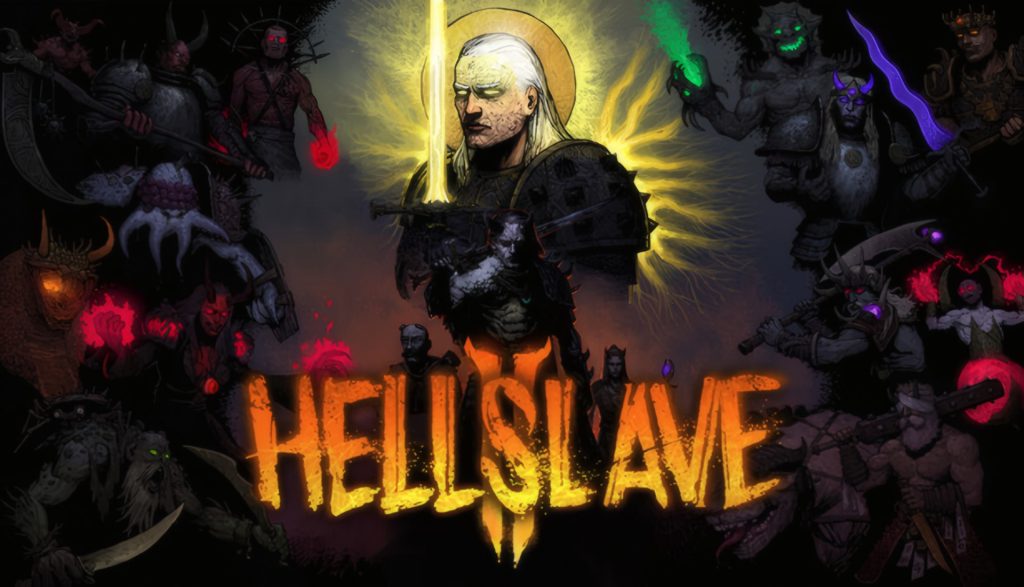
HellSlave II retains the original’s oppressive atmosphere, morally grey world and striking art while adding a larger world, randomized loot…
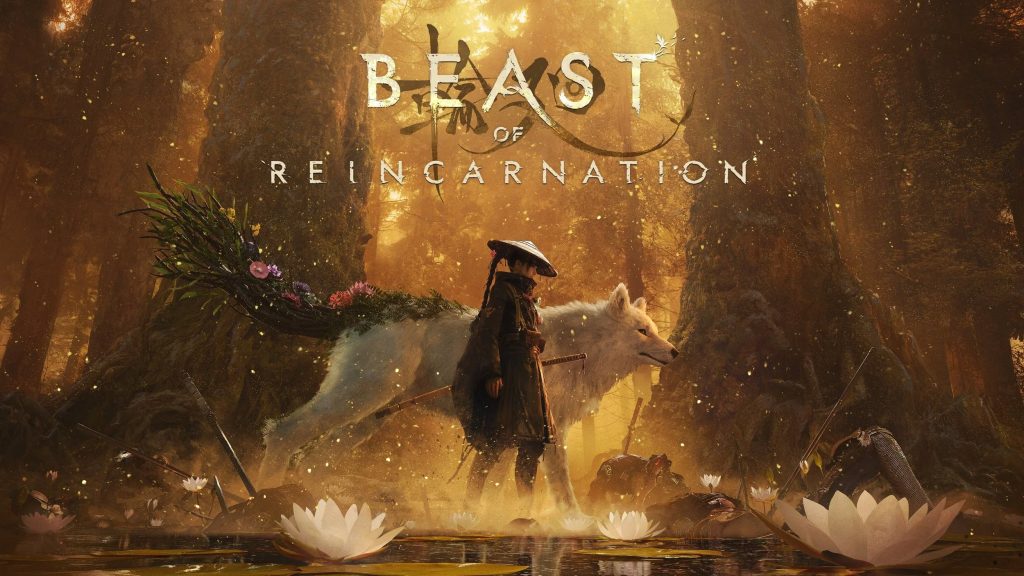
Beast of Reincarnation is an ambitious but uneven action RPG elevated by satisfying parry combat, beautiful art direction and the…

K-pop Idol Stories: Road to Debut captures the pressure of building idol group, but its management systems never explore that…
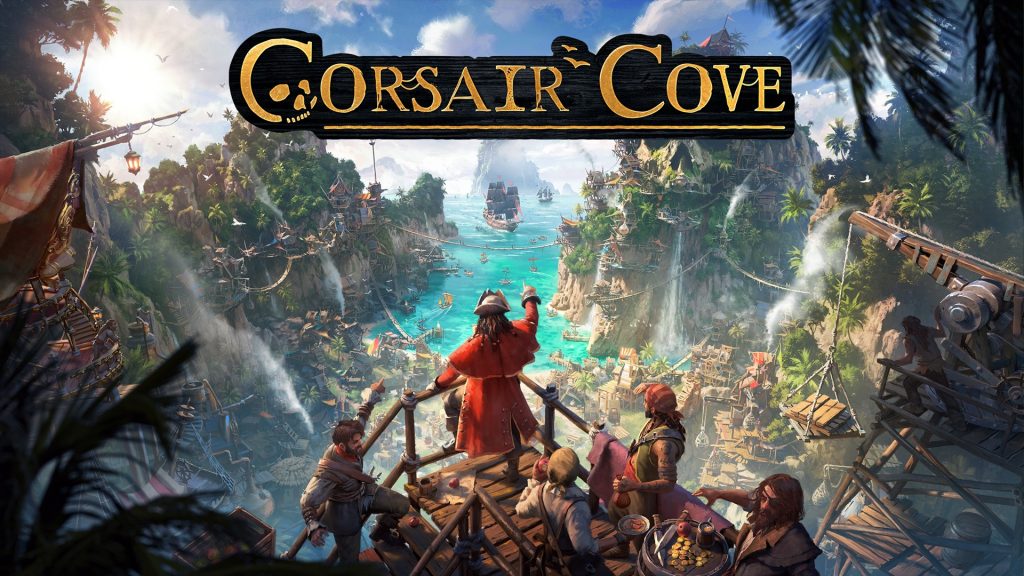
Hooded Horse keeps finding strategy games that know their audience, and Corsair Cove extends its impressive run of excellent city-builders.
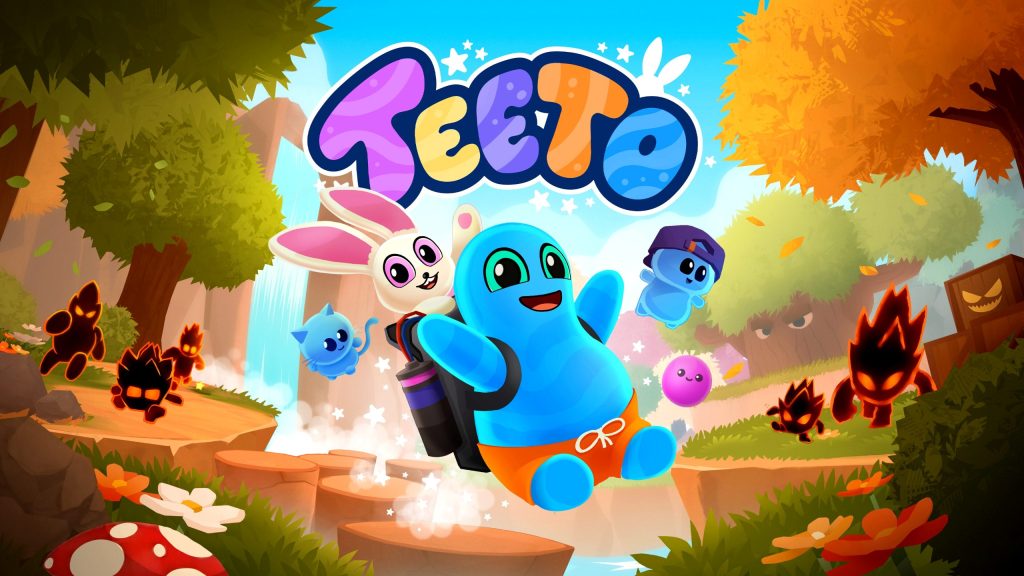
Teeto is a warm, cozy, creative and highly enjoyable 3D platformer that understands why classic collectathons remain so appealing.
Turnip Mountain stands out for its combination of a unique control system and a minimalist approach.
Dystopicon is an imaginative and memorable narrative experiment with sharp social commentary, engaging world-building and several wonderfully absurd scenarios.
Maneki Mania is an incremental game centered around petting a lucky cat.
XeGrader Plus delivers colorful retro shooting, but basic mechanics, a short campaign and paid retro modes make its €20 price…
It has been roughly two and a half years since Palworld first entered Early Access, and quite a lot has…
![[EARLY ACCESS] The Last Caretaker – Survival Game I Cannot Stop Playing](https://www.indie-games.eu/wp-content/uploads/2026/07/The-last-Caretaker-Key-Art-1024x587.jpg)
The Last Caretaker is a compelling survival crafter with a flooded world and mobile base, but weak combat and performance…
