![[GAMESCOM 2026] Vikings Dynasty Preview – Expands the Dynasty Formula](https://www.indie-games.eu/wp-content/uploads/2026/09/Viking-Dynasty-09-21-26-2-1024x576.jpg)
[GAMESCOM 2026] Vikings Dynasty Preview – Expands the Dynasty Formula
After showing me Prospera at Gamescom 2026, Toplitz Productions' Mathias Oertel moved to a very different kind of settlement builder.…

![[PREVIEW] Edge of Memories – One of My Biggest Steam Next Fest Disappointments](https://www.indie-games.eu/wp-content/uploads/2026/06/Edge-of-Memories-Preview.jpg)
If you enjoy independent indie game coverage, consider supporting Indie-Games.eu on Patreon. It helps keep the site independent.
Edge of Memories was one of the games I was looking forward to during Steam Next Fest. The trailers, screenshots, and overall marketing suggested a visually impressive action RPG with an interesting world and a unique premise. Unfortunately, after spending several hours with the demo, I came away disappointed. The game shown in the promotional material feels very different from the one I actually played.
Before getting into the problems, the premise itself is quite interesting. The world is suffering from a plague known as the Corrosion, a force that transforms people, animals, and even nature itself into grotesque abominations. You take control of Eline, a Soul Whisperer capable of helping those affected by the Corrosion. During her journey, she discovers she possesses the rare ability to control the Corrosion within her own body, a power that may ultimately hold the key to stopping the apocalypse.
It’s a setup that should make for an engaging adventure, but the demo struggles to capitalize on its potential. The story introduces some interesting ideas and gradually reveals Eline’s unique abilities, including a berserk-like state that allows her to unleash devastating attacks and perform flashy executions. However, the narrative itself feels mostly like an excuse to move players from one objective marker to the next rather than something that genuinely pulls you into the world.
The biggest issue is the world itself. Despite its colorful environments and fantasy setting, Avaris feels strangely lifeless. Most areas consist of large, empty fields populated almost exclusively by enemies. There are very few NPCs, almost no signs of a living world, and little environmental storytelling to make exploration rewarding. Progression is extremely linear, with the game constantly guiding players down a predetermined path while occasionally hiding a chest or collectible herb off to the side.
Exploration quickly becomes repetitive because there is rarely anything meaningful to discover. The demo already introduces recurring activities such as pushing boulders to access extra loot, and then repeats the same idea multiple times. Hidden paths rarely lead to anything exciting, and the overall structure feels more like moving between combat arenas than exploring an actual world. There is also an alchemy system where you can collect various plants to craft potions. These potions can heal you and provide different bonuses, such as haste, increased damage, and shields.
Combat fares slightly better, although it never rises above being a fairly generic hack-and-slash system. You can chain together combos, activate special abilities, and use a companion who provides elemental support through fire and dark magic attacks. Eline herself primarily relies on sword-based combat while using dodges to avoid incoming attacks.
The problem is that combat lacks depth and impact. Enemy encounters are incredibly easy, yet many enemies have surprisingly large health pools, making fights drag on longer than they should. Instead of feeling challenging, battles become repetitive exercises in mashing attacks until opponents eventually fall over. The lack of a parry system is particularly noticeable because it removes an extra layer of skill and engagement that could have made combat more satisfying.
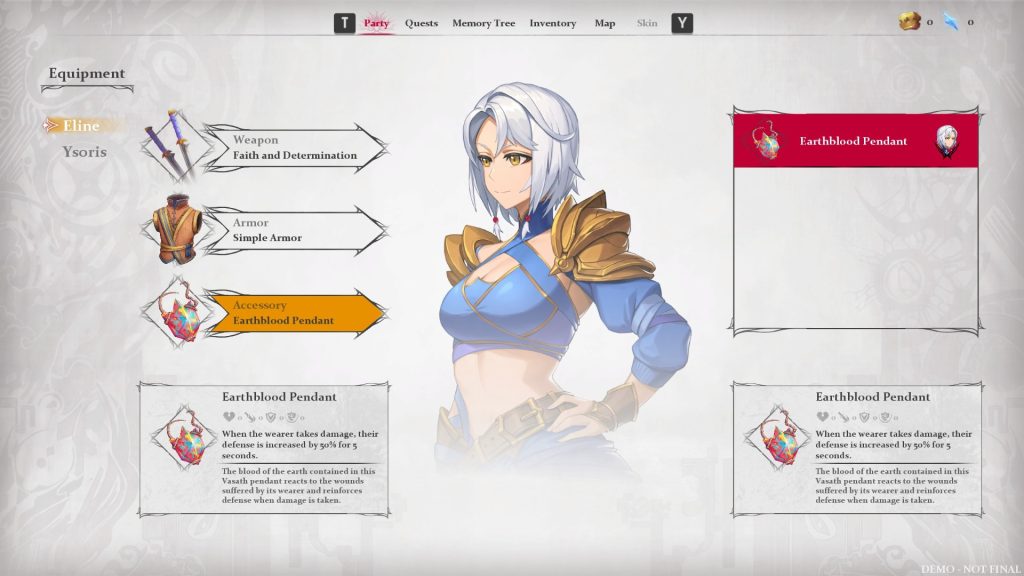
Enemy variety also feels limited throughout the demo. Most encounters revolve around melee opponents rushing directly at you, with very few enemies forcing you to adapt your strategy. While there are mini-bosses and a larger boss encounter, the regular combat quickly becomes repetitive. The lock-on system certainly doesn’t help either, as it frequently switches targets when you don’t want it to, creating unnecessary frustration during fights.
Movement is another area that needs improvement. Both traversal and combat animations feel sluggish, while jumping and air dashing lack the responsiveness expected from a fast-paced action RPG. The game never feels particularly smooth to control, which makes exploration and combat less enjoyable than they should be.
Additionally, while the skill tree system is fairly basic and generic, it successfully introduces a combo mechanic for certain skill sets. For example, executing two left-clicks followed by a right-click activates a specific skill. The tree also includes passive abilities like increased critical hit chance, allowing you to shift your strategy with a single click.
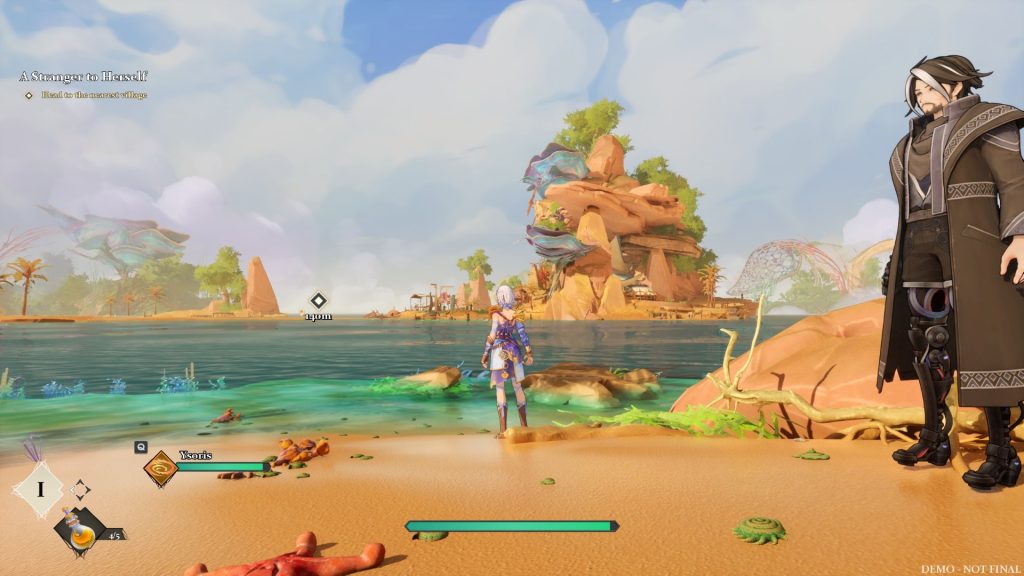
Presentation is perhaps the most disappointing aspect of the demo. The optimization is surprisingly rough considering the visual quality on display. What makes this especially noticeable is that other recent demos, such as Mortal Shell 2, look significantly better while running far more smoothly. Edge of Memories often feels like an early build rather than a project approaching release.
Visually, the game is inconsistent. Some environments are genuinely beautiful thanks to their vibrant colors and fantasy landscapes, but the overall texture quality and environmental detail often fall short. Character interactions are even more problematic. While pre-rendered cinematic scenes look decent enough, regular dialogue sequences feel incredibly static. Characters barely animate, lip-syncing is either limited or absent, and awkward camera angles frequently distract from conversations.
Ironically, the voice acting is one of the stronger parts of the presentation. I played with the Japanese voice track, and the performances were solid throughout. That makes the lackluster character animations stand out even more, because the audio quality often exceeds what is happening visually on screen.
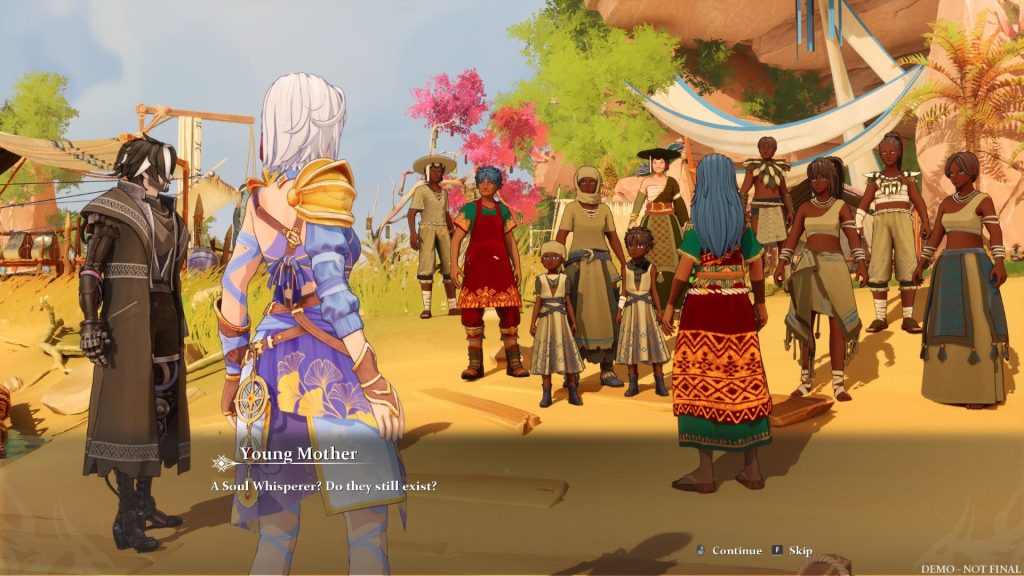
What frustrates me most is that there is clearly potential here. The premise is interesting, Eline’s powers could lead to some unique gameplay ideas, and the world itself has a strong visual identity. The demo simply does not do those strengths justice. Instead, it presents a shallow combat system, uninspired exploration, uneven presentation, and a world that feels empty despite its colorful appearance.
I came away disappointed, but not entirely ready to write the game off. Demos don’t always represent the final product, and there is still time for improvements before release. Right now, however, Edge of Memories feels like a game with good ideas that hasn’t yet figured out how to turn them into a compelling experience.
After showing me Prospera at Gamescom 2026, Toplitz Productions' Mathias Oertel moved to a very different kind of settlement builder.…
![[GAMESCOM 2026] Prospera Preview – Production, Prosperity and Victorian Industry](https://www.indie-games.eu/wp-content/uploads/2026/09/Prospera-09-21-26-5-1024x576.jpg)
At Gamescom 2026, I met with Toplitz Productions' Mathias Oertel for a guided presentation of two upcoming games. One of…
Golden Swirl inventive card combat carries the experience, but repetitive rooms, weak upgrades and excessive dialogue hold it back.
![[GAMESCOM 2026] Wilderdark Preview – Ambitious Dinosaur Horror Game That Still Has Plenty to Prove](https://www.indie-games.eu/wp-content/uploads/2026/09/Wilderdark-1024x576.jpg)
Dinosaur survival horror game Wilderdark has one of those premises that immediately makes you wonder why more games have not…
![[PREVIEW] Tiny Metal 2 – Strategy Game That Wants You to Learn From Every Mistake](https://www.indie-games.eu/wp-content/uploads/2026/09/Tiny-Metal-2-1024x576.jpg)
I rarely enjoy discovering that my opening strategy was completely wrong, but Tiny Metal 2 made that process one of…
![[PREVIEW] Remothered: Red Nun’s Legacy – Ambitious Survival Horror That Needs More Polish](https://www.indie-games.eu/wp-content/uploads/2026/09/Remothered-Red-Nuns-Legacy-4-1024x576.jpg)
Remothered: Red Nun’s Legacy has a gripping atmosphere and promising survival tools, but its repetitive hiding and rough visuals need…
The Alighieri Circle: Dante’s Bloodline is difficult to recommend beyond players who are especially interested in Dante or enjoy solving…
Orc Incremental offers satisfying progression, entertaining totem combinations and enough content to justify its affordable price.
![[GAMESCOM 2026] Chronoscript: The Endless End Preview – Beautiful Pages Hide Deliberate Combat](https://www.indie-games.eu/wp-content/uploads/2026/09/Chronoscript-The-Endless-End-1-1024x576.jpg)
Chronoscript: The Endless End stands out from other Metroidvanias by blending 2D manuscript worlds with exploration inside a 3D manor.
![[GAMESCOM 2026] MegaGum Preview – Combat Hits Hard in This Sticky Platforming Adventure](https://www.indie-games.eu/wp-content/uploads/2026/09/MegaGum-09-09-26-5-1024x576.jpg)
MegaGum combines hard-hitting combat, varied weapons and Gum-powered platforming in a promising Gamescom 2026 demo.
![[GAMESCOM 2026] Delphinium Preview – Cozy Routine Mixed With Enjoyable Minigames](https://www.indie-games.eu/wp-content/uploads/2026/03/Delphinium--1024x665.jpg)
Delphinium mixes cozy farming, exploration and relationships with enjoyable fishing, cooking and forging minigames in its Gamescom 2026 demo.
Lady Death: Demonicron looks the part, but underneath its excellent comic-book exterior is a clunky and painfully short brawler.
![[GAMESCOM 2026] Tomb Raider: Legacy of Atlantis Preview – Expands the Original Without Losing Its Identity](https://www.indie-games.eu/wp-content/uploads/2026/09/tomb-raider-legacy-of-atlantis-06-02-26-1-1024x576.jpg)
Tomb Raider: Legacy of Atlantis brings Lara back to her roots, but its Gamescom 2026 showing proved this is far…
![[GAMESCOM 2026] Clive Barker’s Hellraiser: Revival Preview – Ready to Open the Box](https://www.indie-games.eu/wp-content/uploads/2026/09/Clive-Barkers-Hellraiser-Revival-08-30-26-1-1024x576.jpg)
Hellraiser: Revival preserves the franchise’s sex, gore and psychological horror while delivering approachable survival-horror gameplay.

Swan Song creates a peaceful and forgiving puzzle space without removing the challenge that makes solving a difficult puzzle rewarding.
Mortal Shell II starts brilliantly but grows repetitive and exhausting, while remaining a rewarding and ambitious Soulslike sequel.
![[GAMESCOM 2026] Terranigma Preview – A Lost SNES Classic Returns in 2027](https://www.indie-games.eu/wp-content/uploads/2026/08/Terranigma-1-1024x576.jpg)
After more than three decades of limited availability, Terranigma is returning in 2027. We played its enhanced re-release at Gamescom…

Reading another person’s mind is often presented as a desirable superpower, but Sister Other Paranoia immediately understands why it could…
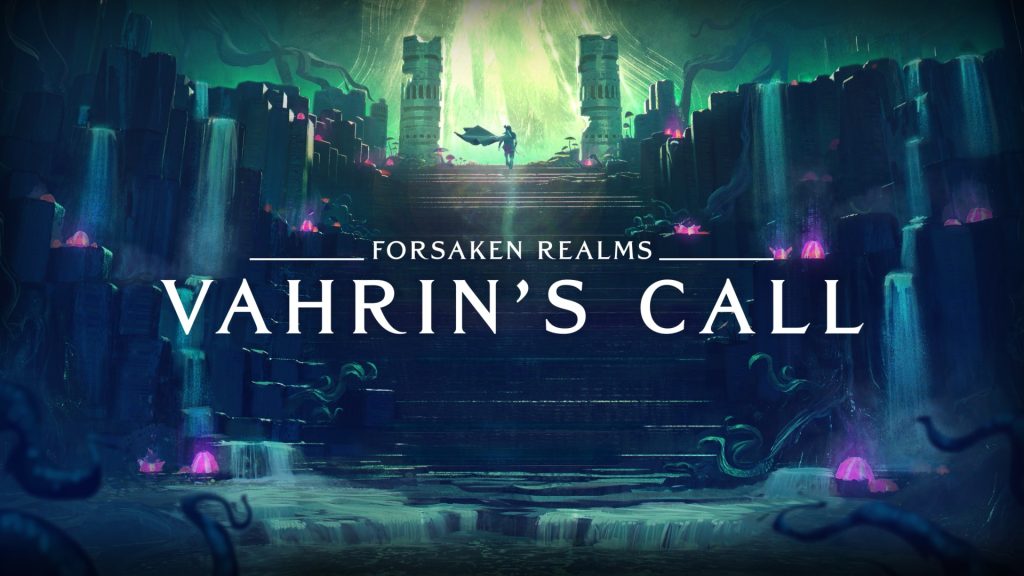
Forsaken Realms: Vahrin’s Call is exactly the kind of ambitious, slightly clumsy fantasy RPG that used to be far more…
![[Early Access] 2nd EVE – Sci-Fi Action RPG That Lacks a Sense of Stakes](https://www.indie-games.eu/wp-content/uploads/2026/08/2ND-EVE-1024x576.jpg)
2nd Eve is a space-set action RPG in which we strive to save humanity.
