
If you enjoy independent indie game coverage, consider supporting Indie-Games.eu on Patreon. It helps keep the site independent.
It’s fair to say that Pairs & Perils is a bit disappointing, not because of the core gameplay mechanics, but due to the limited amount of content it offers. As a roguelite deck-builder, it lacks the solid replayable features typically expected in the genre. Still, its simplicity and strong first impression are enough to occasionally draw you back. The gameplay is straightforward, merging the mechanics of a memory match game with deck-building elements in a charming fantasy world.
You can complete the game in less than two hours if you focus only on unlocking all five classes on normal difficulty, without attempting harder modes like “hard” or “dungeon master.” However, the developers have promised future updates, and given the game’s low price, it offers enough fun for shorter play sessions. This seems intentional, as the game isn’t designed for multi-hour sessions like, for example, Balatro. Instead, it challenges your memory and tactical thinking in shorter bursts.
At the start, you receive a random starting deck, which you can re-roll if you want better cards. Afterward, you face a variety of enemies, from simple rats and golems to tougher mini-bosses. Each enemy has special effects that can impact you, making the battles more dynamic.

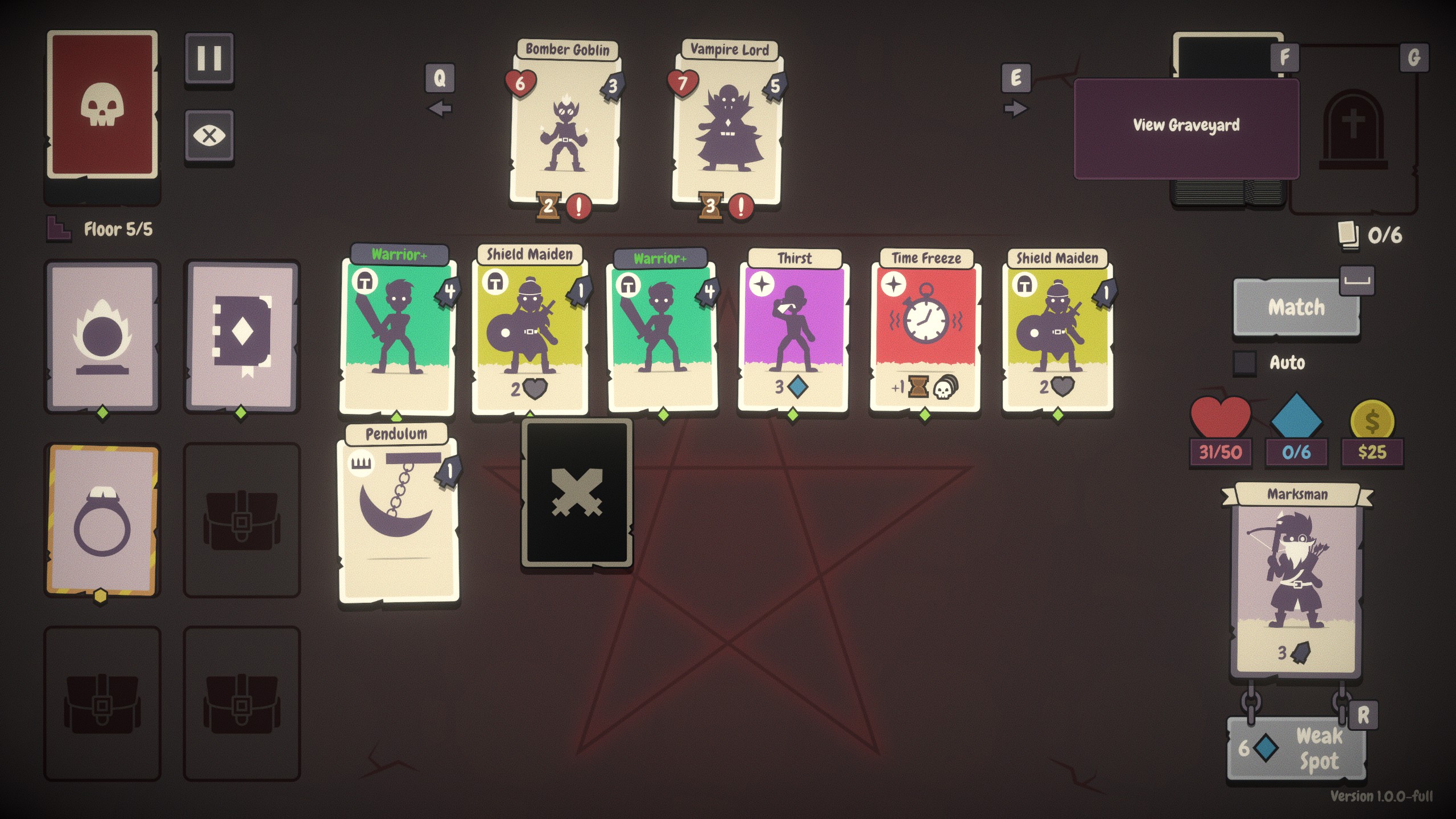
The main idea of the game is that each enemy has a certain number of moves before they attack. During your turn, you draw cards from your deck, which briefly flip face-up. You must memorize as many pairs as possible before the cards flip back. The goal is to match the cards correctly to attack the enemy or activate effects. If you make a mistake, it’s not the end of the world; you usually have enough moves to correct the error before the enemy attacks.
That is the basic way to progress through the game, but there are additional mechanics that make the game more interesting. You can upgrade cards, remove them from your deck, buy new ones in shops, and restore health. You can also carry various items like bandages for healing after each round or items that reveal hidden cards. Although you can carry multiple items, there is a limit to prevent overuse.
The cards you use are interesting. For example, you can use a Warrior card for high damage, a Shield Maiden to add shields, or a Thief to steal money every time an enemy dies. There are also Elite cards, like the Knight, which provide stronger bonuses and higher damage but are more expensive to acquire. However, one of the problems is that the cards become a bit repetitive over time. Even if you choose a different class, most of the cards remain the same, which limits diversity. In addition to attack cards, you can also get useful cards that affect the battlefield, such as those that add lifesteal or delay enemy attacks.

The bosses at the end of each level bring more variety and offer unique challenges. For example, the Medusa has the ability to block your view of the cards on the field, forcing you to guess and rely on memory. Fortunately, each class has a special mana-powered skill, such as dealing direct damage to enemies or adding shields. These skills are useful in specific situations and provide an extra layer of strategy during tougher fights.
The biggest complaint about the game is the lack of card variety. While every run is technically different, I often found myself returning to the Warrior card due to its power compared to other options. The game would benefit significantly from better balance. For example, why would I choose a Wizard card that only gives me one Mana when there are much better options? Additionally, the more cards you have in your deck, the harder it is to memorize all the chosen cards, as you need to track what you’ve already selected.
Another issue is the traps hidden among the cards. While they add an extra layer of challenge, they require double the effort to avoid, which can become tedious. Still, it wasn’t too difficult to track the useful cards. Personally, I focused on memorizing the cards that were most beneficial to me, while neglecting or revealing the others using utility cards.

On the positive side, I enjoyed the game’s graphics. They are simple and charming, and the visual design doesn’t distract from the gameplay. The fantasy world the game is set in further adds to its appeal. However, as I’ve already mentioned, while the core gameplay mechanic is solid, the game is lacking in content. I don’t expect 20 hours of completely random cards in every class, but more variety in the starting options and enemy types would significantly improve the experience.
Overall, I would recommend this title. It is well-crafted, and if you are a fan of fast-paced, shorter play sessions, this is a great choice for you.
| Pros | Cons |
|---|---|
| Affordable price. | Limited content and variety. |
| Unique gameplay mechanic combining memory and card matching. | Doesn’t offer good replayability. |
| Charming visual design. | |
| Varied enemy types. |
Review copy provided by the publisher
![[PREVIEW] 1666: Amsterdam – Fails to Capture the Promise of Its Reveal](https://www.indie-games.eu/wp-content/uploads/2026/06/1666-amsterdam-300x169.jpg)
Having just recently been revealed during Summer Game Fest, 1666: Amsterdam has already received a playable prologue on Steam.
![[EARLY ACCESS] Far Far West – Co-Op Shooter I Didn’t Expect to Love This Much](https://www.indie-games.eu/wp-content/uploads/2026/04/Far-Far-West-300x169.jpg)
There is a reason why Far Far West is currently sitting at overwhelmingly positive reviews on Steam and has already…

Retro Rewind - Video Store Simulator latest update that adds repair stations, street sign and more to the game, could…

Vultures: Scavengers of Death is a turn-based tactical strategy game heavily inspired by classic survival horror.
![[Early Access] No Stone Unturned – A fowl play](https://www.indie-games.eu/wp-content/uploads/2026/05/Unturned-1-300x169.jpg)
In No Stone Unturned, we play as Detective Cox, a squirrel with amnesia who investigates a murder of a chicken…

Outbound is a mediocre, shallow cozy game with a beautiful presentation and strong concept, but one that fails to deliver…
![[PREVIEW] L’Agence – The Hearts of Paris](https://www.indie-games.eu/wp-content/uploads/2026/05/LAgence-naslovna-300x169.jpg)
L'Agence - The Hearts of Paris already feels like one of those indie games you randomly discover and end up…

Memoriapolis has just received its massive “Banners and Wonders” update, released alongside the game’s one-year anniversary.

Demon Lord: Just a Block initially felt like another roguelike I would spend a few hours with before eventually moving…

Wardrum is a flawed but genuinely creative roguelite, one that rhythm game and tactical RPG fans may still find worthwhile,…

Motorslice blends Prince of Persia-style platforming with Shadow of the Colossus-like boss encounters, throwing you into a world filled with…

Even in early access, Dead as Disco is an extremely fun mix of rhythm, action, and brawler gameplay.

Dungeon Clawler is a roguelike deck-builder built around heavy RNG, but instead of leaning fully into chaos or strict balance,…

Bus Bound sits somewhere between a driving simulator and light management game, but leans much more toward the simulation side,…

InKONBINI is for players who want something slow and introspective and less about managing a store and more about understanding…

Reptilian Rising is a thoughtful, cohesive tactics game that fully commits to its identity.
![[PREVIEW] Duo Quest – This Game Tests Your Friendship](https://www.indie-games.eu/wp-content/uploads/2025/12/Duo-Quest-300x169.jpg)
Duo Quest highlights everything great about the indie scene, though its chaotic gameplay might just put your friendships to the…

Cinderia is a really nice surprise, an action roguelite with tight gameplay that doesn't reinvent the genre but executes its…

Yu-Gi-Oh! Legacy of the Duelist: Link Evolution is probably the best single-player Yu-Gi-Oh! game we have right now.

StarRupture got its first major update about two weeks ago, and it pretty much changes everything you knew about the…
Having just recently been revealed during Summer Game Fest, 1666: Amsterdam has already received a playable prologue on Steam.
There is a reason why Far Far West is currently sitting at overwhelmingly positive reviews on Steam and has already…
Retro Rewind - Video Store Simulator latest update that adds repair stations, street sign and more to the game, could…
Vultures: Scavengers of Death is a turn-based tactical strategy game heavily inspired by classic survival horror.
In No Stone Unturned, we play as Detective Cox, a squirrel with amnesia who investigates a murder of a chicken…
Outbound is a mediocre, shallow cozy game with a beautiful presentation and strong concept, but one that fails to deliver…
L'Agence - The Hearts of Paris already feels like one of those indie games you randomly discover and end up…
Memoriapolis has just received its massive “Banners and Wonders” update, released alongside the game’s one-year anniversary.
Demon Lord: Just a Block initially felt like another roguelike I would spend a few hours with before eventually moving…
Wardrum is a flawed but genuinely creative roguelite, one that rhythm game and tactical RPG fans may still find worthwhile,…
Motorslice blends Prince of Persia-style platforming with Shadow of the Colossus-like boss encounters, throwing you into a world filled with…
Even in early access, Dead as Disco is an extremely fun mix of rhythm, action, and brawler gameplay.
Dungeon Clawler is a roguelike deck-builder built around heavy RNG, but instead of leaning fully into chaos or strict balance,…
Bus Bound sits somewhere between a driving simulator and light management game, but leans much more toward the simulation side,…
InKONBINI is for players who want something slow and introspective and less about managing a store and more about understanding…
Reptilian Rising is a thoughtful, cohesive tactics game that fully commits to its identity.
Duo Quest highlights everything great about the indie scene, though its chaotic gameplay might just put your friendships to the…
Cinderia is a really nice surprise, an action roguelite with tight gameplay that doesn't reinvent the genre but executes its…
Yu-Gi-Oh! Legacy of the Duelist: Link Evolution is probably the best single-player Yu-Gi-Oh! game we have right now.
StarRupture got its first major update about two weeks ago, and it pretty much changes everything you knew about the…
