

If you enjoy independent indie game coverage, consider supporting Indie-Games.eu on Patreon. It helps keep the site independent.
I swear Balatro is an addiction. Yes, it won the Best Indie Game award at The Game Awards 2024, yes it has cool card skins that bring famous franchises into the game, and yes it’s a great way to learn poker hands, but I never expected it to be this good. The last time I played it was back in 2024, before The Game Awards, and even then I spent around 50 hours with it. I never fully finished it either, I unlocked about half of the content and then just stopped. I don’t even remember why I came back to it, all I know is that the grind is very real.
Maybe I just got bored of Ball x Pitt and Absolum and wanted something different, a game that doesn’t demand all of your focus. Balatro is perfect for that, it’s mostly clicking, moving cards around, and watching your numbers grow over time. It’s probably the roguelike design that makes it so hard to put down. Every run is different, which gives it almost endless replay value. You can even replay seeded runs, but they still end up feeling different in small ways.

At first, Balatro looks like a simple poker-style card game, but the depth shows itself very quickly. Each run is made up of poker hands called blinds that you must beat by arranging cards, earning chips, and triggering combos with Jokers. Jokers and other special cards can completely change how a run plays, encouraging you to experiment and take risks. While it uses poker as a base, Balatro is very different from real poker. Luck matters, but smart choices matter more, like building strong combos, timing multipliers, managing your deck, and adapting when things don’t go as planned. This mix of luck and strategy is what makes the game so addictive and creates that constant “one more run” feeling.
You don’t need to know poker to enjoy the game either. Balatro explains what the cards do, and you learn the rest very quickly by playing. The learning curve can feel a bit rough at first because the game doesn’t hold your hand, but that’s also part of the fun. It lets you learn through mistakes and experimentation. That’s why it’s such a great game to play after a long day at work or when you’re tired. It respects your time, with each run lasting around 30 to 45 minutes, and since it’s also quite cheap, it almost forces you to accept defeat and jump right back in until you finally win.
Once you complete specific challenges, which vary by deck, you unlock an Endless Mode. These challenges introduce unique starting conditions, such as extra hands, additional discards, or starting with a Tarot card. The game’s depth comes from its layers of modifiers, for example, steel cards grant multipliers while held in your hand, planet cards permanently level up the value of poker hands (like Flushes or Full Houses), and rare Spectral cards offer powerful, transformative boosts to your Jokers. While there is a lot to learn, the mechanics remain intuitive and easy to master.
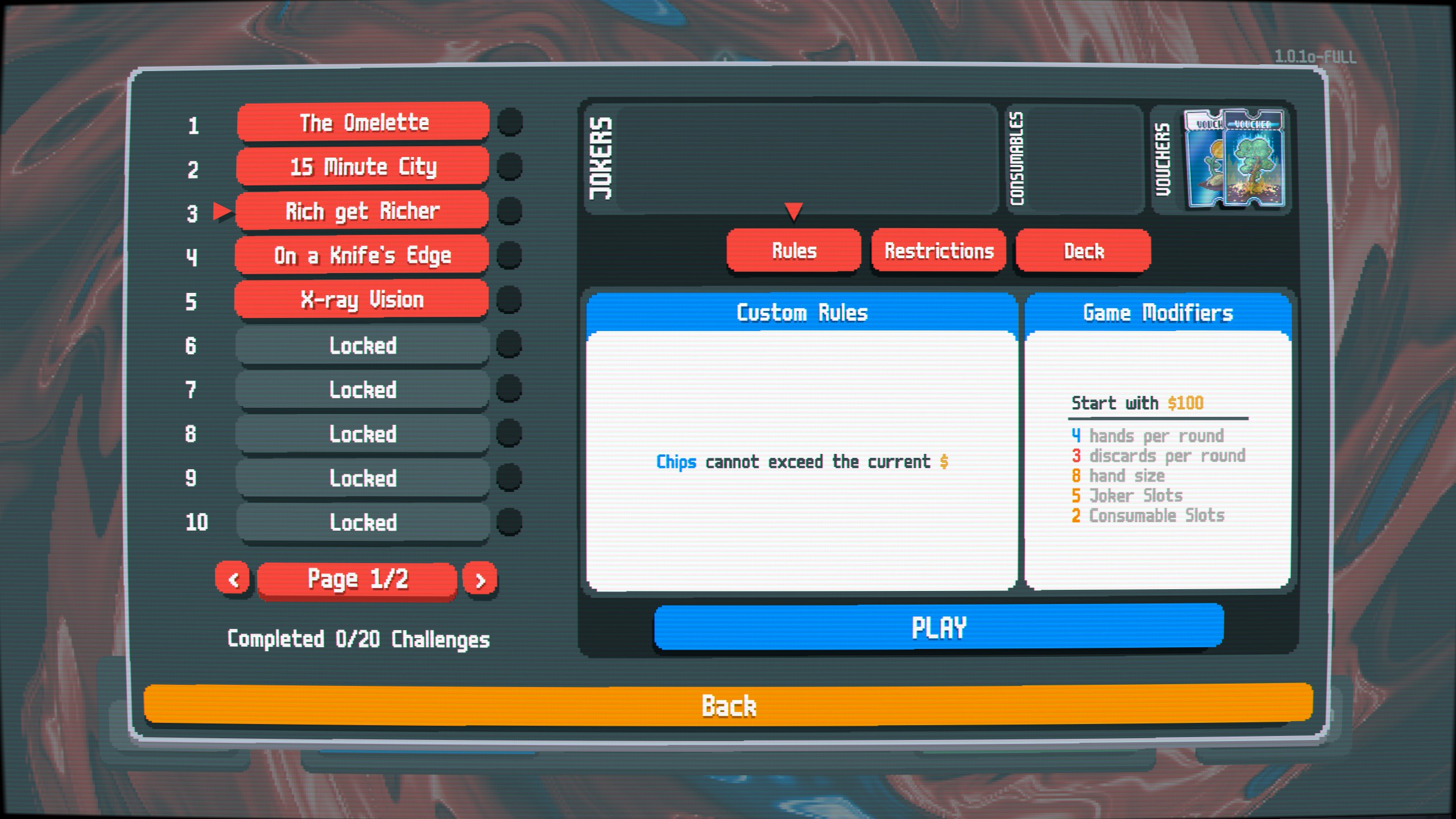
However, after replaying the game, I started to notice a few things. Balatro is very RNG-based, and a lot depends on luck and how you play your runs. Money is extremely important, so you need to be careful early on and think about when to save and when to spend. Each blind and boss becomes harder, and if you don’t build a strong deck or focus on a clear strategy from the start, you will most likely lose.
While many people praise the replay value, the core loop can feel repetitive after a long time, especially if you are trying to unlock specific decks. Progress can sometimes be frustrating, as you might need several runs before luck finally goes your way. Some runs end quickly with a win, others end in constant losses. Still, that randomness is part of what makes the game fun.
Even now, I don’t fully understand why Balatro never tried to expand its scope. For example, a multiplayer mode could have been really interesting. I’m not sure how it would work in practice, but simply being able to play alongside a friend would already add something new and fun to the experience.
So, is Balatro worth playing in 2026? Absolutely. It’s a great example of how a small, focused game can become a huge success, and how one strong idea can turn into something incredibly addictive. The game doesn’t ask much from the player, but it gives a lot in return over a long period of time. It’s also available on mobile, which makes it easy to recommend there, although it plays very well on PC and feels especially good on the Steam Deck. If you still haven’t played Balatro, you’re truly missing out. Even two years later, it remains an amazing game.
![[PREVIEW] 1666: Amsterdam – Fails to Capture the Promise of Its Reveal](https://www.indie-games.eu/wp-content/uploads/2026/06/1666-amsterdam-300x169.jpg)
Having just recently been revealed during Summer Game Fest, 1666: Amsterdam has already received a playable prologue on Steam.
![[EARLY ACCESS] Far Far West – Co-Op Shooter I Didn’t Expect to Love This Much](https://www.indie-games.eu/wp-content/uploads/2026/04/Far-Far-West-300x169.jpg)
There is a reason why Far Far West is currently sitting at overwhelmingly positive reviews on Steam and has already…

Retro Rewind - Video Store Simulator latest update that adds repair stations, street sign and more to the game, could…
Vultures: Scavengers of Death is a turn-based tactical strategy game heavily inspired by classic survival horror.
![[Early Access] No Stone Unturned – A fowl play](https://www.indie-games.eu/wp-content/uploads/2026/05/Unturned-1-300x169.jpg)
In No Stone Unturned, we play as Detective Cox, a squirrel with amnesia who investigates a murder of a chicken…

Outbound is a mediocre, shallow cozy game with a beautiful presentation and strong concept, but one that fails to deliver…
![[PREVIEW] L’Agence – The Hearts of Paris](https://www.indie-games.eu/wp-content/uploads/2026/05/LAgence-naslovna-300x169.jpg)
L'Agence - The Hearts of Paris already feels like one of those indie games you randomly discover and end up…

Memoriapolis has just received its massive “Banners and Wonders” update, released alongside the game’s one-year anniversary.

Demon Lord: Just a Block initially felt like another roguelike I would spend a few hours with before eventually moving…
Wardrum is a flawed but genuinely creative roguelite, one that rhythm game and tactical RPG fans may still find worthwhile,…

Motorslice blends Prince of Persia-style platforming with Shadow of the Colossus-like boss encounters, throwing you into a world filled with…

Even in early access, Dead as Disco is an extremely fun mix of rhythm, action, and brawler gameplay.

Dungeon Clawler is a roguelike deck-builder built around heavy RNG, but instead of leaning fully into chaos or strict balance,…

Bus Bound sits somewhere between a driving simulator and light management game, but leans much more toward the simulation side,…

InKONBINI is for players who want something slow and introspective and less about managing a store and more about understanding…

Reptilian Rising is a thoughtful, cohesive tactics game that fully commits to its identity.
![[PREVIEW] Duo Quest – This Game Tests Your Friendship](https://www.indie-games.eu/wp-content/uploads/2025/12/Duo-Quest-300x169.jpg)
Duo Quest highlights everything great about the indie scene, though its chaotic gameplay might just put your friendships to the…

Cinderia is a really nice surprise, an action roguelite with tight gameplay that doesn't reinvent the genre but executes its…

Yu-Gi-Oh! Legacy of the Duelist: Link Evolution is probably the best single-player Yu-Gi-Oh! game we have right now.

StarRupture got its first major update about two weeks ago, and it pretty much changes everything you knew about the…
Having just recently been revealed during Summer Game Fest, 1666: Amsterdam has already received a playable prologue on Steam.
There is a reason why Far Far West is currently sitting at overwhelmingly positive reviews on Steam and has already…
Retro Rewind - Video Store Simulator latest update that adds repair stations, street sign and more to the game, could…
Vultures: Scavengers of Death is a turn-based tactical strategy game heavily inspired by classic survival horror.
In No Stone Unturned, we play as Detective Cox, a squirrel with amnesia who investigates a murder of a chicken…
Outbound is a mediocre, shallow cozy game with a beautiful presentation and strong concept, but one that fails to deliver…
L'Agence - The Hearts of Paris already feels like one of those indie games you randomly discover and end up…
Memoriapolis has just received its massive “Banners and Wonders” update, released alongside the game’s one-year anniversary.
Demon Lord: Just a Block initially felt like another roguelike I would spend a few hours with before eventually moving…
Wardrum is a flawed but genuinely creative roguelite, one that rhythm game and tactical RPG fans may still find worthwhile,…
Motorslice blends Prince of Persia-style platforming with Shadow of the Colossus-like boss encounters, throwing you into a world filled with…
Even in early access, Dead as Disco is an extremely fun mix of rhythm, action, and brawler gameplay.
Dungeon Clawler is a roguelike deck-builder built around heavy RNG, but instead of leaning fully into chaos or strict balance,…
Bus Bound sits somewhere between a driving simulator and light management game, but leans much more toward the simulation side,…
InKONBINI is for players who want something slow and introspective and less about managing a store and more about understanding…
Reptilian Rising is a thoughtful, cohesive tactics game that fully commits to its identity.
Duo Quest highlights everything great about the indie scene, though its chaotic gameplay might just put your friendships to the…
Cinderia is a really nice surprise, an action roguelite with tight gameplay that doesn't reinvent the genre but executes its…
Yu-Gi-Oh! Legacy of the Duelist: Link Evolution is probably the best single-player Yu-Gi-Oh! game we have right now.
StarRupture got its first major update about two weeks ago, and it pretty much changes everything you knew about the…
