

If you enjoy independent indie game coverage, consider supporting Indie-Games.eu on Patreon. It helps keep the site independent.
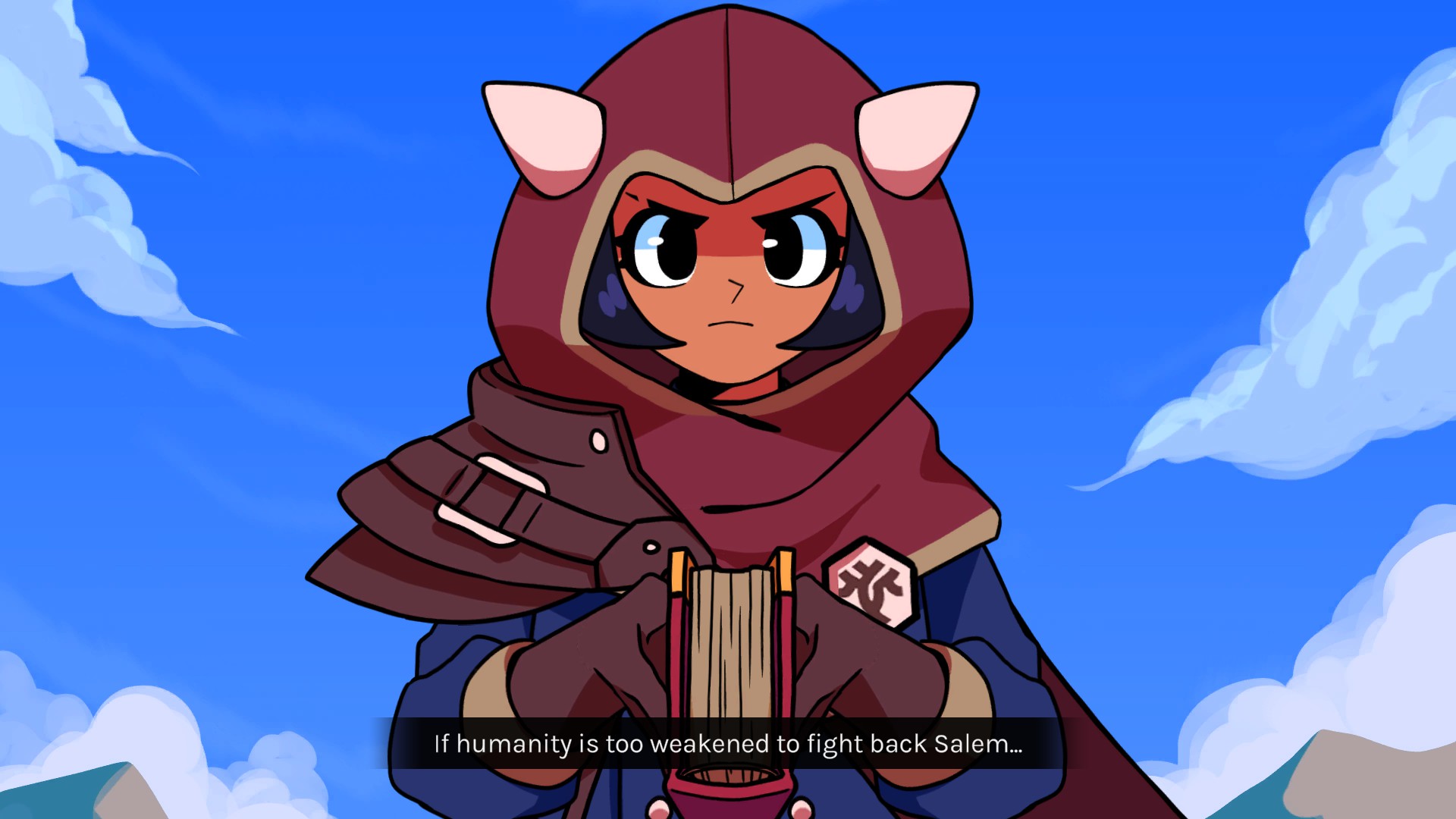
There’s something about Dicefolk that always draws me in, regardless of how difficult it gets in the later stages. Perhaps it’s the combination of turn-based combat and roguelike elements, where things don’t always go the way you want them to. In Dicefolk, we take on the role of a summoner who wants to save the world, controlling an army of chimeras. These are the creatures you intend to recruit into your own party, train them, and lead them into battle, and these beasts are varied with different appearances.
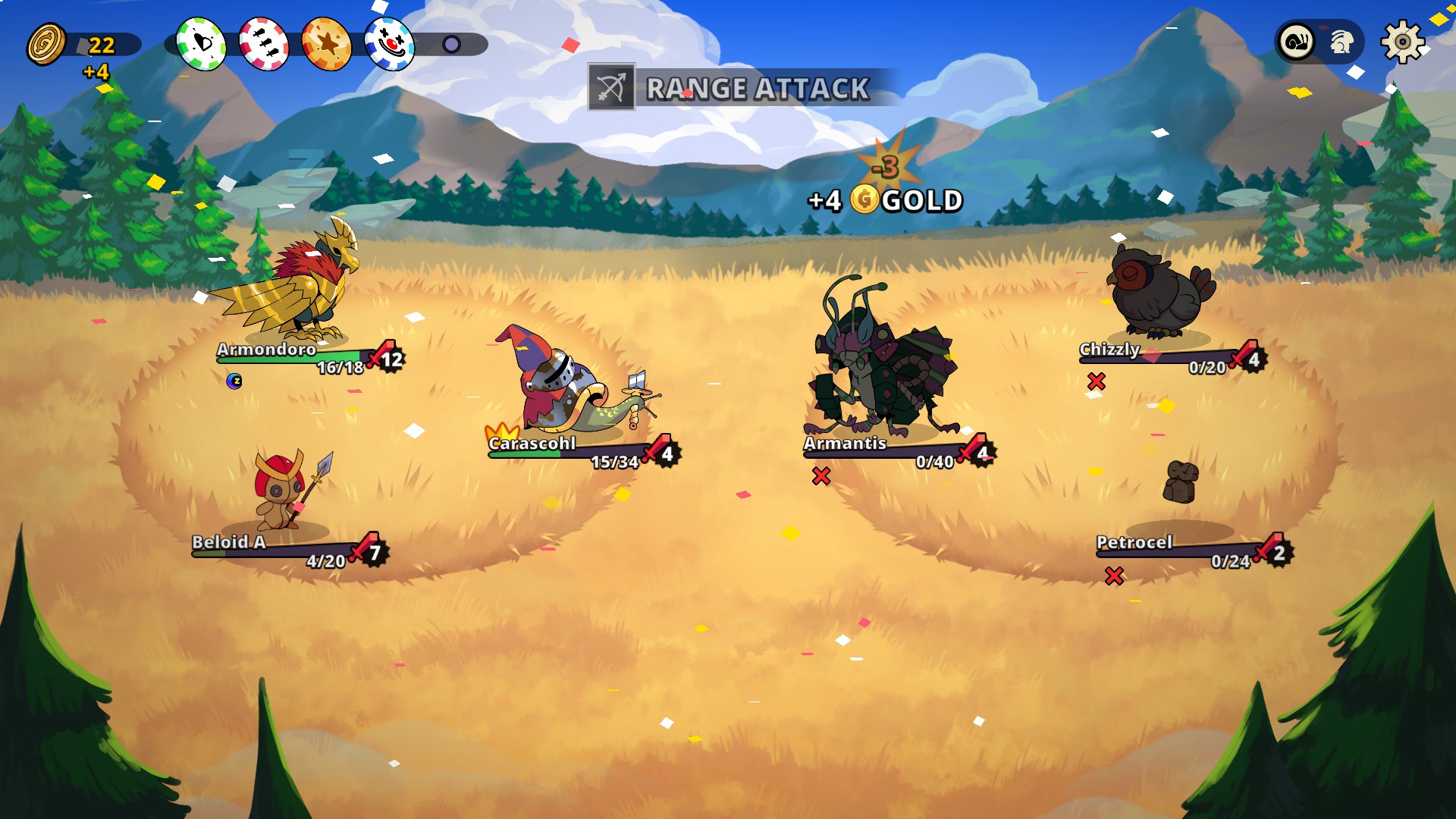
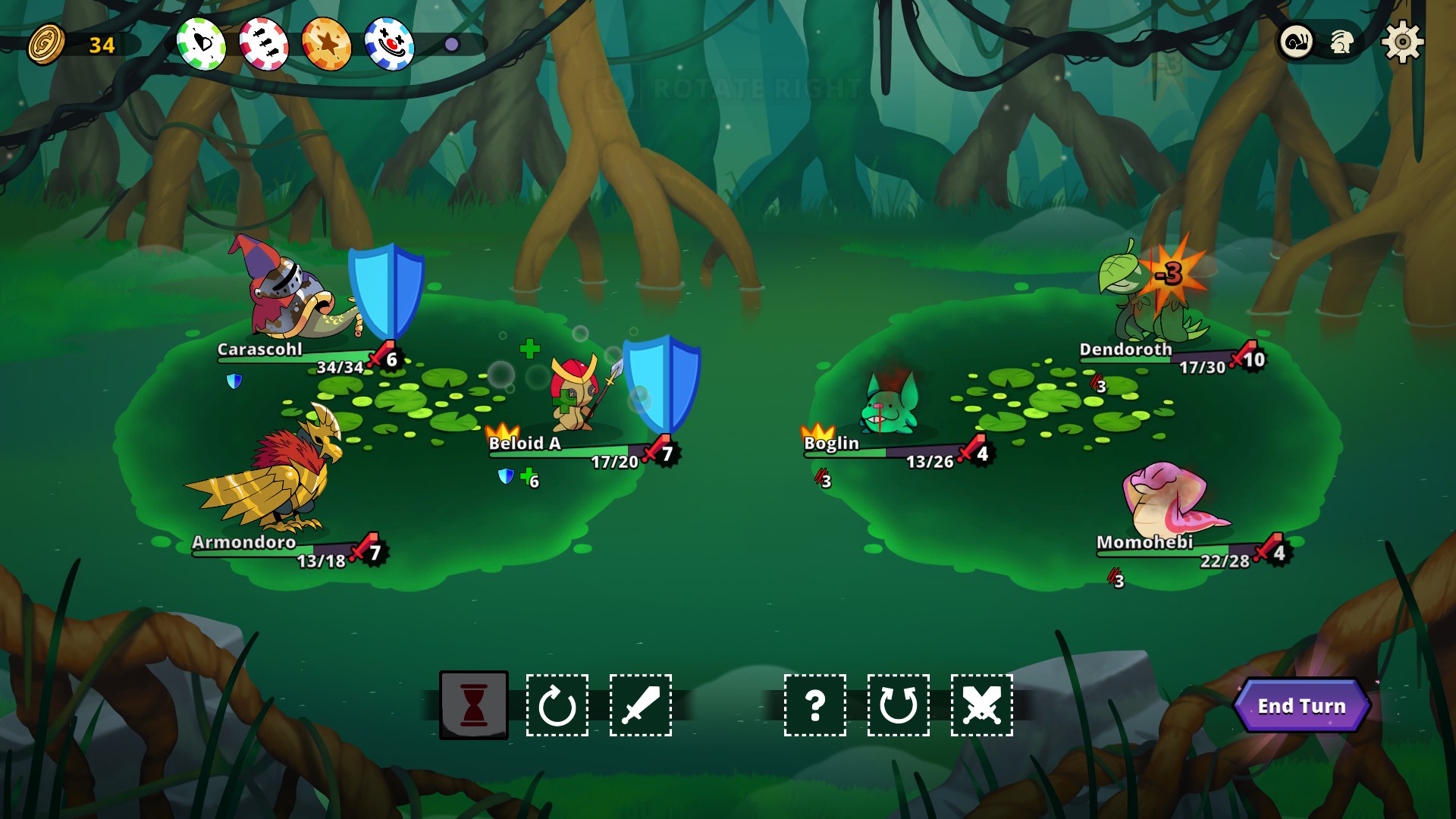
The turn-based combat is very fluid. The animations can be sped up, meaning you don’t have to wait long for each turn to finish. Battles mostly take place in a 3-on-3 format, although enemies can sometimes have fewer, depending on luck or circumstances. What isn’t clear to me is why we can’t choose the three starting chimeras ourselves; instead, the game assigns us three rather weak creatures that aren’t too special. It’s then up to us, as we travel, to discover statues or scroll vendors that will allow us to recruit creatures, for a certain price, of course.
It won’t take you long to get used to the strategic part of the game; you’ll quickly figure out how things work and start combining different chimera attacks and abilities. What sets this game apart from similar titles is your complete control over every move, including those of the enemy.
This means you must carefully study the situation in front of you and plan every move in advance. This includes rotation, and each combat round is controlled by rolling three dice, each granting different types of attacks. For example, you can shield yourself, attack from a distance, perform a counterattack, use magic, and so on.
Battles in Dicefolk consist of fights where you rotate your team to determine the current attacking leader. Rotation isn’t just a means of determining who attacks and who is the main focus, as even the act of rotating and changing the leader has an impact on the battle. Certain chimeras, when they take the leading position, can immediately attack all opposing enemies.

The main attraction of Dicefolk lies in its unpredictability, you never know what you’ll find, which enemies you’ll face, or which boss you’ll encounter. The entire game experience is like gambling, and it’s not made easier by the fact that the game is quite challenging and sometimes forces you to rely on luck.
You can move freely on the map, where you’ll find shops to buy gear and armor that provide various improvements to your chimera party. Additionally, you can upgrade your dice or buy new ones. Various events can also occur during the game, such as encounters with adventurers from whom you can purchase various bonuses. To heal, you must find a campfire, and cursed items can also appear, which cannot be removed from your creatures but provide valuable bonuses.
As I’ve already mentioned, you never know what you’ll get or who you’ll face, and this also applies to the rewards you receive after defeating a boss or enemies. The rewards could definitely be richer, and this situation can be frustrating because you feel you haven’t been adequately rewarded when you defeat an extremely difficult enemy. Enemies change during each run and vary depending on the biome you are in. Despite this, every defeat doesn’t necessarily mean the end, as each playthrough unlocks new things, whether they are new creatures or various useful bonuses.
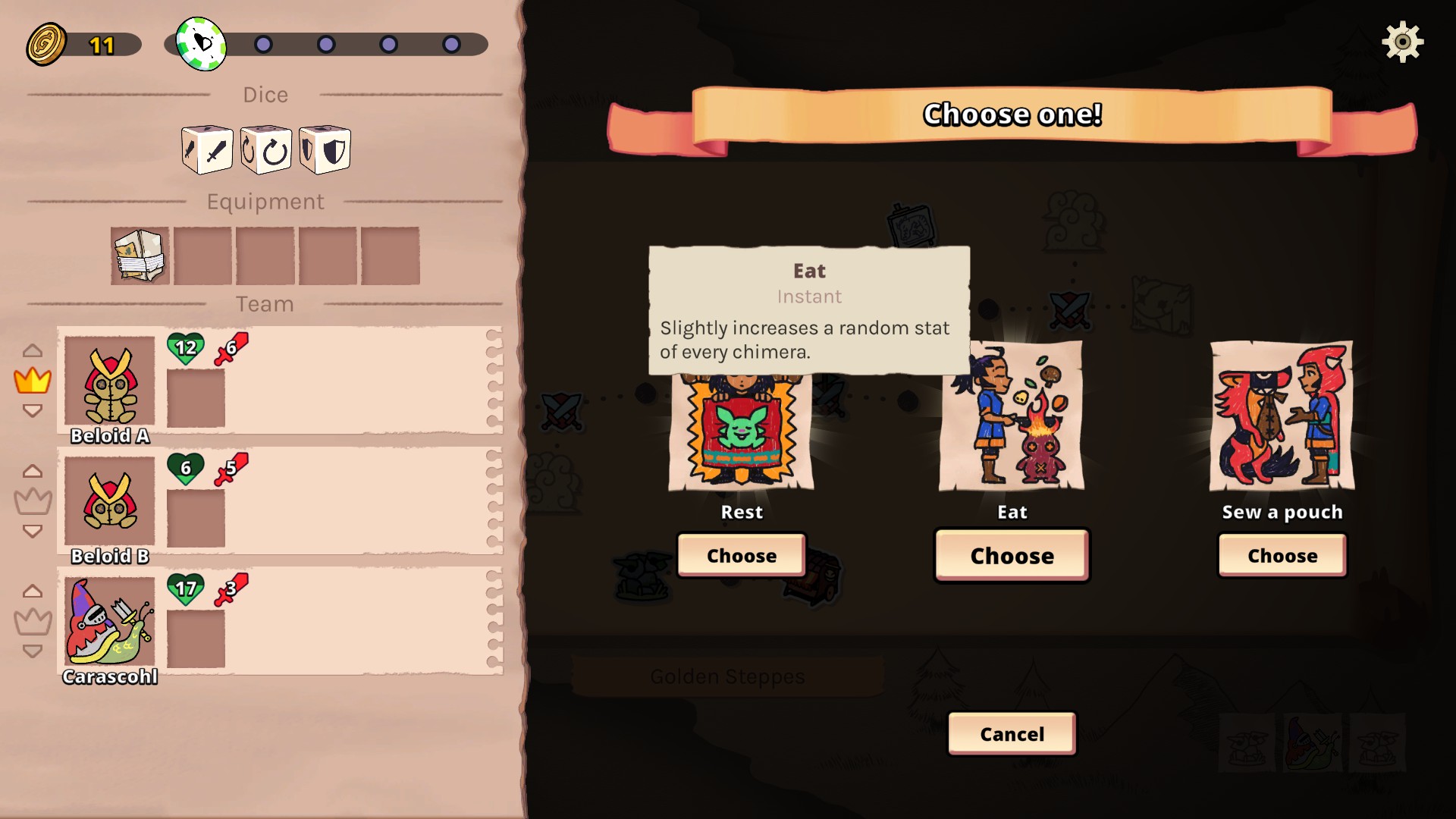
There is no central hub between runs where you can talk to characters and check your upgrades. All the areas you visit essentially only offer gear without any real visual representations. The NPCs you meet often provide only the most basic information without any real insight into the world.
And while the chimeras are well-designed, even the biomes you explore lack creativity when it comes to visual elements, resulting in a lack of narrative. The story segments you receive come in drips and drops, with different texts given to you in the form of one or two paragraphs.
Another intriguing feature involves the presence of glowing creatures known as Iridescent, which not only change their color but also enhance individual abilities. This adds an extra layer of depth to the chimera-collecting aspect while providing a new dimension to your tactics. If you feel a certain ability of these creatures is not justified in your team, the enhanced variant might prove the opposite.
Ultimately, Dicefolk is a very solid title that brings some innovative approaches to the roguelike genre. While you might feel that 10 hours of playtime is short, this game offers exceptional replayability and motivation to return. Rounds don’t last too long; it can be challenging to progress further due to certain limitations, but the Pokémon-like creatures can always capture a player’s attention. The graphics are solid, though a clear narrative is missing, but you certainly won’t regret trying this title.
Review copy provided by the publisher.

Last Flag is a third-person, 5v5 hero shooter with a bright, cartoonish presentation, simple mechanics, and a clear focus on…
Before I Go is a polished game with outstanding visuals and fantastic atmosphere, yet undermined by an nonexistent story.
After spending around 70 hours with Enshrouded, I can confidently say that this is one of the best survival games…

For newcomers, it’s an easy recommendation. It’s bigger, more refined, and more complete, offering a richer experience from start to…

Pompeii: The Legacy is a very good city builder that stands out through its grounded, historically accurate approach rather than…
![[EARLY ACCESS] Morbid Metal – Great Idea Still Finding Its Shape](https://www.indie-games.eu/wp-content/uploads/2025/04/Morbid-Metal-300x169.jpg)
Morbid Metal is a genuine surprise with a combat system that is fun and gives the game a strong identity,…
![[EARLY ACCESS] Road to Vostok – Hardcore Survival FPS with Rough Edges](https://www.indie-games.eu/wp-content/uploads/2026/04/Road-to-Vostok-300x169.jpg)
Road to Vostok delivers a great single-player Tarkov-like experience, backed by a well-structured zone progression, realistic gunplay, and a clean…

Crimson Desert isn't a masterpiece, nor is it consistently great, but it is compelling, unpredictable, and surprisingly hard to put…

Mama's Sleeping Angels is a bizarre yet intriguing co-op horror game that excels in atmosphere but struggles with repetition and…
Minishoot' Adventures starts as an interesting blend of top-down shooter and Zelda-like exploration that evolves into something much deeper.

This is a game that’s easy to enjoy in short sessions and revisit occasionally, but harder to stay invested in…

Hozy offers a calm experience centered around cleaning, painting, and decorating abandoned homes.

Ranger's Path: National Park Simulator offers a visually appealing, relaxing concept that will appeal to fans of slow-paced, task-oriented simulators.

Island of Hearts is a romantic FMV visual novel that promises choice-driven storytelling but fails to deliver on nearly every…

Project Songbird is an ambitious blend of psychological horror, puzzle-solving, narrative exploration, and light stealth elements.

Summer's Heartbeat is a well-produced but narrowly focused visual novel with polished presentation, solid acting, genuine humor, and strong replayability.

Machine Gun Fury is a retro-style arcade military shooter focused on fast-paced action and large-scale destruction.

The Steam page promises far more than the game actually delivers, to the point where it feels misleading.

FATAL FRAME II: Crimson Butterfly REMAKE looks great, with impressive detail and visual quality. However, the combat may not appeal…

Retro Rewind is a management simulation game that places you in the heart of an early 90s video rental store,…
Last Flag is a third-person, 5v5 hero shooter with a bright, cartoonish presentation, simple mechanics, and a clear focus on…
Before I Go is a polished game with outstanding visuals and fantastic atmosphere, yet undermined by an nonexistent story.
After spending around 70 hours with Enshrouded, I can confidently say that this is one of the best survival games…
For newcomers, it’s an easy recommendation. It’s bigger, more refined, and more complete, offering a richer experience from start to…
Pompeii: The Legacy is a very good city builder that stands out through its grounded, historically accurate approach rather than…
Morbid Metal is a genuine surprise with a combat system that is fun and gives the game a strong identity,…
Road to Vostok delivers a great single-player Tarkov-like experience, backed by a well-structured zone progression, realistic gunplay, and a clean…
Crimson Desert isn't a masterpiece, nor is it consistently great, but it is compelling, unpredictable, and surprisingly hard to put…
Mama's Sleeping Angels is a bizarre yet intriguing co-op horror game that excels in atmosphere but struggles with repetition and…
Minishoot' Adventures starts as an interesting blend of top-down shooter and Zelda-like exploration that evolves into something much deeper.
This is a game that’s easy to enjoy in short sessions and revisit occasionally, but harder to stay invested in…
Hozy offers a calm experience centered around cleaning, painting, and decorating abandoned homes.
Ranger's Path: National Park Simulator offers a visually appealing, relaxing concept that will appeal to fans of slow-paced, task-oriented simulators.
Island of Hearts is a romantic FMV visual novel that promises choice-driven storytelling but fails to deliver on nearly every…
Project Songbird is an ambitious blend of psychological horror, puzzle-solving, narrative exploration, and light stealth elements.
Summer's Heartbeat is a well-produced but narrowly focused visual novel with polished presentation, solid acting, genuine humor, and strong replayability.
Machine Gun Fury is a retro-style arcade military shooter focused on fast-paced action and large-scale destruction.
The Steam page promises far more than the game actually delivers, to the point where it feels misleading.
FATAL FRAME II: Crimson Butterfly REMAKE looks great, with impressive detail and visual quality. However, the combat may not appeal…
Retro Rewind is a management simulation game that places you in the heart of an early 90s video rental store,…
