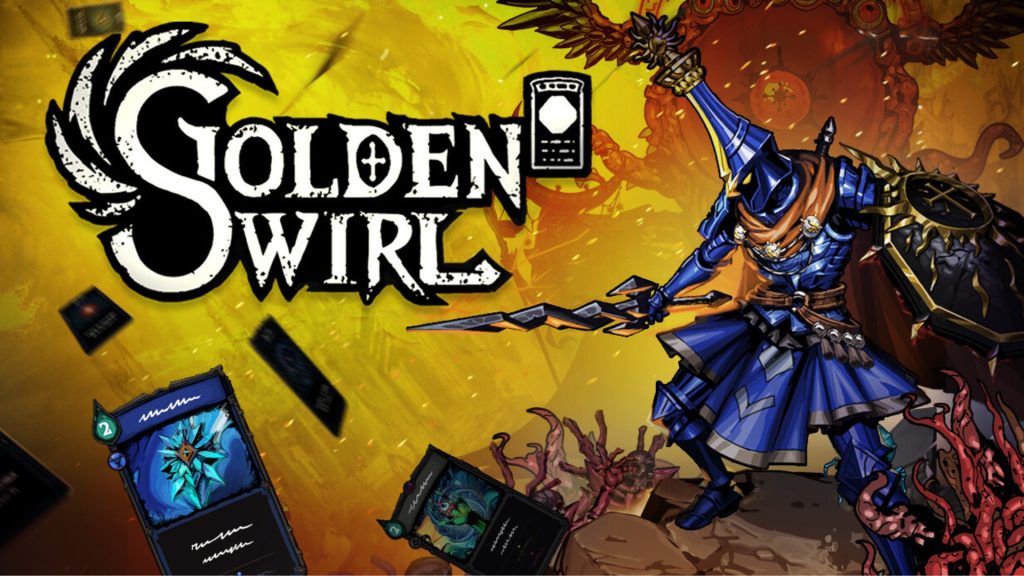
Golden Swirl – Brilliant Deckbuilding Buried Under Endless Dialogue
Golden Swirl inventive card combat carries the experience, but repetitive rooms, weak upgrades and excessive dialogue hold it back.


If you enjoy independent indie game coverage, consider supporting Indie-Games.eu on Patreon. It helps keep the site independent.
Dreams of Another is much more than a regular video game. It is a deep philosophical journey disguised as a third-person shooter and exploration experience. The core idea is the thought-provoking theme: “No Creation Without Destruction.” This powerful concept immediately challenges how games usually work, offering an introspective journey through a surreal, fragmented world.
If you expect a typical shooter experience, this isn’t the right game for you. Dreams of Another focuses entirely on the story, voices, music, memories, and the intrigue of having different dreams every night. That’s why if you are not a fan of deep, slow-paced experiences, this game might not be for you. However, if this style intrigues you, particularly if you liked a game such as 1000xResist, then you are in the perfect place.
The heart of Dreams of Another is its innovative core mechanic. Unlike a traditional shooter, where you destroy things with bullets, here, shooting becomes an act of creation. You play as one of two protagonists: The Man in Pajamas or The Wandering Soldier. They use their weapon to materialize parts of the world. To do this, you aim and fire at floating, pixel-like particle clouds found in the environment. You then bind these elements into solid objects like doors, trees, and pathways.
The game is structured around reflective exploration and puzzle-solving. You must utilize the creation mechanic to construct necessary elements, advance through the story, and unlock fragmented memories. Adding depth to the surreal landscape is the interaction with sentient objects, such as trees and doors, which engage you in dialogue and give reflections on human society, such as a piano telling you: “I only allow this human to play me and no one else.”
Dreams of Another uses this unique framework to ask you deep philosophical questions. For instance, why are moles being thrown out and dying? And why does the soldier constantly collect useless objects and assign them meaning? The storytelling is intentionally non-linear and focused on thematic closure. In fact, the main idea is for you to sit, relax, and listen to the dialogue happening in the background.

Personally, I was especially intrigued by one question: “Do we remember when a certain object was given to us, and what kind of emotions were involved in creating it?” The game asks many questions like this but does not necessarily give you the answers. Instead, it lets these questions stick with you. The ending avoids traditional plot twists, as it offers an emotional resolution that emphasizes creation and destruction as a natural cycle.
The entire focus is on the characters’ quest for self-understanding, especially since the protagonist cannot use the gun to fight or protect himself. This is what the game does perfectly: it draws you deeper into the dreams. Every time you complete a level, you are taken back to the main menu, just like a dream that eventually ends. Then, when you click play again, it feels like you are sleeping once more.
However, the actual gameplay is almost nonexistent. While you can shoot, throw a grenade, or use a bazooka, these actions are not THAT important. The fun is not in the mechanics, but in everything else the game offers. Dreams of Another uses an instantly unique and recognizable visual style. This is achieved by using point cloud technology. As a result, the entire world gives the impression of walking through a shifting, dreamlike landscape made entirely of flexible particles.
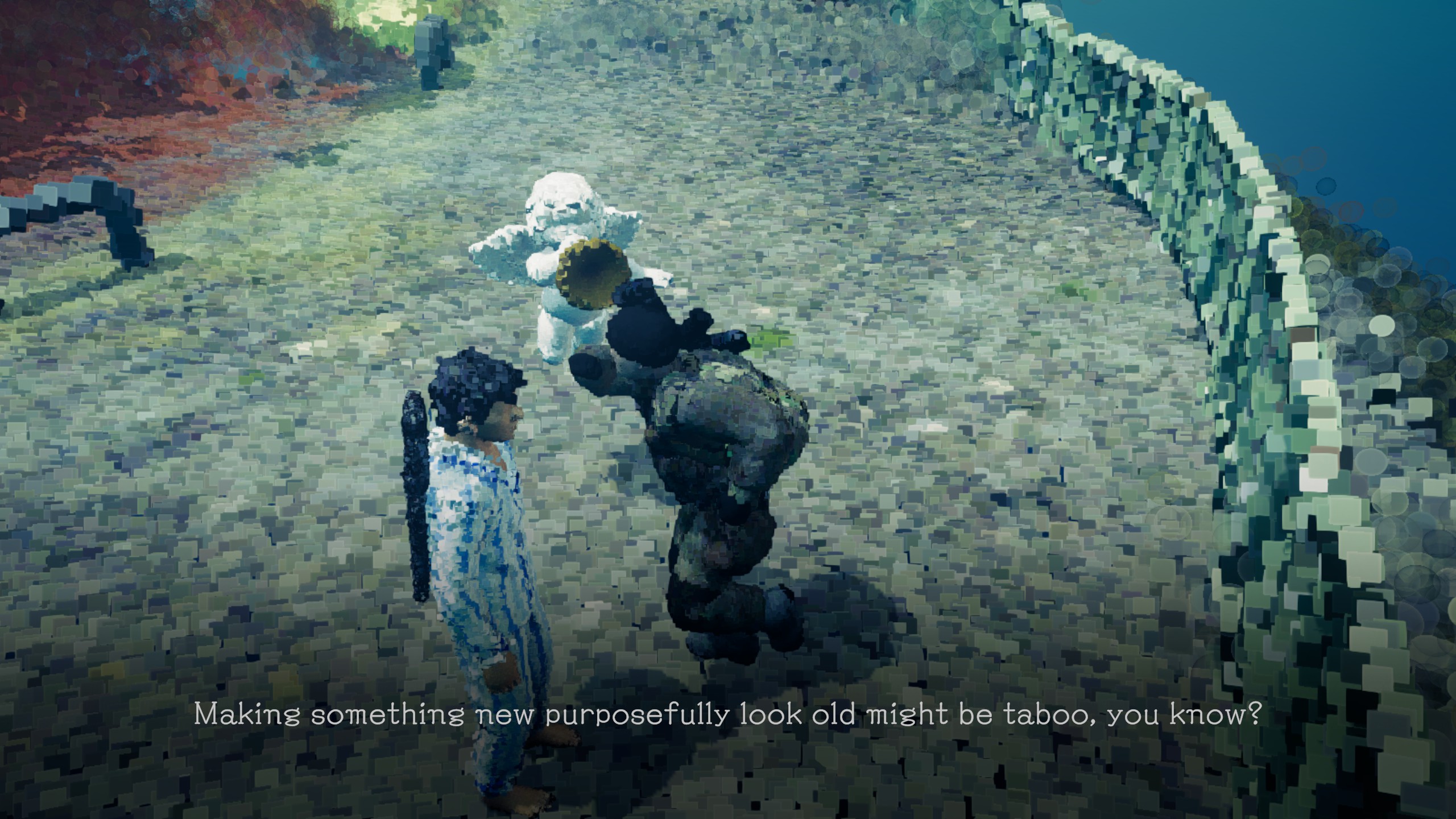
Game director Baiyon made sure the experimental music score fits the atmosphere perfectly. The music adds to the feelings of dread and the sense of not knowing what awaits. This score also successfully complements the visuals, however voice acting often sounds flat and lacks emotion, which sometimes clashes with the game’s overall vibe. I think that this is rather subjective, as some might find the voice acting fitting while others won’t.
If you think this is a short game, you are mistaken; the story keeps evolving, which was a genuinely nice surprise. The pacing is consistent too. You usually visit the same areas, but they either change or you move to new ones. Although the story gets more interesting as you play, the core mechanics unfortunately always stay the same, which definitely makes the game less fun. Despite this, if you enjoy deep psychological themes, this is a game you should be buying.
Review copy provided by the publisher
Golden Swirl inventive card combat carries the experience, but repetitive rooms, weak upgrades and excessive dialogue hold it back.
![[GAMESCOM 2026] Wilderdark Preview – Ambitious Dinosaur Horror Game That Still Has Plenty to Prove](https://www.indie-games.eu/wp-content/uploads/2026/09/Wilderdark-1024x576.jpg)
Dinosaur survival horror game Wilderdark has one of those premises that immediately makes you wonder why more games have not…
![[PREVIEW] Tiny Metal 2 – Strategy Game That Wants You to Learn From Every Mistake](https://www.indie-games.eu/wp-content/uploads/2026/09/Tiny-Metal-2-1024x576.jpg)
I rarely enjoy discovering that my opening strategy was completely wrong, but Tiny Metal 2 made that process one of…
![[PREVIEW] Remothered: Red Nun’s Legacy – Ambitious Survival Horror That Needs More Polish](https://www.indie-games.eu/wp-content/uploads/2026/09/Remothered-Red-Nuns-Legacy-4-1024x576.jpg)
Remothered: Red Nun’s Legacy has a gripping atmosphere and promising survival tools, but its repetitive hiding and rough visuals need…
The Alighieri Circle: Dante’s Bloodline is difficult to recommend beyond players who are especially interested in Dante or enjoy solving…
Orc Incremental offers satisfying progression, entertaining totem combinations and enough content to justify its affordable price.
![[GAMESCOM 2026] Chronoscript: The Endless End Preview – Beautiful Pages Hide Deliberate Combat](https://www.indie-games.eu/wp-content/uploads/2026/09/Chronoscript-The-Endless-End-1-1024x576.jpg)
Chronoscript: The Endless End stands out from other Metroidvanias by blending 2D manuscript worlds with exploration inside a 3D manor.
![[GAMESCOM 2026] MegaGum Preview – Combat Hits Hard in This Sticky Platforming Adventure](https://www.indie-games.eu/wp-content/uploads/2026/09/MegaGum-09-09-26-5-1024x576.jpg)
MegaGum combines hard-hitting combat, varied weapons and Gum-powered platforming in a promising Gamescom 2026 demo.
![[GAMESCOM 2026] Delphinium Preview – Cozy Routine Mixed With Enjoyable Minigames](https://www.indie-games.eu/wp-content/uploads/2026/03/Delphinium--1024x665.jpg)
Delphinium mixes cozy farming, exploration and relationships with enjoyable fishing, cooking and forging minigames in its Gamescom 2026 demo.
Lady Death: Demonicron looks the part, but underneath its excellent comic-book exterior is a clunky and painfully short brawler.
![[GAMESCOM 2026] Tomb Raider: Legacy of Atlantis Preview – Expands the Original Without Losing Its Identity](https://www.indie-games.eu/wp-content/uploads/2026/09/tomb-raider-legacy-of-atlantis-06-02-26-1-1024x576.jpg)
Tomb Raider: Legacy of Atlantis brings Lara back to her roots, but its Gamescom 2026 showing proved this is far…
![[GAMESCOM 2026] Clive Barker’s Hellraiser: Revival Preview – Ready to Open the Box](https://www.indie-games.eu/wp-content/uploads/2026/09/Clive-Barkers-Hellraiser-Revival-08-30-26-1-1024x576.jpg)
Hellraiser: Revival preserves the franchise’s sex, gore and psychological horror while delivering approachable survival-horror gameplay.

Swan Song creates a peaceful and forgiving puzzle space without removing the challenge that makes solving a difficult puzzle rewarding.

Mortal Shell II starts brilliantly but grows repetitive and exhausting, while remaining a rewarding and ambitious Soulslike sequel.
![[GAMESCOM 2026] Terranigma Preview – A Lost SNES Classic Returns in 2027](https://www.indie-games.eu/wp-content/uploads/2026/08/Terranigma-1-1024x576.jpg)
After more than three decades of limited availability, Terranigma is returning in 2027. We played its enhanced re-release at Gamescom…

Reading another person’s mind is often presented as a desirable superpower, but Sister Other Paranoia immediately understands why it could…
Forsaken Realms: Vahrin’s Call is exactly the kind of ambitious, slightly clumsy fantasy RPG that used to be far more…
![[Early Access] 2nd EVE – Sci-Fi Action RPG That Lacks a Sense of Stakes](https://www.indie-games.eu/wp-content/uploads/2026/08/2ND-EVE-1024x576.jpg)
2nd Eve is a space-set action RPG in which we strive to save humanity.
![[PREVIEW] Dreamcards – Strategic Exploration of Consciousness](https://www.indie-games.eu/wp-content/uploads/2026/08/Dreamcards_20260810_233631_0000-1024x576.jpg)
Dreamcards is a roguelike deckbuilder centered around dreams and nightmares.
![[Early Access] OFFBEAT – Incredibly Fun Way to Start a Music Career](https://www.indie-games.eu/wp-content/uploads/2026/08/Offbeat_20260808_201446_0000-1024x576.jpg)
In OFFBEAT, we play the role of a jobbing composer who is launching their music career.
