![[PREVIEW] Remothered: Red Nun’s Legacy – Ambitious Survival Horror That Needs More Polish](https://www.indie-games.eu/wp-content/uploads/2026/09/Remothered-Red-Nuns-Legacy-4-1024x576.jpg)
[PREVIEW] Remothered: Red Nun’s Legacy – Ambitious Survival Horror That Needs More Polish
Remothered: Red Nun’s Legacy has a gripping atmosphere and promising survival tools, but its repetitive hiding and rough visuals need…

![[PREVIEW] The Whims of the Gods – Tenochtitlán Was Not Built in a Day](https://www.indie-games.eu/wp-content/uploads/2025/03/The-Whims-of-the-Gods_keyart-logo-1920x1080-1.jpg)
If you enjoy independent indie game coverage, consider supporting Indie-Games.eu on Patreon. It helps keep the site independent.
City-builder games, although they rely on similar patterns and mechanics, can offer a wide spectrum of worlds and stories. However, most of them are still focused on single-player strategy. But what if I told you there is a city-builder with a co-op mode, auto-battler mechanics, and a transcendent narrative that leads to multiple different endings? You will find all of this in The Whims of the Gods, a new title from developer Juggler Games and publisher PJ Games. Although the game’s release is planned for the third quarter of 2025, we had the opportunity to try outthe second public playtest in February.
The Whims of the Gods is a city-builder designed with an emphasis on online co-op gameplay. The objectives in this game seem simple at first glance: gather resources, build an ancient city, and meet the needs of its inhabitants. However, when your plans are in the hands of ancient, whimsical gods, the situation quickly becomes complicated.
In this case, managing a growing civilization involves creating complex production systems, fighting terrifying enemies, and even adjusting to a mystical calendar. This is an opportunity to join forces with another player and collaboratively build a prosperous metropolis. If you want to find out more details about the game, be sure to check out our interview with the developers here.
I had the opportunity to play the game twice: first in co-op mode with one of the testers from the Juggler Games team, and then a second time on my own. In both cases, the gameplay focused on completing tutorial tasks, but the impressions from these two playthroughs are quite different. But before we get to that part, let’s look at the basics.


The game begins with an introductory dialogue between four ancient deities, who discuss their previous creations and failed experiments. Now, they’ve devised a new plan: to place humans on an island full of dangers to prove their worth to the gods. Right from the start, there is a strong inspiration from Aztec and Mayan culture; the names of the gods, their depictions, the drawings on the rotating circles, and the gentle melody in the background reflect elements we immediately associate with those civilizations.
Although this brief scene mostly serves as a story introduction, it also hints at some key gameplay elements: the rotating circles resemble the mystical calendar, while the conversation among the gods emphasizes their capriciousness and its consequences, which players will soon feel through blessings or curses. Another interesting detail can be noticed on the loading screen, which gives us a brief glimpse of a fully developed city, like the one we’ll be able to build in later stages of the game.
The introduction is followed by the tutorial. We start with the basics like camera control, UI navigation, and learning the main mechanics, and then quickly move on to gathering resources, building various structures, hiring workers, increasing the population, and expanding the territory. After this, it’s necessary to research more advanced buildings to sustain the economy and fulfill Quest Objectives.
Although this seems like a typical progression in city-builder games at first, original solutions are soon revealed: for example, making sacrifices at shrines and performing rituals to unlock new regions or receive a surprise. Also, the activation of the ancient calendar, which warns players about upcoming events, can bring unexpected consequences due to the gods. In general, the instructions are clear and easy to follow, but I believe additional help would be useful for assembling and activating the calendar mechanic, as it introduces kinetic and thermal energy into the gameplay.
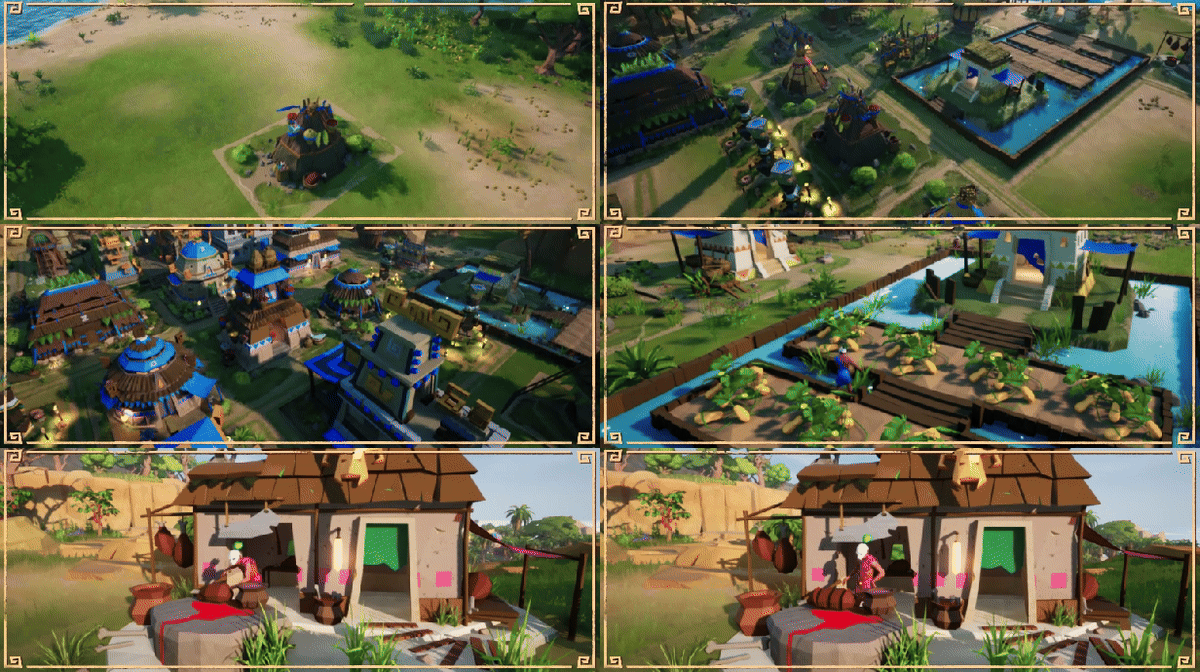

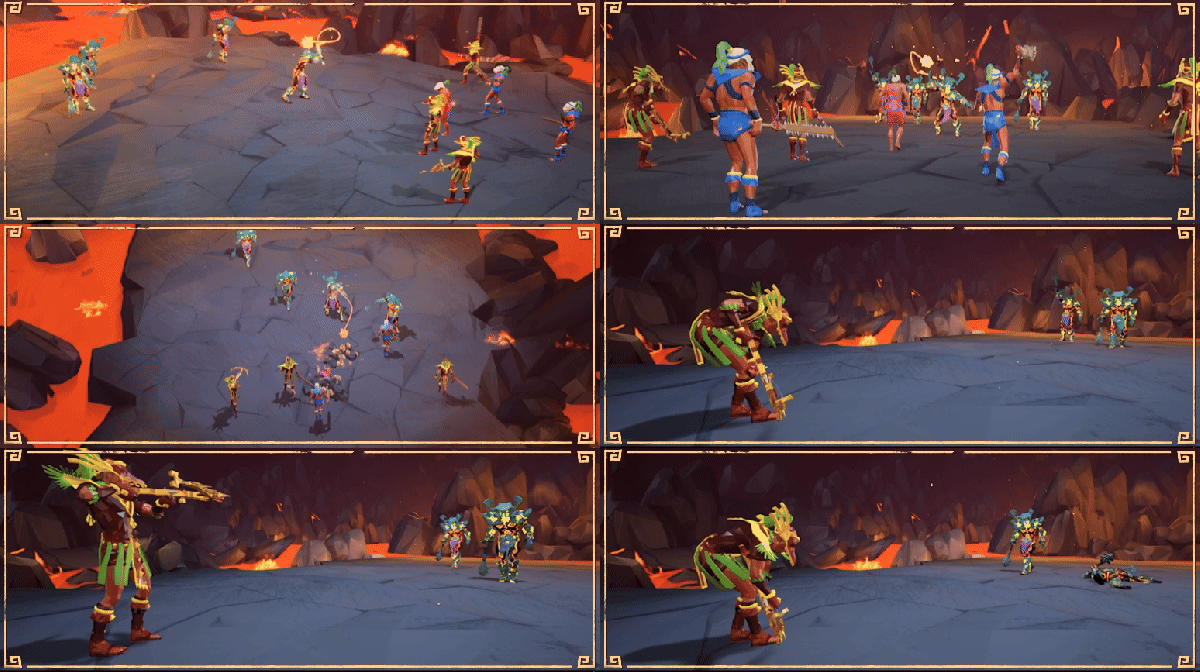
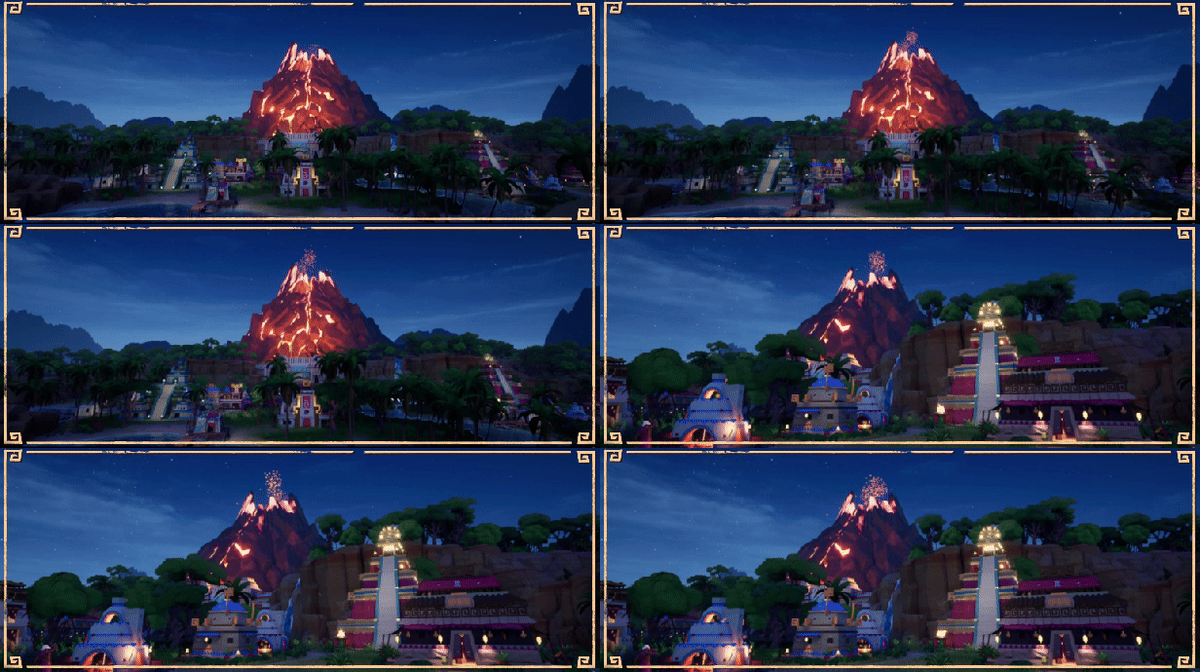
As I mentioned at the beginning, the experience of playing this game in single-player mode is not the same as in co-op mode. Choosing the solo option definitely maintains the game’s challenge, and although you have access to a wider range of actions, ensuring the city’s prosperity becomes quite difficult. However, it is precisely the cooperative system that makes this title special compared to other games in the genre.
I particularly liked how the game adapts to two players and encourages them to collaborate. For example, when dividing responsibilities, you have to agree on who will be in charge of buildings, resources, and technology trees, while also ensuring that your mutual cooperation benefits both of you. This fresh and innovative multiplayer mechanic definitely makes the gameplay more dynamic and interesting, and it’s no wonder it is treated as the main attraction of the game.
While I was playing, I found out that one of the playtest participants made an interesting observation: The Whims of the Gods has cozy elements. While that might not be the first association when you’re battling challenges and watching your inhabitants die (which doesn’t exactly sound like a cozy experience), I agree that the game as a whole has a relaxed atmosphere. Thanks to the vibrant and colorful environment, the soothing sound of waterfalls, and the rhythmic gameplay, I can easily imagine someone becoming completely engrossed in the game and spending hours on it.


To round up my impressions, this version of The Whims of the Gods offers a truly strong and fun experience. Moreover, the game is already fully functional, with no bugs, crashes, or major technical problems, which is worth mentioning considering that issues reported during the second playtest have already been fixed. Still, there is room for improvement: the instructions in the later phases of the game should be more precise, notifications appeared even when the inhabitants were already engaged in those tasks, and animations were missing at some points.
However, these details did not negatively affect the overall gameplay experience, and the game gets better with every new round; not only do you get used to the mechanics faster and complete tasks, but you also more easily notice details you might have missed before (like being able to see the names of all the inhabitants in their huts, which is quite cool).
I am particularly interested in how the auto-battler combat system will work and in what direction the story will develop; the volcano and multiple endings sound promising. Speaking of promises: although the exact release date is not yet known, there is a high probability that we will get the full version of the game in the third quarter of 2025. And given the current progress, I can assure you, it will be worth the wait.
Remothered: Red Nun’s Legacy has a gripping atmosphere and promising survival tools, but its repetitive hiding and rough visuals need…
The Alighieri Circle: Dante’s Bloodline is difficult to recommend beyond players who are especially interested in Dante or enjoy solving…
Orc Incremental offers satisfying progression, entertaining totem combinations and enough content to justify its affordable price.
![[GAMESCOM 2026] Chronoscript: The Endless End Preview – Beautiful Pages Hide Deliberate Combat](https://www.indie-games.eu/wp-content/uploads/2026/09/Chronoscript-The-Endless-End-1-1024x576.jpg)
Chronoscript: The Endless End stands out from other Metroidvanias by blending 2D manuscript worlds with exploration inside a 3D manor.
![[GAMESCOM 2026] MegaGum Preview – Combat Hits Hard in This Sticky Platforming Adventure](https://www.indie-games.eu/wp-content/uploads/2026/09/MegaGum-09-09-26-5-1024x576.jpg)
MegaGum combines hard-hitting combat, varied weapons and Gum-powered platforming in a promising Gamescom 2026 demo.
![[GAMESCOM 2026] Delphinium Preview – Cozy Routine Mixed With Enjoyable Minigames](https://www.indie-games.eu/wp-content/uploads/2026/03/Delphinium--1024x665.jpg)
Delphinium mixes cozy farming, exploration and relationships with enjoyable fishing, cooking and forging minigames in its Gamescom 2026 demo.
Lady Death: Demonicron looks the part, but underneath its excellent comic-book exterior is a clunky and painfully short brawler.
![[GAMESCOM 2026] Tomb Raider: Legacy of Atlantis Preview – Expands the Original Without Losing Its Identity](https://www.indie-games.eu/wp-content/uploads/2026/09/tomb-raider-legacy-of-atlantis-06-02-26-1-1024x576.jpg)
Tomb Raider: Legacy of Atlantis brings Lara back to her roots, but its Gamescom 2026 showing proved this is far…
![[GAMESCOM 2026] Clive Barker’s Hellraiser: Revival Preview – Ready to Open the Box](https://www.indie-games.eu/wp-content/uploads/2026/09/Clive-Barkers-Hellraiser-Revival-08-30-26-1-1024x576.jpg)
Hellraiser: Revival preserves the franchise’s sex, gore and psychological horror while delivering approachable survival-horror gameplay.

Swan Song creates a peaceful and forgiving puzzle space without removing the challenge that makes solving a difficult puzzle rewarding.
Mortal Shell II starts brilliantly but grows repetitive and exhausting, while remaining a rewarding and ambitious Soulslike sequel.
![[GAMESCOM 2026] Terranigma Preview – A Lost SNES Classic Returns in 2027](https://www.indie-games.eu/wp-content/uploads/2026/08/Terranigma-1-1024x576.jpg)
After more than three decades of limited availability, Terranigma is returning in 2027. We played its enhanced re-release at Gamescom…

Reading another person’s mind is often presented as a desirable superpower, but Sister Other Paranoia immediately understands why it could…
Forsaken Realms: Vahrin’s Call is exactly the kind of ambitious, slightly clumsy fantasy RPG that used to be far more…
![[Early Access] 2nd EVE – Sci-Fi Action RPG That Lacks a Sense of Stakes](https://www.indie-games.eu/wp-content/uploads/2026/08/2ND-EVE-1024x576.jpg)
2nd Eve is a space-set action RPG in which we strive to save humanity.
![[PREVIEW] Dreamcards – Strategic Exploration of Consciousness](https://www.indie-games.eu/wp-content/uploads/2026/08/Dreamcards_20260810_233631_0000-1024x576.jpg)
Dreamcards is a roguelike deckbuilder centered around dreams and nightmares.
![[Early Access] OFFBEAT – Incredibly Fun Way to Start a Music Career](https://www.indie-games.eu/wp-content/uploads/2026/08/Offbeat_20260808_201446_0000-1024x576.jpg)
In OFFBEAT, we play the role of a jobbing composer who is launching their music career.
HellSlave II retains the original’s oppressive atmosphere, morally grey world and striking art while adding a larger world, randomized loot…
Beast of Reincarnation is an ambitious but uneven action RPG elevated by satisfying parry combat, beautiful art direction and the…

K-pop Idol Stories: Road to Debut captures the pressure of building idol group, but its management systems never explore that…
