Palworld – Messy, Ambitious and Incredibly Addictive
It has been roughly two and a half years since Palworld first entered Early Access, and quite a lot has…

If you enjoy independent indie game coverage, consider supporting Indie-Games.eu on Patreon. It helps keep the site independent.
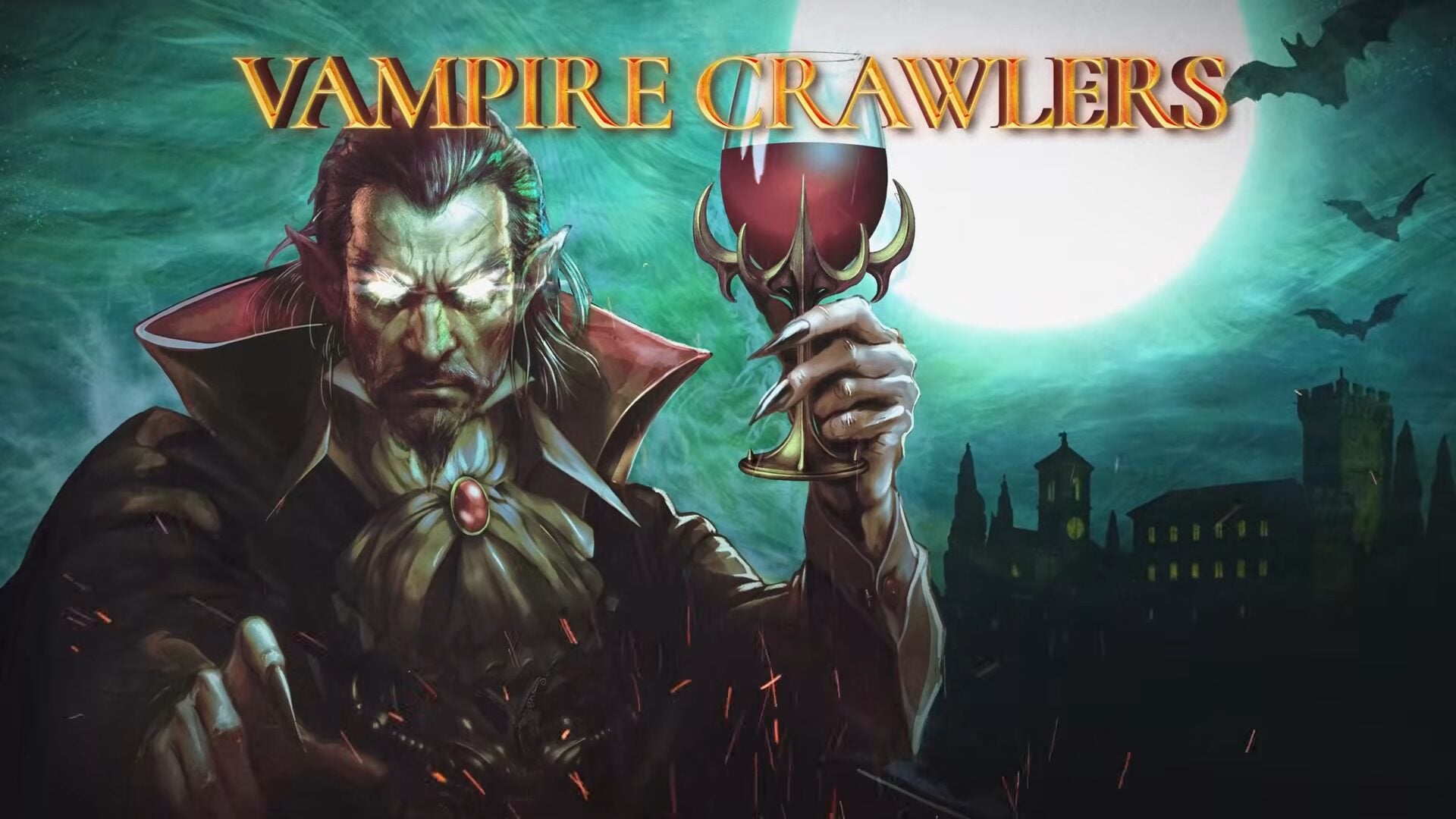
Vampire Crawlers will immediately hook you, especially if you’ve spent any time with Vampire Survivors. It takes that familiar world, its enemies, abilities, and overall vibe, and then completely reshapes it into something different. A dungeon crawler mixed with a roguelike deck-builder, layered with a surprisingly deep combo system. And for a game that costs around 10 euros, it honestly offers a lot more than you’d expect at first glance.
You move across a world map, pick challenges, enter dungeons, collect relics, and gradually build up your character through upgrades and better cards. On paper, it sounds simple, and it is, but the way everything connects: deck-building, stats, combos, and risk-reward decisions make it really engaging.
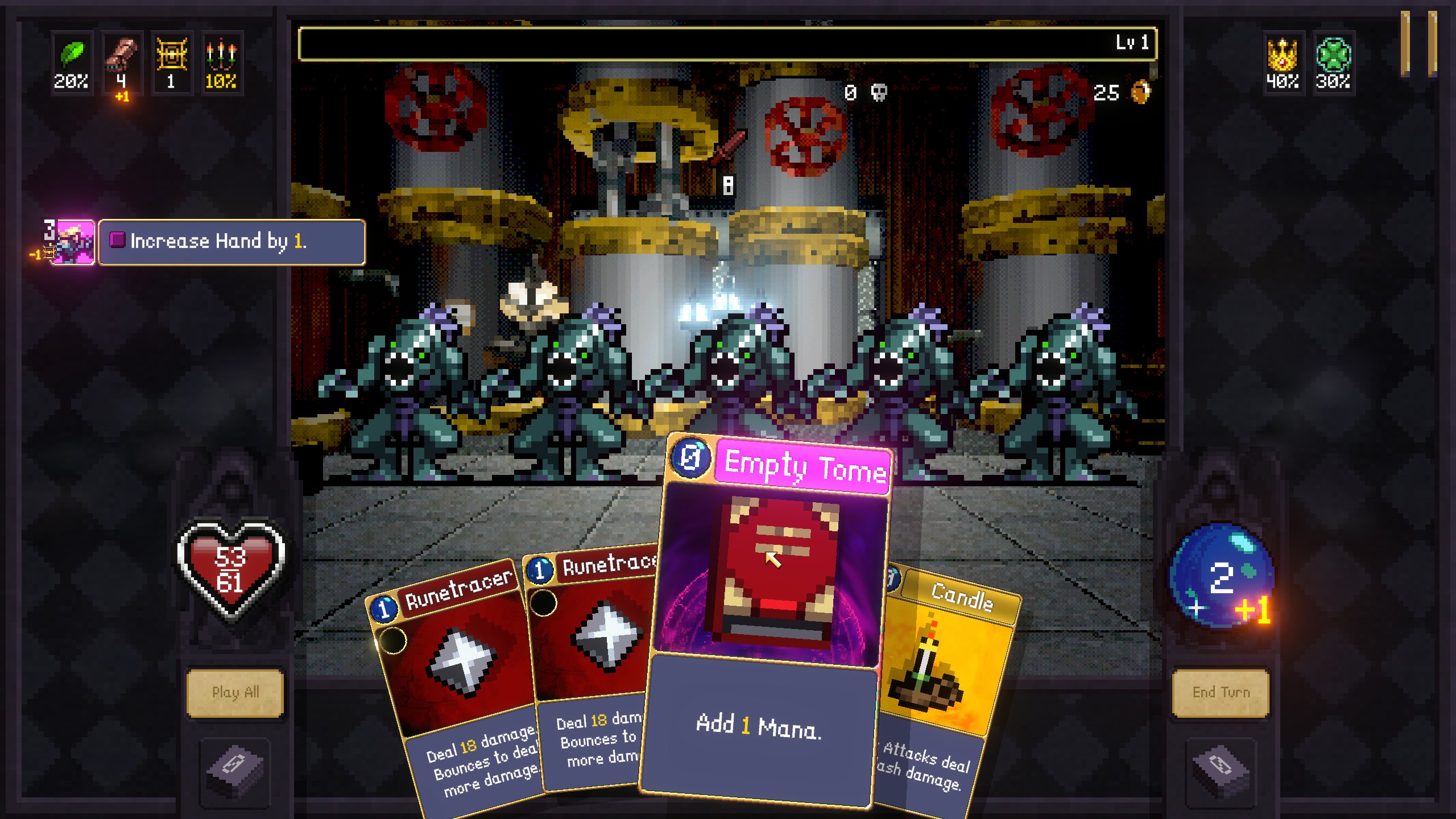
The real strength of the game lies in its deck-building and combo mechanics. Every card has a value, usually between zero and three, and playing them in the correct sequence builds up combos that significantly improve your effects. It’s not just about dealing damage, it’s about how you chain everything together. You can stack buffs, boost your stats repeatedly, or set up massive turns that completely turn the tide of a fight. There’s something extremely satisfying about building a sequence that suddenly makes your character feel unstoppable.
At the same time, the game doesn’t just let you mindlessly throw cards into your deck. You actually need to think about what you’re doing. Decks can easily become bloated if you’re not careful, and while there are ways to remove or sacrifice cards, they’re limited. That means every decision matters, and if you don’t have a clear direction for your build, things can quickly fall apart. It’s a system that rewards planning, but also adaptability.
Another layer that makes things interesting is how Crawlers work. Instead of directly controlling characters in the traditional sense, you bring them along as part of your deck. Each one has unique starting weapons and passives, and later you can combine up to three of them. Mixing and matching Crawlers adds a lot of variety before you even start a run, and it gives you a strong foundation to build around, even if the rest of your deck ends up being influenced by RNG.
And yes, RNG is definitely part of the experience. Card acquisition is somewhat random, and while you can reroll or skip options after unlocking certain upgrades, you don’t have full control. But the game handles this surprisingly well. It’s not overly punishing, and more often than not, success comes from how well you use what you’re given rather than chasing the perfect build. You can still win runs with messy, imperfect decks if you understand the combo system and play smart.
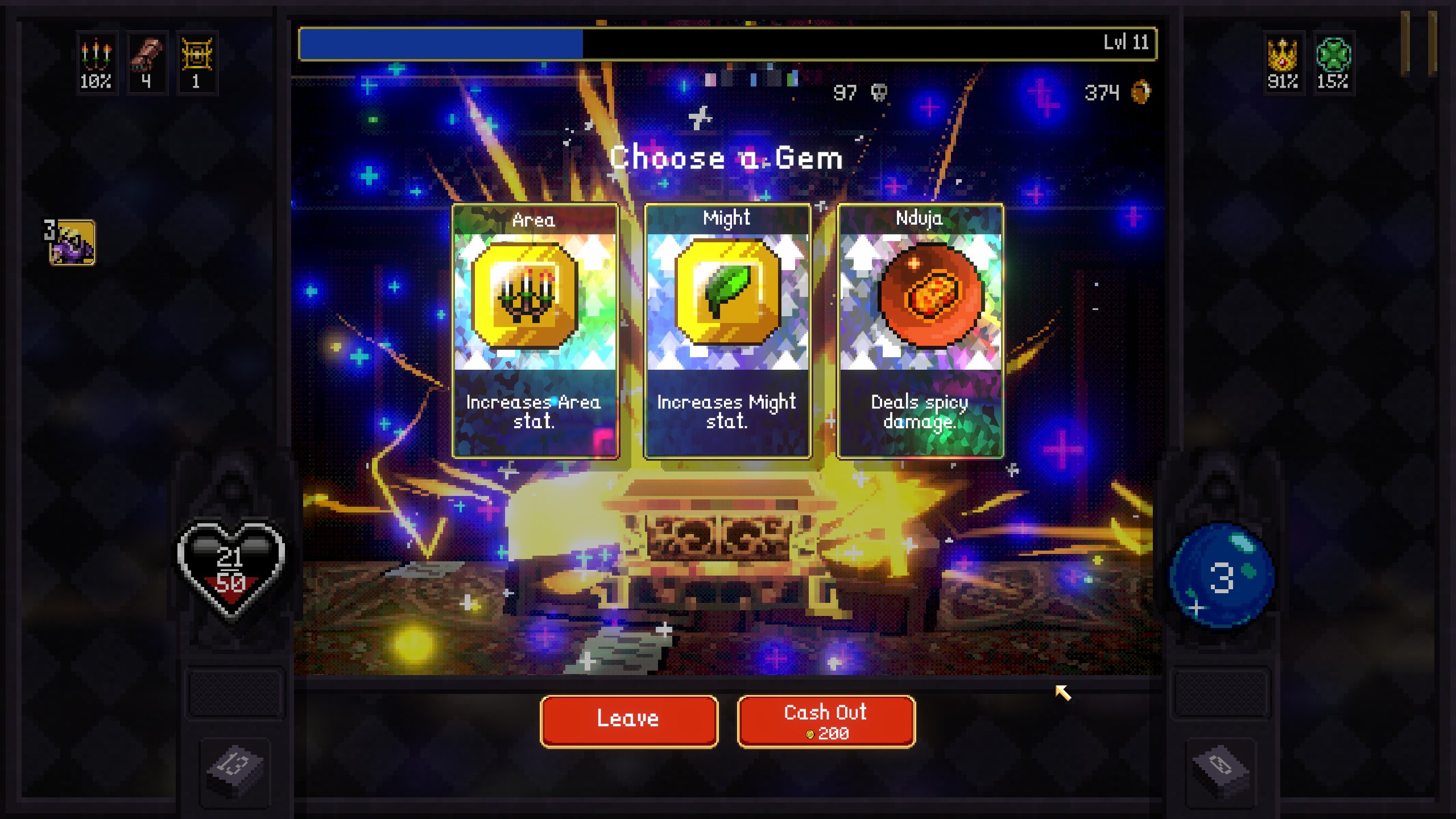
On top of cards, you also have gems that can be socketed into them, adding another layer of customization. These gems can modify how cards behave, improve stats, or even let you reuse them in certain situations. Combined with the stat system, things like damage, mana, projectile count, and overall efficiency, it becomes very clear that you can’t ignore progression outside of your deck. If you do, you’ll feel it later.
Where the game starts to lose some momentum is in its dungeon crawling aspect. While each map has its own visual identity and different encounters, the moment-to-moment exploration can feel repetitive over time. You’ll come across similar events: shrines, sacrifices, healing points, loot spots and while they offer meaningful choices, the structure itself doesn’t evolve enough to stay consistently exciting. It works, but it doesn’t stand out as much as the card gameplay does.
Visually, the game does a great job. It leans into the flashy, over-the-top style you’d expect from its inspiration, but it never becomes overwhelming. Animations are smooth, effects are satisfying, and the UI is clean and easy to read, which is extremely important in a game where you’re constantly making quick decisions. It strikes a really good balance between spectacle and clarity.
At the end of the day, Vampire Crawlers is an extremely addictive experience. It doesn’t reinvent the genre, but it doesn’t need to. What it does, it does very well, especially the deck-building and combo systems, which carry the entire experience. For the price, the amount of content, and how engaging it is, it’s hard to go wrong here. It’s not just a spin-off idea riding on the success of Vampire Survivors, it’s a genuinely solid game that stands on its own.
It’s not perfect. The dungeon crawling side could use more variety, and repetition does start to creep in over longer sessions. But the core gameplay loop is strong enough to keep pulling you back in. If you enjoy roguelike deck-builders, especially something in the vein of Slay the Spire, this is an easy recommendation.
Cascadou is incredibly addictive deck-building roguelike that clearly takes inspiration from Balatro but builds on it with its own twist centered around chain reactions and combos. The core loop is easy to pick up but hard to master, where you manipulate cards within limited moves to set up massive scoring combos.
Ending Thoughts
This review is based on the retail copy I purchased
It has been roughly two and a half years since Palworld first entered Early Access, and quite a lot has…
![[EARLY ACCESS] The Last Caretaker – Survival Game I Cannot Stop Playing](https://www.indie-games.eu/wp-content/uploads/2026/07/The-last-Caretaker-Key-Art-1024x587.jpg)
The Last Caretaker is a compelling survival crafter with a flooded world and mobile base, but weak combat and performance…

Advent: Dawn is an intriguing science-fiction visual novel elevated by a likable cast and one of the most convenient flowchart…
![[EARLY ACCESS] Hell Maiden – Beautiful but Uneven Journey Through Hell](https://www.indie-games.eu/wp-content/uploads/2025/06/HMD_screenshot_019-1024x576.jpg)
Bullet heaven and rougelite game Hell Maiden lands between a polished Early Access release and a promising game that still…
![[PREVIEW] Dark Queen of Samobor – Promising Croatian Adventure Still in Need of Polish](https://www.indie-games.eu/wp-content/uploads/2026/07/Dark-Queen-of-Samobor-1024x587.jpg)
Dark Queen of Samobor is a promising 2.5D side-scrolling action-adventure that combines Croatian folklore with combat, puzzles and cinematic platforming.

70s-style Robot Anime Geppy-X offers incredible animation, music and mecha nostalgia, but its average shooting make the €39 price difficult…

Denshattack! blends Tony Hawk, Jet Set Radio, and Japanese train culture into one of the year's most creative and unforgettable…
If you're looking for a game that takes an incredibly simple idea and somehow turns it into something addictive, KAZ…
Cat Mail Co. charms with cozy visuals and satisfying mail sorting, but its full release doesn't quite live up to…
Forensics: Crime Scene Detective follows Aerosoft's familiar formula: an interesting simulation with decent visuals, weak optimization, and repetitive gameplay.

Foxy The First Steps is an excellent precision platformer that understands exactly what makes the genre enjoyable.

Tokyo Valkyries blends visual novel, roguelite deck-building, and fan service into a surprisingly enjoyable mix, despite few standout elements.
Moonlight Peaks refreshes the cozy farming formula with a more unique supernatural and magical approach while keeping the familiar mechanics…

The first thing that stands out about GRID 2 in 2026 has nothing to do with its handling, graphics, or…
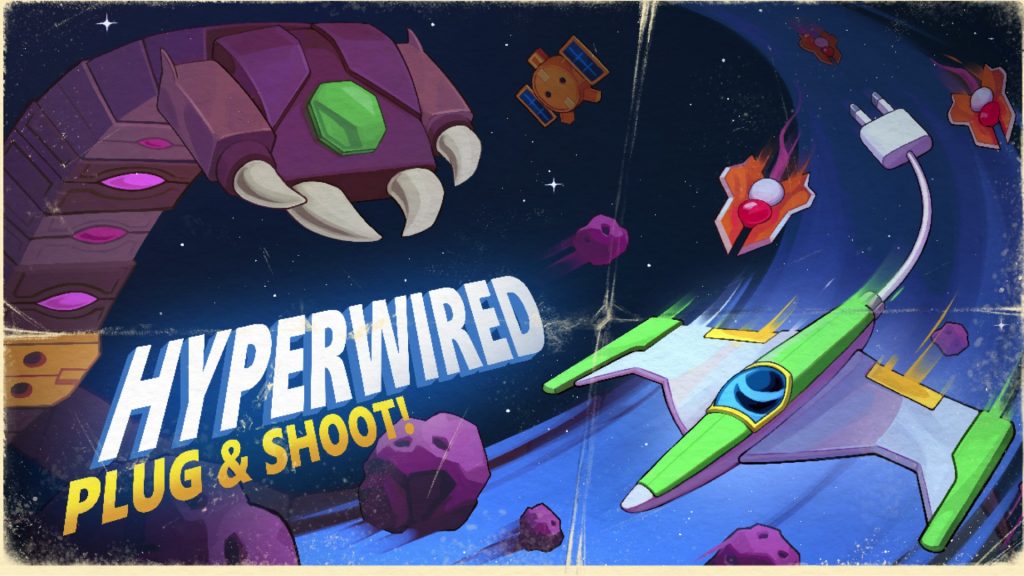
HYPERWIRED is a top-down roguelike where your ship drags a giant plug, powering sockets to complete objectives and progress through…
![[PREVIEW] 70s-style Robot Anime Geppy-X – This Game Pretends It’s a Real 1970s Anime](https://www.indie-games.eu/wp-content/uploads/2026/06/70s-Style-Robot-Anime-Geppy-X-Preview-1024x576.jpg)
As I continue my Steam Next Fest journey, I stumbled upon a game I honestly wasn't expecting to enjoy as…
![[PREVIEW] Edge of Memories – One of My Biggest Steam Next Fest Disappointments](https://www.indie-games.eu/wp-content/uploads/2026/06/Edge-of-Memories-Preview-1024x576.jpg)
Right now, Edge of Memories feels like a game with good ideas that hasn't yet figured out how to turn…
![[PREVIEW] Penguin Colony – Lovecraftian Horror Meets Antarctic Exploration](https://www.indie-games.eu/wp-content/uploads/2026/06/Penguin-Colony-5-1024x576.jpg)
It is surprisingly difficult to explain Penguin Colony, yet incredibly easy to become fascinated by.

Magical Princess is one of those games that immediately reminded me of the classic Princess Maker series, but it does…
![[PREVIEW] Mortal Shell II – Difficult, Fair, and Surprisingly Polished](https://www.indie-games.eu/wp-content/uploads/2026/06/Mortal-Shell-II-1-1-1024x576.jpg)
Mortal Shell II has opened its beta to everyone, and I have to admit, this is exactly how you showcase…
