![[GAMESCOM 2026] Wilderdark Preview – Ambitious Dinosaur Horror Game That Still Has Plenty to Prove](https://www.indie-games.eu/wp-content/uploads/2026/09/Wilderdark-1024x576.jpg)
[GAMESCOM 2026] Wilderdark Preview – Ambitious Dinosaur Horror Game That Still Has Plenty to Prove
Dinosaur survival horror game Wilderdark has one of those premises that immediately makes you wonder why more games have not…

If you enjoy independent indie game coverage, consider supporting Indie-Games.eu on Patreon. It helps keep the site independent.
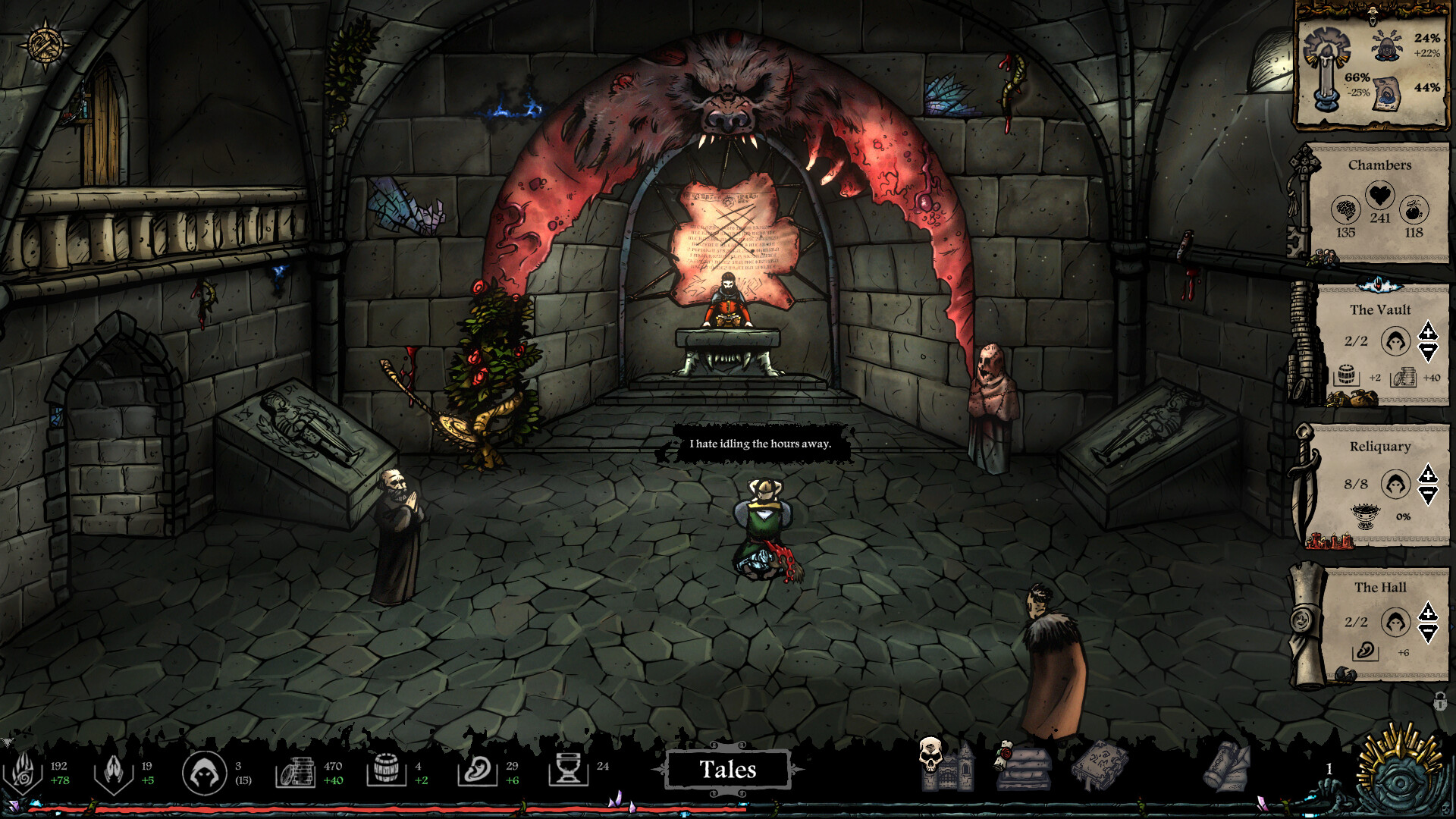
Whispers of the Eyeless emerges from the shadows with an intriguing premise: you control a secret cult in a dark fantasy world, wielding dangerous magic to awaken ancient gods. The game comes from Evil Gingerbread Studio, led by Venris (known for the Total War: Warhammer SFO: Grimhammer mod). It blends multiple gameplay styles: turn-based tactics, cult management, and roguelike elements. The developers drew inspiration from games like Darkest Dungeon, Loop Hero, and Children of Morta, as well as Polish folklore.
The game launched in Early Access following a hugely successful Kickstarter campaign (over 500% funded). While Whispers of the Eyeless already delivers a strong atmosphere and immense potential, it still feels unfinished, with some sections appearing raw or unclear. Personally, I enjoyed my first playthrough back in September last year, but I understand why it might not appeal to everyone. Nevertheless, it’s a game that will consume hours of your life.
Whispers of the Eyeless is built around three core gameplay pillars: dungeon exploration, world exploration, and cult management, with the roguelite Fate’s Mirror mode serving as the centerpiece of Early Access. You play as the First Prophet, infiltrating the districts of Aranthora to gather resources, recruit followers, and battle enemies while developing your secret cult temple.
The main gameplay loop involves exploring districts or dungeons and engaging in turn-based tactical battles. Enemies include corrupted guards and monsters, while your prophet can wield blessings (empowerments from dead gods) and equipment. Managing health, sanity, and zeal—a mechanic similar to morale for cultists—is crucial. Combat is tactical but straightforward: you select attacks, abilities, and blessings (presented as dice), then watch the battle play out automatically.
Early encounters are simple, for example, an axe can cause bleeding, and Wrath’s Fury boosts damage. Later fights demand better synergy between abilities and passive effects. The auto-battle option speeds up repetitive encounters, which is helpful since animations in standard mode can be slow. The influence of Darkest Dungeon is clear, particularly through the sanity system, where the prophet begins to falter if too much is lost.
However, combat isn’t always tactically satisfying. Luck plays too large a role: random blessings and enemy critical hits can abruptly shift a battle’s outcome, undermining strategic control. The demo promised “hundreds of abilities,” but even in the full Early Access version, the selection remains modest. Some abilities are significantly stronger than others, meaning balancing is still an issue. March updates added new enemies and modifiers, increasing variety, but the game has yet to become the “deeply strategic experience” it aims to be.

Between battles, players explore the districts of Aranthora using a point-and-click map. Each chosen path leads to different events—some provide loot, others trigger conflicts, and some allow you to recruit new followers. Your decisions shape the future of your cult: will you side with Wrath and choose violence, or align with Desire and use cunning? This “Choose Your Own Adventure” style adds a narrative layer, but events can become repetitive over time. Currently, the Early Access version has districts that look and function too similarly, lacking enough variety in events. Still, the different paths suggest the game could gain depth as it develops further.
In your sanctuary, you take control of cult operations, managing resources such as gold, influence, and materials while overseeing your followers. Here, you build altars, upgrade structures, and perform dark rituals to appease the gods. This system stands out as one of the game’s most original aspects, requiring careful balancing of cult zeal to prevent betrayal, assigning acolytes to missions like sabotage or espionage, and deciding which deities to favor for blessings.
The sanctuary evolves gradually, introducing new mechanics over time to ease players into the complexity. However, the initial experience can be overwhelming, as the interface is packed with menus and key elements—like ritual costs or acolyte traits—aren’t always clearly explained, forcing a trial-and-error learning approach. Yet once everything clicks, managing your own cult becomes highly enjoyable. The game captures the intrigue of Cultist Simulator but approaches cult leadership with a darker, more hands-on style.

Additionally, items such as rusty axes, crimson robes, or pendants modify stats like health, damage, sanity resistance, or provide passive bonuses. Gear is ranked from common to rare, with higher ranks requiring sanctuary upgrades. In Fate’s Mirror, you can’t fully reshape your prophet in a single run, but the persistent sanctuary allows gradual improvement over multiple attempts. It’s not loot on the scale of Diablo—variety is limited, and RNG-based gear drops can be frustrating, but the system still offers some degree of customization.
The Early Access version is primarily focused on Fate’s Mirror, a roguelite mode where each run is procedurally generated. You can unlock special modifiers (shards) that alter gameplay, such as stronger attacks or risky health penalties. While designed for replayability with different strategies, it currently feels limited. Individual runs last only a few hours, and there isn’t enough content yet to sustain long-term engagement.
For now, this mode feels more like a mechanics test than a full-fledged experience. The full story campaign won’t arrive until the official 1.0 release, and while the core gameplay shows potential, it still requires refinement. Battles need more polish and variety, exploration feels sparse, and cult management is alternately intriguing and frustrating. The foundation is solid, but the execution hasn’t yet reached its full potential.

This year has brought us many visually striking games, and Whispers of the Eyeless is one of them. The game uses beautifully hand-drawn 2D art in a style reminiscent of Darkest Dungeon, rough ink strokes, dark colors, and eerie monster designs give it a comic book feel. The various regions of Aranthor are visually distinct, ranging from grimy back alleys to mysterious cult hideouts. Enemies are genuinely intimidating, whether they are fanatics or spirits. While the animations are simple, they work well; battles are accompanied by satisfying blood splashes and glittering holy powers.
Perhaps the best visual details are offered by your cult’s altars, each representing one of the dead gods. They are full of character: Wrath’s altar looks like a sharp, dangerous throne, while Desire’s features smooth, alluring shapes. The music is minimalist but powerful—deep tones, mournful violins, and haunting chants create perfect tension. Combat sounds, from clashing swords to whispered spells, are sharp and clear. The game fully delivers its dark fantasy atmosphere. Every scene feels like a carefully painted gothic artwork.
In the end, Whispers of the Eyeless shows tremendous potential but isn’t fully complete yet. It combines Darkest Dungeon-style tense combat with deep cult management in a beautifully dark world. While the style and concept are fantastic, the Early Access version still needs refinement. If you enjoy challenging strategy games and don’t mind waiting for improvements, it’s worth trying now. Casual players might want to wait for the full 2026 release. The development team has created something unique, and with extra time and polish, this could become an outstanding game. It’s definitely worth keeping an eye on.
| Pros | Cons |
|---|---|
| Beautiful comic-style graphics. | Combat still needs improvement. |
| Cult management gameplay. | Takes time to understand the mechanics. |
| Good roguelite mode. | Too little new content. |
| Atmospheric world. | Story is lost very quickly. |
Review copy provided by the publisher
Dinosaur survival horror game Wilderdark has one of those premises that immediately makes you wonder why more games have not…
![[PREVIEW] Tiny Metal 2 – Strategy Game That Wants You to Learn From Every Mistake](https://www.indie-games.eu/wp-content/uploads/2026/09/Tiny-Metal-2-1024x576.jpg)
I rarely enjoy discovering that my opening strategy was completely wrong, but Tiny Metal 2 made that process one of…
![[PREVIEW] Remothered: Red Nun’s Legacy – Ambitious Survival Horror That Needs More Polish](https://www.indie-games.eu/wp-content/uploads/2026/09/Remothered-Red-Nuns-Legacy-4-1024x576.jpg)
Remothered: Red Nun’s Legacy has a gripping atmosphere and promising survival tools, but its repetitive hiding and rough visuals need…
The Alighieri Circle: Dante’s Bloodline is difficult to recommend beyond players who are especially interested in Dante or enjoy solving…
Orc Incremental offers satisfying progression, entertaining totem combinations and enough content to justify its affordable price.
![[GAMESCOM 2026] Chronoscript: The Endless End Preview – Beautiful Pages Hide Deliberate Combat](https://www.indie-games.eu/wp-content/uploads/2026/09/Chronoscript-The-Endless-End-1-1024x576.jpg)
Chronoscript: The Endless End stands out from other Metroidvanias by blending 2D manuscript worlds with exploration inside a 3D manor.
![[GAMESCOM 2026] MegaGum Preview – Combat Hits Hard in This Sticky Platforming Adventure](https://www.indie-games.eu/wp-content/uploads/2026/09/MegaGum-09-09-26-5-1024x576.jpg)
MegaGum combines hard-hitting combat, varied weapons and Gum-powered platforming in a promising Gamescom 2026 demo.
![[GAMESCOM 2026] Delphinium Preview – Cozy Routine Mixed With Enjoyable Minigames](https://www.indie-games.eu/wp-content/uploads/2026/03/Delphinium--1024x665.jpg)
Delphinium mixes cozy farming, exploration and relationships with enjoyable fishing, cooking and forging minigames in its Gamescom 2026 demo.
Lady Death: Demonicron looks the part, but underneath its excellent comic-book exterior is a clunky and painfully short brawler.
![[GAMESCOM 2026] Tomb Raider: Legacy of Atlantis Preview – Expands the Original Without Losing Its Identity](https://www.indie-games.eu/wp-content/uploads/2026/09/tomb-raider-legacy-of-atlantis-06-02-26-1-1024x576.jpg)
Tomb Raider: Legacy of Atlantis brings Lara back to her roots, but its Gamescom 2026 showing proved this is far…
![[GAMESCOM 2026] Clive Barker’s Hellraiser: Revival Preview – Ready to Open the Box](https://www.indie-games.eu/wp-content/uploads/2026/09/Clive-Barkers-Hellraiser-Revival-08-30-26-1-1024x576.jpg)
Hellraiser: Revival preserves the franchise’s sex, gore and psychological horror while delivering approachable survival-horror gameplay.

Swan Song creates a peaceful and forgiving puzzle space without removing the challenge that makes solving a difficult puzzle rewarding.
Mortal Shell II starts brilliantly but grows repetitive and exhausting, while remaining a rewarding and ambitious Soulslike sequel.
![[GAMESCOM 2026] Terranigma Preview – A Lost SNES Classic Returns in 2027](https://www.indie-games.eu/wp-content/uploads/2026/08/Terranigma-1-1024x576.jpg)
After more than three decades of limited availability, Terranigma is returning in 2027. We played its enhanced re-release at Gamescom…

Reading another person’s mind is often presented as a desirable superpower, but Sister Other Paranoia immediately understands why it could…
Forsaken Realms: Vahrin’s Call is exactly the kind of ambitious, slightly clumsy fantasy RPG that used to be far more…
![[Early Access] 2nd EVE – Sci-Fi Action RPG That Lacks a Sense of Stakes](https://www.indie-games.eu/wp-content/uploads/2026/08/2ND-EVE-1024x576.jpg)
2nd Eve is a space-set action RPG in which we strive to save humanity.
![[PREVIEW] Dreamcards – Strategic Exploration of Consciousness](https://www.indie-games.eu/wp-content/uploads/2026/08/Dreamcards_20260810_233631_0000-1024x576.jpg)
Dreamcards is a roguelike deckbuilder centered around dreams and nightmares.
![[Early Access] OFFBEAT – Incredibly Fun Way to Start a Music Career](https://www.indie-games.eu/wp-content/uploads/2026/08/Offbeat_20260808_201446_0000-1024x576.jpg)
In OFFBEAT, we play the role of a jobbing composer who is launching their music career.
HellSlave II retains the original’s oppressive atmosphere, morally grey world and striking art while adding a larger world, randomized loot…
