Golden Swirl – Brilliant Deckbuilding Buried Under Endless Dialogue
Golden Swirl inventive card combat carries the experience, but repetitive rooms, weak upgrades and excessive dialogue hold it back.

If you enjoy independent indie game coverage, consider supporting Indie-Games.eu on Patreon. It helps keep the site independent.
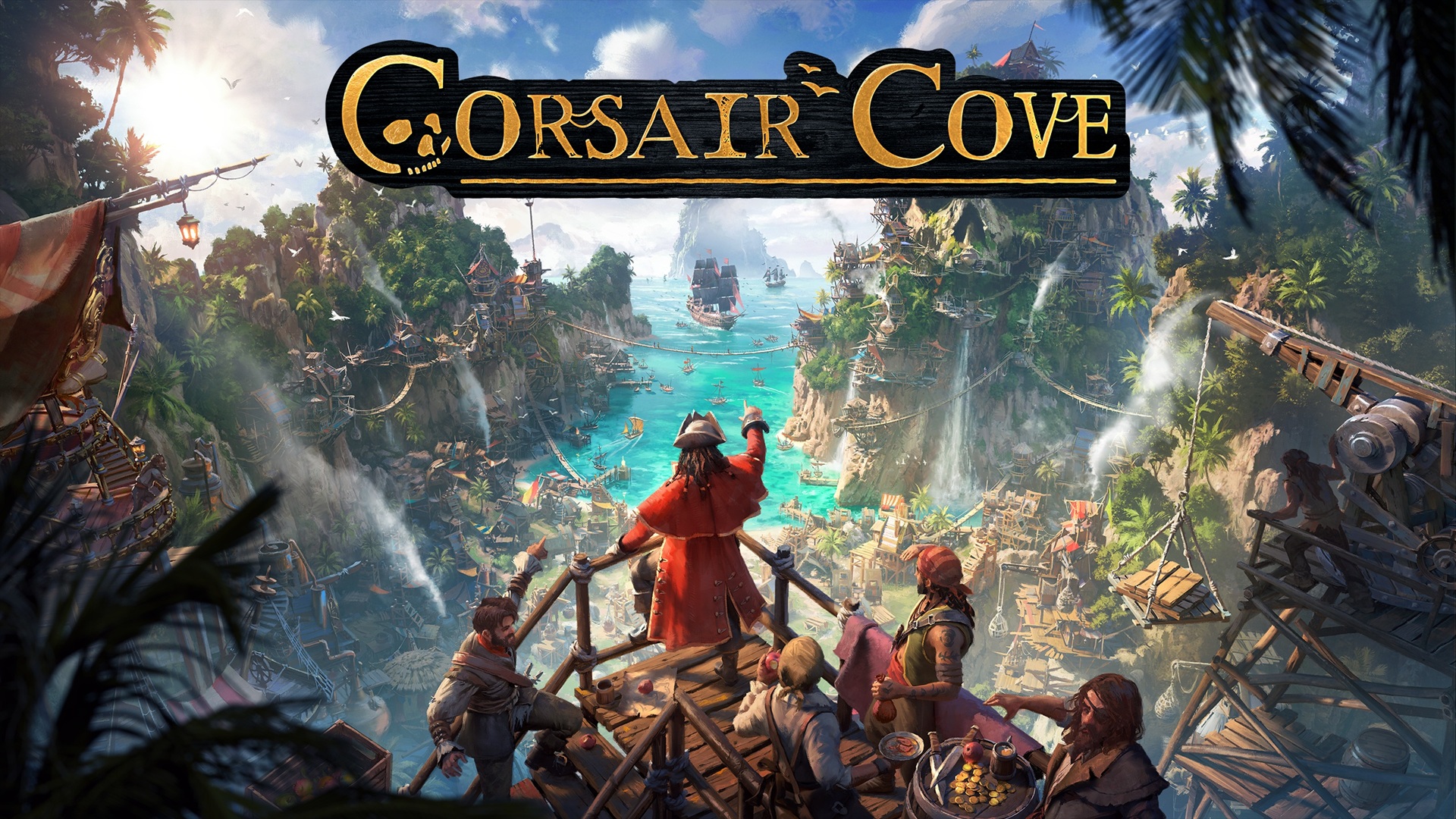
Hooded Horse has become remarkably consistent at finding strategy and management games that understand their audience, so it should no longer be surprising when another excellent city-builder appears in its publishing lineup and Corsair Cove continues that streak.
It is polished, accessible and possibly the best pirate management game currently available, offering an enjoyable experience whether you are approaching the genre for the first time or already understand the pain of watching an entire economy collapse because one warehouse is in the wrong place.
It is not a perfect voyage, however. Corsair Cove begins brilliantly, loses some of its momentum beneath a mountain of mid-game bottlenecks and repetitive events, and then recovers once its late-game systems open up. The complete journey is still worth taking, but progression is not balanced as smoothly as it should be.
Corsair Cove starts with a shipwrecked crew and a mostly empty island. From there, you construct housing, gather wood and stone, produce food and booze, and gradually transform a basic camp into a chaotic pirate haven. The early game is exceptionally enjoyable because everything moves at a satisfying pace. New mechanics arrive regularly, production remains understandable, and reaching tier-two ships feels like a natural reward for everything you have built.
The defining feature is vertical construction. Flat land is limited, but buildings can cling to cliffs and occupy narrow ledges. Bridges, ladders, elevators and zip lines connect settlements that look as if they were assembled by pirates with no concern for conventional city planning. This freedom gives each island tremendous personality and makes expansion more interesting than simply filling another square grid.
Production routes are equally important. Resources must travel between gathering buildings, workshops, warehouses and distribution points, with distance determining how efficient every connection is. At first, this creates an enjoyable logistical puzzle. You can watch workers carry goods across bridges and diagnose inefficient routes before they become serious problems.
It also helps that Corsair Cove looks wonderful. Its colorful pirate aesthetic, detailed buildings, lively animations and attractive tropical environments make every growing settlement enjoyable to observe. I encountered no major lag or frame-rate drops during my playthrough, and the game generally feels impressively polished.
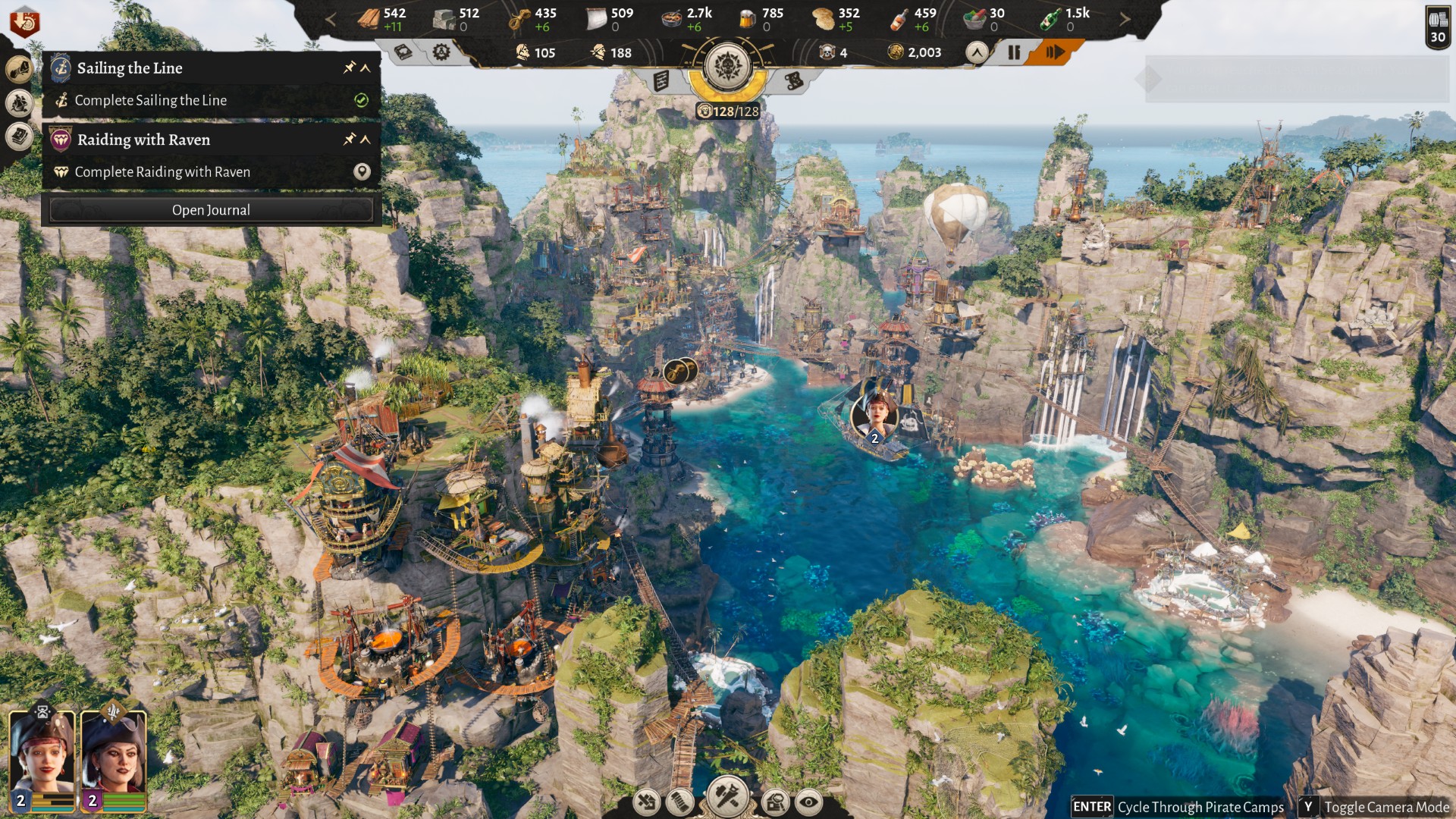
Unfortunately, the mid-game is where that wonderful rhythm begins to break down. Production chains grow more complicated, higher-tier pirates demand additional goods, and new ships require specialized crews. One resource may be located on the opposite side of the island from the workshop that needs it, forcing workers through a long and inefficient network of paths.
Complexity itself is not the problem. This is a management game, after all, and maintaining an expanding economy should require effort. The frustration comes from how poorly some bottlenecks are communicated and how few convenient tools you initially have to correct them. Expanding into another part of the island can disrupt a previously stable economy, while one missing resource can quietly damage several connected industries.
Planning from the beginning sounds like the obvious solution, but it is difficult when you do not yet know which buildings, resources and routes later tiers will require. Most first-time players will place whatever they currently need wherever it fits. By the late game, that organic settlement can become an overwhelming mass of buildings, pathways and production links. Instead of designing an attractive pirate city, you sometimes construct things simply because progression requires them.
This issue is tied to the Technology Compass. Corsair Cove divides progression across Wealth, Empire, Seafaring and Notoriety, with points earned by completing Deeds. Some encourage sensible development, such as improving production or creating efficient routes. Others become trivial checklists that ask you to construct unnecessary buildings or repeat activities solely to obtain another unlock.
Pirates are not only workers but also the crews required to operate your ships, meaning every expedition can pull valuable people away from production. New pirates are largely obtained through events and exploration rather than dependable passive growth, which further explains why sailing around the map eventually feels mandatory instead of optional.
Your settlement supports a growing fleet that explores the map, raids valuable locations, recruits pirates and fights the Crown. These expeditions are essential because certain resources cannot be produced at home. They also give the city-building a broader purpose: your economy builds better ships, while successful voyages return with materials needed to expand that economy.
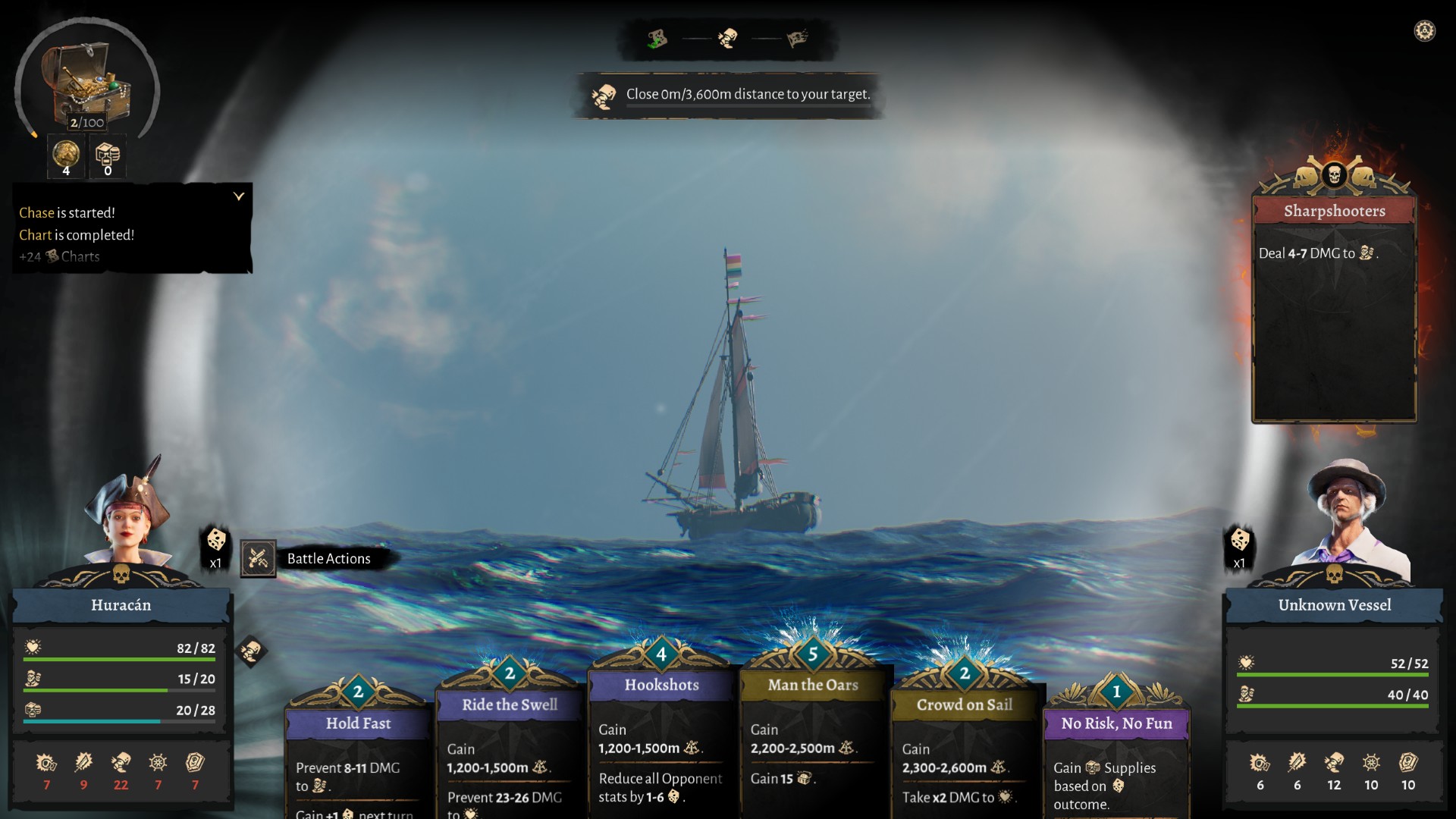
Encounters use a turn-based card-and-dice system. Cards represent actions determined by the objective, ship and captain, while dice modify their effectiveness. You might damage an enemy vessel, protect your crew, gain distance during a chase or search for clues. Health, crew and supplies must all be preserved, giving each encounter an element of resource management.
It works well initially, but the illusion of variety fades. A chase, escape or stealth mission may use different language while asking you to perform essentially the same actions. Dice rolls can also exert too much influence, making some difficult events feel dependent on luck even when you arrive with an appropriate ship.
This becomes particularly frustrating because exploration is tied directly to progression. When the next unlock requires more Deeds, you can spend long stretches sailing between events instead of developing the city. Corsair Cove repeatedly follows the same uneven rhythm: satisfying development, a progression bottleneck, several repetitive events, and then another burst of new buildings and ships.
Additionally, choosing the correct captain and vessel matters because ships specialize in gun damage, boarding, speed, maneuverability and armour, but even good preparation can be undermined by an unfortunate sequence of dice rolls.
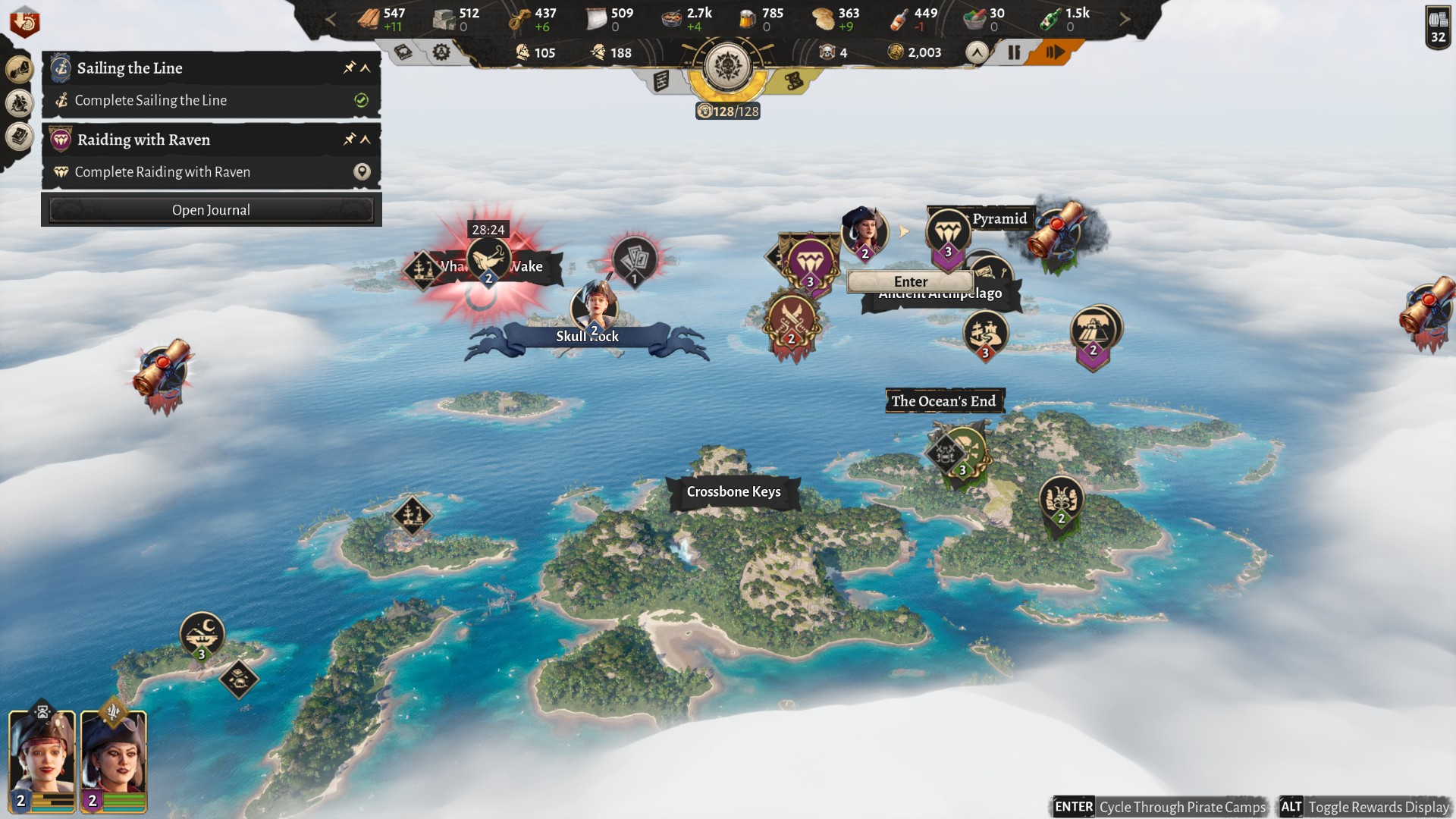
The late game becomes enjoyable again once advanced transportation, production options, elite crews and powerful ships are available. Managing the resulting pirate empire can be satisfying, and Corsair Cove offers an impressive amount of content for its price. There are numerous production chains, three islands, two modes, multiple ship classes and enough progression to support a substantial campaign.
Unfortunately, the larger your haven becomes, the harder it is to read. Routes overlap, buildings obscure one another and correcting an early layout can demand extensive reconstruction. The game gives you plenty to build but does not always make managing that scale as convenient as it should be.
Corsair Cove nevertheless remains a very good city-builder and an easy recommendation for fans of management games. Its vertical settlements are distinctive, its pirate atmosphere is excellent and its opening hours are among the most immediately enjoyable I have experienced in the genre.
Better progression balance and stronger logistical tools could have made it exceptional. Even with those frustrations, however, this is a polished, generous pirate adventure that is absolutely worth its asking price. Your first haven may be a logistical disaster, but the lessons learned make the prospect of starting another one surprisingly tempting.
Corsair Cove is a polished, distinctive and highly enjoyable pirate city-builder that offers one of the strongest management experiences currently available within its theme. Its vertical settlements, interconnected economy, fleet progression and excellent atmosphere make building a pirate haven consistently rewarding. Its greatest weakness is progression balance. The opening is excellent, the middle becomes weighed down by logistical bottlenecks and repetitive expeditions, and the late game only regains momentum once stronger transportation and production systems become available.
Ending Thoughts
This review is based on the Game Pass version of the game
Golden Swirl inventive card combat carries the experience, but repetitive rooms, weak upgrades and excessive dialogue hold it back.
![[GAMESCOM 2026] Wilderdark Preview – Ambitious Dinosaur Horror Game That Still Has Plenty to Prove](https://www.indie-games.eu/wp-content/uploads/2026/09/Wilderdark-1024x576.jpg)
Dinosaur survival horror game Wilderdark has one of those premises that immediately makes you wonder why more games have not…
![[PREVIEW] Tiny Metal 2 – Strategy Game That Wants You to Learn From Every Mistake](https://www.indie-games.eu/wp-content/uploads/2026/09/Tiny-Metal-2-1024x576.jpg)
I rarely enjoy discovering that my opening strategy was completely wrong, but Tiny Metal 2 made that process one of…
![[PREVIEW] Remothered: Red Nun’s Legacy – Ambitious Survival Horror That Needs More Polish](https://www.indie-games.eu/wp-content/uploads/2026/09/Remothered-Red-Nuns-Legacy-4-1024x576.jpg)
Remothered: Red Nun’s Legacy has a gripping atmosphere and promising survival tools, but its repetitive hiding and rough visuals need…
The Alighieri Circle: Dante’s Bloodline is difficult to recommend beyond players who are especially interested in Dante or enjoy solving…
Orc Incremental offers satisfying progression, entertaining totem combinations and enough content to justify its affordable price.
![[GAMESCOM 2026] Chronoscript: The Endless End Preview – Beautiful Pages Hide Deliberate Combat](https://www.indie-games.eu/wp-content/uploads/2026/09/Chronoscript-The-Endless-End-1-1024x576.jpg)
Chronoscript: The Endless End stands out from other Metroidvanias by blending 2D manuscript worlds with exploration inside a 3D manor.
![[GAMESCOM 2026] MegaGum Preview – Combat Hits Hard in This Sticky Platforming Adventure](https://www.indie-games.eu/wp-content/uploads/2026/09/MegaGum-09-09-26-5-1024x576.jpg)
MegaGum combines hard-hitting combat, varied weapons and Gum-powered platforming in a promising Gamescom 2026 demo.
![[GAMESCOM 2026] Delphinium Preview – Cozy Routine Mixed With Enjoyable Minigames](https://www.indie-games.eu/wp-content/uploads/2026/03/Delphinium--1024x665.jpg)
Delphinium mixes cozy farming, exploration and relationships with enjoyable fishing, cooking and forging minigames in its Gamescom 2026 demo.
Lady Death: Demonicron looks the part, but underneath its excellent comic-book exterior is a clunky and painfully short brawler.
![[GAMESCOM 2026] Tomb Raider: Legacy of Atlantis Preview – Expands the Original Without Losing Its Identity](https://www.indie-games.eu/wp-content/uploads/2026/09/tomb-raider-legacy-of-atlantis-06-02-26-1-1024x576.jpg)
Tomb Raider: Legacy of Atlantis brings Lara back to her roots, but its Gamescom 2026 showing proved this is far…
![[GAMESCOM 2026] Clive Barker’s Hellraiser: Revival Preview – Ready to Open the Box](https://www.indie-games.eu/wp-content/uploads/2026/09/Clive-Barkers-Hellraiser-Revival-08-30-26-1-1024x576.jpg)
Hellraiser: Revival preserves the franchise’s sex, gore and psychological horror while delivering approachable survival-horror gameplay.

Swan Song creates a peaceful and forgiving puzzle space without removing the challenge that makes solving a difficult puzzle rewarding.
Mortal Shell II starts brilliantly but grows repetitive and exhausting, while remaining a rewarding and ambitious Soulslike sequel.
![[GAMESCOM 2026] Terranigma Preview – A Lost SNES Classic Returns in 2027](https://www.indie-games.eu/wp-content/uploads/2026/08/Terranigma-1-1024x576.jpg)
After more than three decades of limited availability, Terranigma is returning in 2027. We played its enhanced re-release at Gamescom…

Reading another person’s mind is often presented as a desirable superpower, but Sister Other Paranoia immediately understands why it could…
Forsaken Realms: Vahrin’s Call is exactly the kind of ambitious, slightly clumsy fantasy RPG that used to be far more…
![[Early Access] 2nd EVE – Sci-Fi Action RPG That Lacks a Sense of Stakes](https://www.indie-games.eu/wp-content/uploads/2026/08/2ND-EVE-1024x576.jpg)
2nd Eve is a space-set action RPG in which we strive to save humanity.
![[PREVIEW] Dreamcards – Strategic Exploration of Consciousness](https://www.indie-games.eu/wp-content/uploads/2026/08/Dreamcards_20260810_233631_0000-1024x576.jpg)
Dreamcards is a roguelike deckbuilder centered around dreams and nightmares.
![[Early Access] OFFBEAT – Incredibly Fun Way to Start a Music Career](https://www.indie-games.eu/wp-content/uploads/2026/08/Offbeat_20260808_201446_0000-1024x576.jpg)
In OFFBEAT, we play the role of a jobbing composer who is launching their music career.
