Golden Swirl – Brilliant Deckbuilding Buried Under Endless Dialogue
Golden Swirl inventive card combat carries the experience, but repetitive rooms, weak upgrades and excessive dialogue hold it back.

If you enjoy independent indie game coverage, consider supporting Indie-Games.eu on Patreon. It helps keep the site independent.
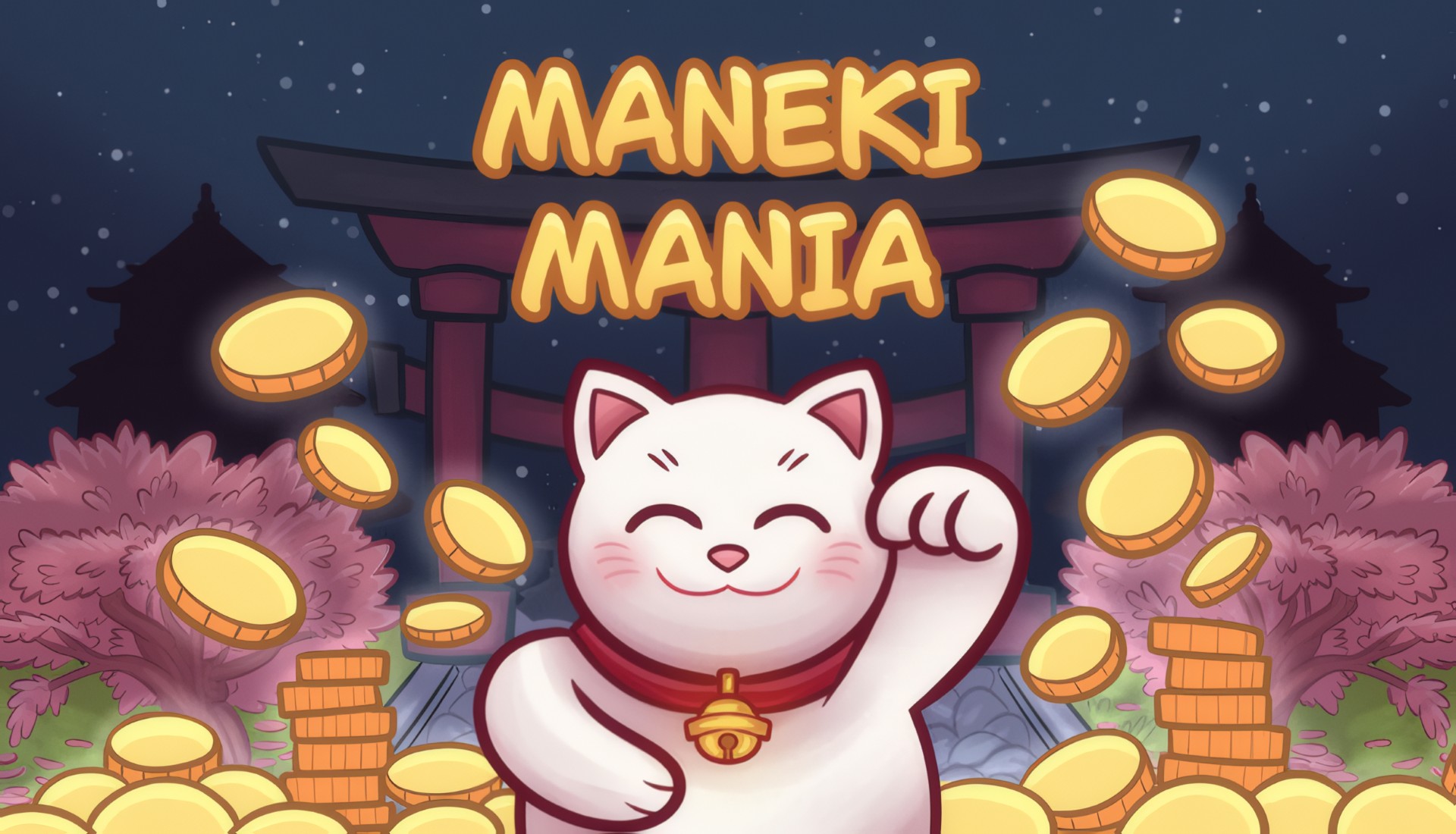
You don’t have to travel to Japan to recognize figurines of a cat with a paw raised in a beckoning gesture or moving back and forth. Maneki-neko, which are sometimes also called “lucky cats” or “calling cats,” are believed to bring good luck to their owners, including financial gain and business prosperity. It was this belief that inspired Maneki Mania, a charming incremental game that combines Japanese aesthetics with casino mechanics and the very important task of petting a cat.
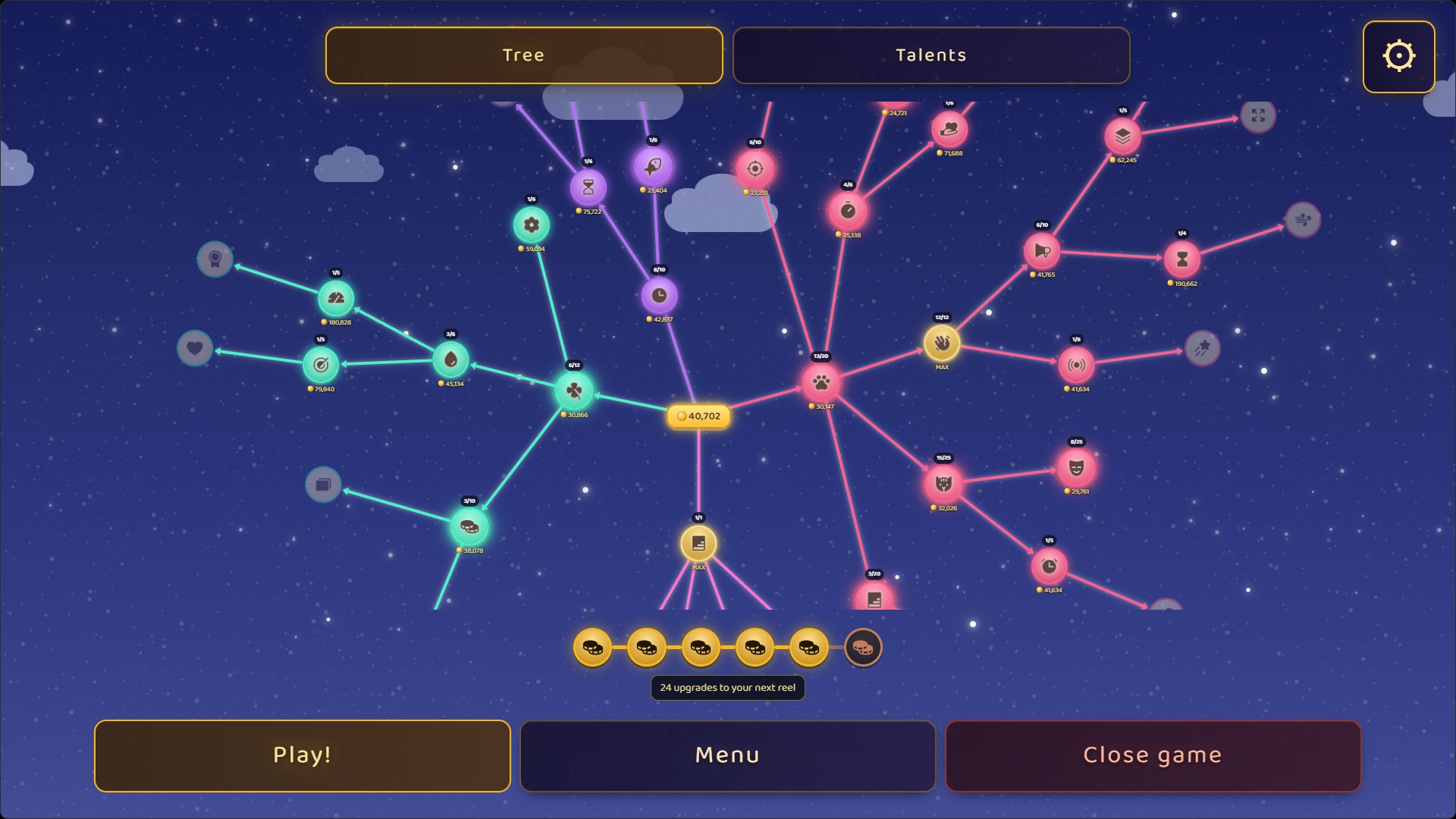
Maneki Mania is a game in which the players’ goal is to earn more and more koban with each round. To make this happen, we need to click on the lucky cat during the short rounds to collect coins and fill up the fortune meter, which lets us try our luck at the slot machine. After each round, we have the option to switch to the 95-node upgrade tree and use our earnings to unlock bonuses that speed up and increase wealth accumulation. We also benefit from the talents we gain by spinning the Wheel of Fortune and raising our shrine ranks.
From the very beginning, it’s clear that this is a typical clicker game, drawing heavily on well-known mechanics such as manual tapping, idle generators, currency accumulation, and exponential scaling. In this context, fans of this type of game won’t find anything revolutionary in Maneki Mania, but that doesn’t mean it doesn’t try to bring something interesting to the gameplay.
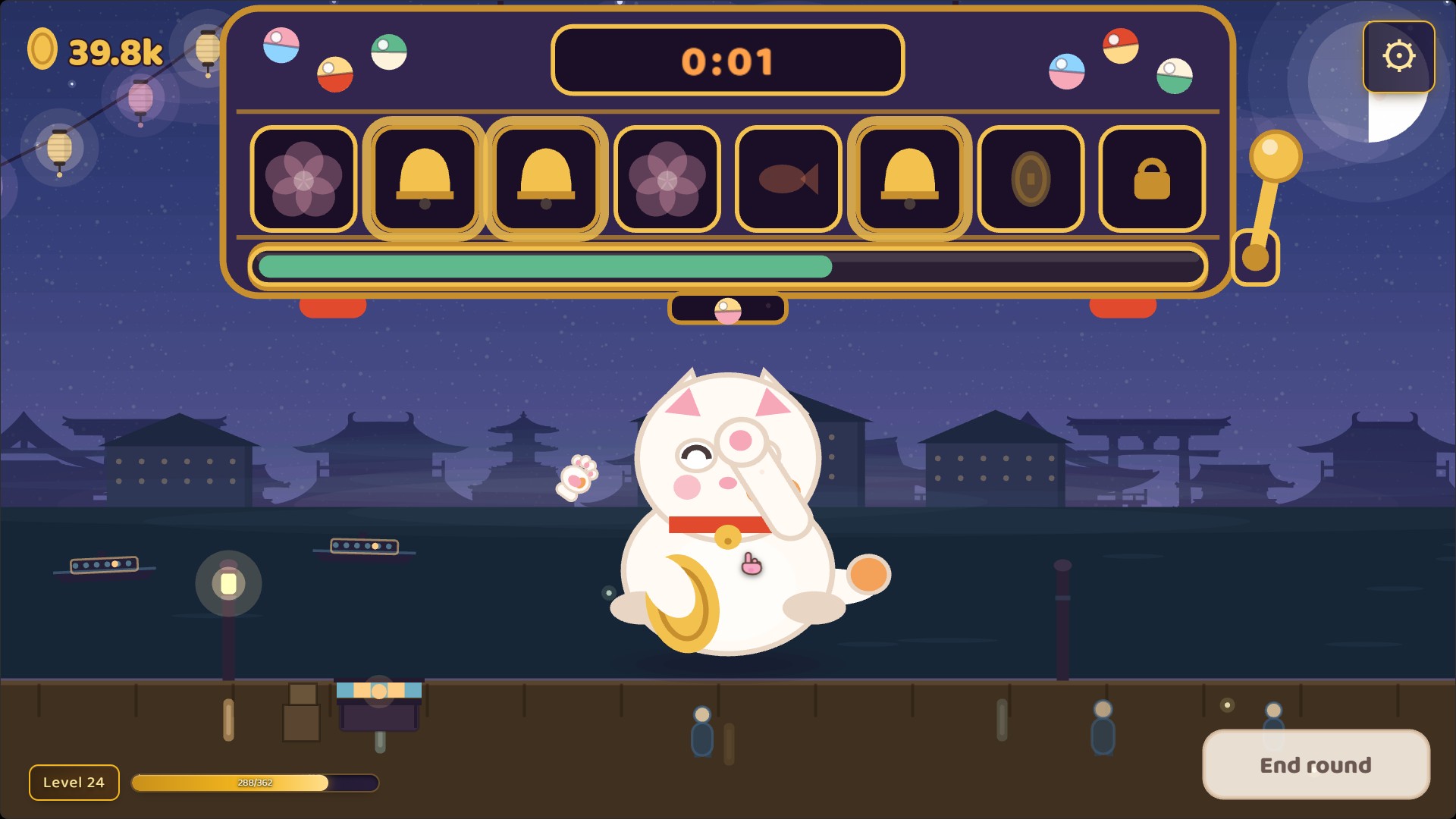
The most obvious example is the addition of a slot machine to the game, which seamlessly combines the incremental accumulation of in-game resources with a casino simulation. What’s more, during rounds that last several dozen seconds, we switch between different locations, where background elements such as a full moon, swimming carp, or lit lanterns can also add koban to our total upon interaction. This means players don’t have to constantly focus on just two elements, so they can also look for surprises in their surroundings.
While the game fosters engagement and the desire to achieve more and more, it’s worth noting that it doesn’t use dark patterns to keep players hooked. All upgrades can only be purchased with in-game currency; there are no streaks or rewards based on logging in regularly, nor is there any burdensome grinding. The slot machine mechanics and the need to earn upgrades are designed in such a way that the player doesn’t feel pressured to progress, but rather takes a casual approach to earning new ranks.
In addition to the gameplay, the cozy feel of the Maneki Mania is also evident in its presentation. The minimalist design is complemented by the use of different color palettes and lighting for each scene. The cute cat figurine itself is also a reason why you’ll want to come back for more.
The casual fun of Maneki Mania is evident from the start, but after a while, the gameplay falls into a rut of monotony and tedium. This is due in part to the repetitive nature of the environments and background music, as well as the lack of any creativity when advancing to higher levels. Players can only look forward to unlocking new upgrades, but their enthusiasm for doing so wanes when they realize that this doesn’t introduce anything new to the gameplay loop.
The whole game also seems to be designed more for a short play session: I managed to unlock all the slots in the machine after exactly 100 minutes of play, which would likely be possible in even less time. At this point, for those who want to be completionists, there is still the entire upgrade tree to unlock; however, the motivation to do so diminishes due to the predictability of the rest of the experience.
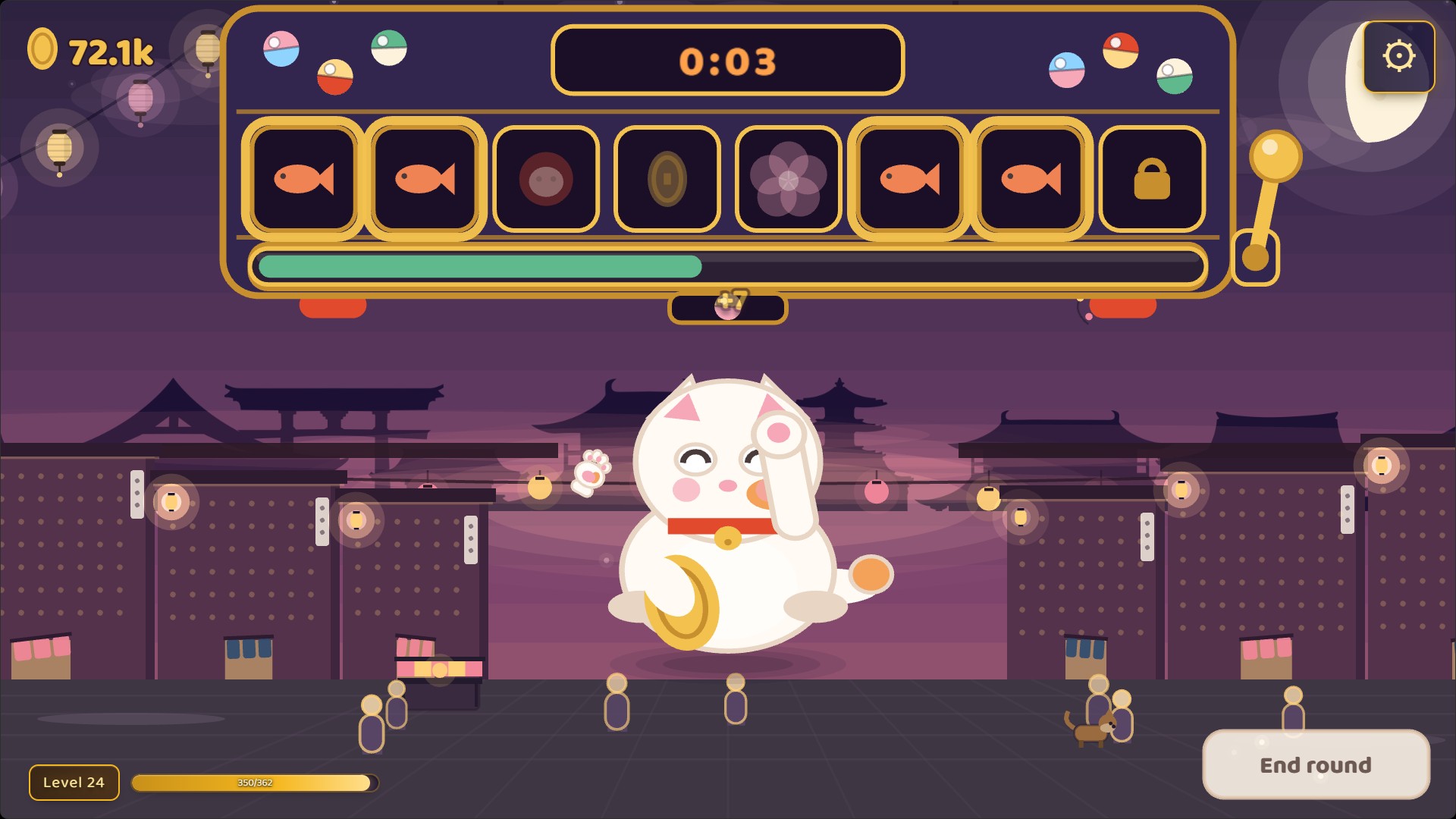
Maneki Mania proves that it can create a blend of mechanics that appeal not only to seasoned incremental game players but also to fans of cozy titles. The repetitive gameplay typical of this genre – here wrapped in a unique and adorable package – encourages steady progress and the desire to earn upgrades, but after a while it gets boring due to the lack of variety.
However, there’s one thing that needs to be emphasized in this review: I’m talking about a game whose demo is scheduled for October and whose full release is set for December. There’s still quite a bit of time before this game will be available for the general public to try out – that’s why I’m sharing my impressions of the version I received in late July in this article, and I don’t deny that the final version of the game may be completely different. To find out for sure, however, we’ll have to wait until premiere.
Maneki Mania is a charming and relaxing incremental game that successfully combines cozy Japanese imagery with light casino mechanics. Its cute presentation, straightforward progression and refusal to use aggressive retention systems make it easy to enjoy during short sessions. The problem is that its strongest ideas reveal themselves very quickly. Once the slot machine has been expanded and the initial upgrades have been unlocked, the gameplay offers few meaningful changes. Additional scenes, events and upgrade effects would give players a stronger reason to continue pursuing the complete skill tree.
Ending Thoughts
Review copy provided by the publisher
Golden Swirl inventive card combat carries the experience, but repetitive rooms, weak upgrades and excessive dialogue hold it back.
![[GAMESCOM 2026] Wilderdark Preview – Ambitious Dinosaur Horror Game That Still Has Plenty to Prove](https://www.indie-games.eu/wp-content/uploads/2026/09/Wilderdark-1024x576.jpg)
Dinosaur survival horror game Wilderdark has one of those premises that immediately makes you wonder why more games have not…
![[PREVIEW] Tiny Metal 2 – Strategy Game That Wants You to Learn From Every Mistake](https://www.indie-games.eu/wp-content/uploads/2026/09/Tiny-Metal-2-1024x576.jpg)
I rarely enjoy discovering that my opening strategy was completely wrong, but Tiny Metal 2 made that process one of…
![[PREVIEW] Remothered: Red Nun’s Legacy – Ambitious Survival Horror That Needs More Polish](https://www.indie-games.eu/wp-content/uploads/2026/09/Remothered-Red-Nuns-Legacy-4-1024x576.jpg)
Remothered: Red Nun’s Legacy has a gripping atmosphere and promising survival tools, but its repetitive hiding and rough visuals need…
The Alighieri Circle: Dante’s Bloodline is difficult to recommend beyond players who are especially interested in Dante or enjoy solving…

Orc Incremental offers satisfying progression, entertaining totem combinations and enough content to justify its affordable price.
![[GAMESCOM 2026] Chronoscript: The Endless End Preview – Beautiful Pages Hide Deliberate Combat](https://www.indie-games.eu/wp-content/uploads/2026/09/Chronoscript-The-Endless-End-1-1024x576.jpg)
Chronoscript: The Endless End stands out from other Metroidvanias by blending 2D manuscript worlds with exploration inside a 3D manor.
![[GAMESCOM 2026] MegaGum Preview – Combat Hits Hard in This Sticky Platforming Adventure](https://www.indie-games.eu/wp-content/uploads/2026/09/MegaGum-09-09-26-5-1024x576.jpg)
MegaGum combines hard-hitting combat, varied weapons and Gum-powered platforming in a promising Gamescom 2026 demo.
![[GAMESCOM 2026] Delphinium Preview – Cozy Routine Mixed With Enjoyable Minigames](https://www.indie-games.eu/wp-content/uploads/2026/03/Delphinium--1024x665.jpg)
Delphinium mixes cozy farming, exploration and relationships with enjoyable fishing, cooking and forging minigames in its Gamescom 2026 demo.
Lady Death: Demonicron looks the part, but underneath its excellent comic-book exterior is a clunky and painfully short brawler.
![[GAMESCOM 2026] Tomb Raider: Legacy of Atlantis Preview – Expands the Original Without Losing Its Identity](https://www.indie-games.eu/wp-content/uploads/2026/09/tomb-raider-legacy-of-atlantis-06-02-26-1-1024x576.jpg)
Tomb Raider: Legacy of Atlantis brings Lara back to her roots, but its Gamescom 2026 showing proved this is far…
![[GAMESCOM 2026] Clive Barker’s Hellraiser: Revival Preview – Ready to Open the Box](https://www.indie-games.eu/wp-content/uploads/2026/09/Clive-Barkers-Hellraiser-Revival-08-30-26-1-1024x576.jpg)
Hellraiser: Revival preserves the franchise’s sex, gore and psychological horror while delivering approachable survival-horror gameplay.

Swan Song creates a peaceful and forgiving puzzle space without removing the challenge that makes solving a difficult puzzle rewarding.
Mortal Shell II starts brilliantly but grows repetitive and exhausting, while remaining a rewarding and ambitious Soulslike sequel.
![[GAMESCOM 2026] Terranigma Preview – A Lost SNES Classic Returns in 2027](https://www.indie-games.eu/wp-content/uploads/2026/08/Terranigma-1-1024x576.jpg)
After more than three decades of limited availability, Terranigma is returning in 2027. We played its enhanced re-release at Gamescom…

Reading another person’s mind is often presented as a desirable superpower, but Sister Other Paranoia immediately understands why it could…
Forsaken Realms: Vahrin’s Call is exactly the kind of ambitious, slightly clumsy fantasy RPG that used to be far more…
![[Early Access] 2nd EVE – Sci-Fi Action RPG That Lacks a Sense of Stakes](https://www.indie-games.eu/wp-content/uploads/2026/08/2ND-EVE-1024x576.jpg)
2nd Eve is a space-set action RPG in which we strive to save humanity.
![[PREVIEW] Dreamcards – Strategic Exploration of Consciousness](https://www.indie-games.eu/wp-content/uploads/2026/08/Dreamcards_20260810_233631_0000-1024x576.jpg)
Dreamcards is a roguelike deckbuilder centered around dreams and nightmares.
![[Early Access] OFFBEAT – Incredibly Fun Way to Start a Music Career](https://www.indie-games.eu/wp-content/uploads/2026/08/Offbeat_20260808_201446_0000-1024x576.jpg)
In OFFBEAT, we play the role of a jobbing composer who is launching their music career.
