
If you enjoy independent indie game coverage, consider supporting Indie-Games.eu on Patreon. It helps keep the site independent.
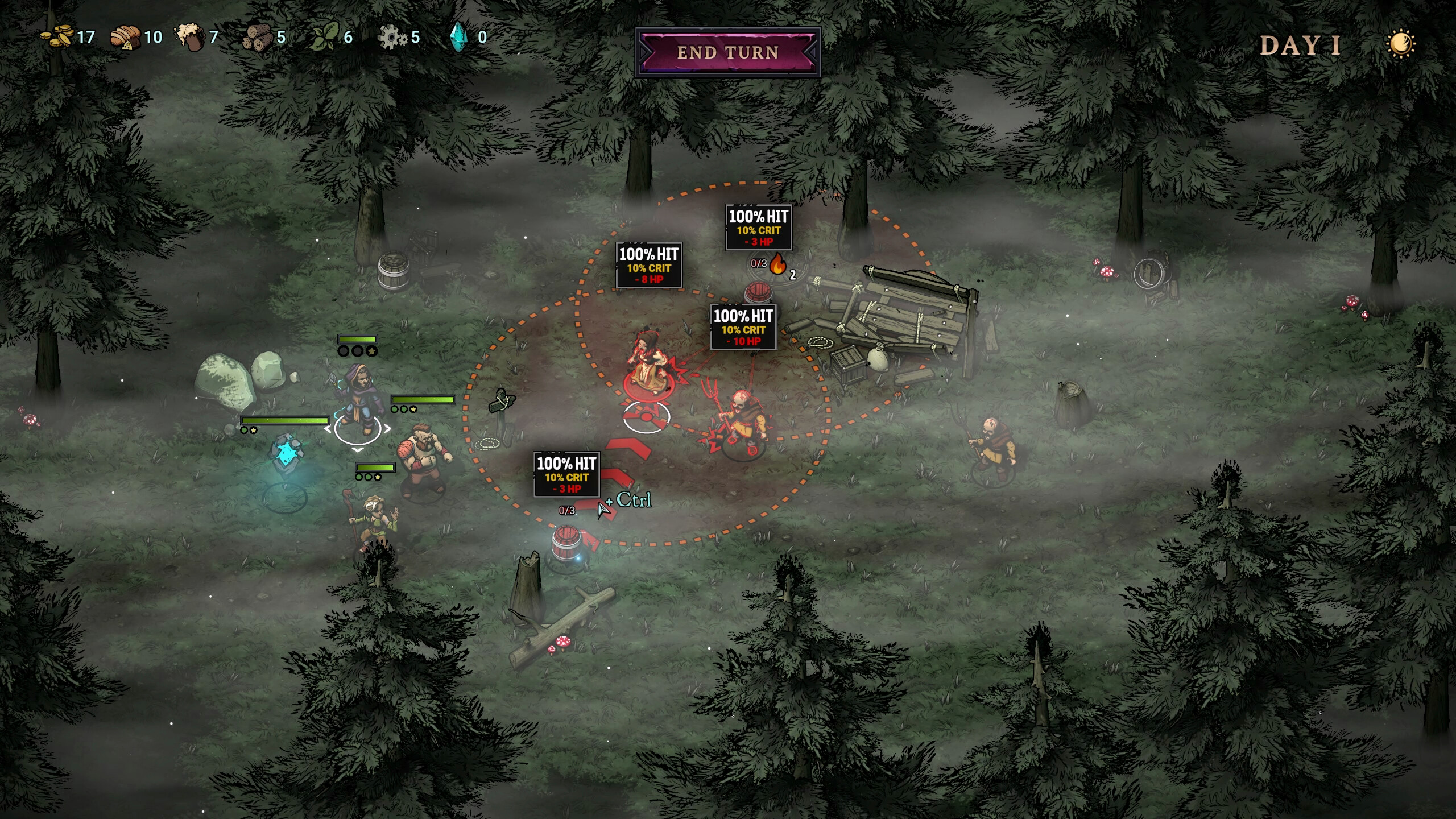
Blightstone is the kind of game that could make anyone fall in love with the turn-based strategy and roguelike genres. It boasts a unique premise, a rich fantasy setting and a satisfying long-term progression system that rewards you as you improve. At its core, it is an incredible strategy title that offers immense freedom, particularly through its gridless movement system. However, despite having all the ingredients for greatness, the game falls short in a few key areas.
While the Early Access version is fully playable, featuring three maps, five hero classes and a variety of bosses and enemies, the content pool feels shallow. After roughly 10 hours, you will have seen most of what the game has to offer and the experience begins to feel repetitive. This isn’t necessarily a flaw in the roguelike loop itself, but rather a lack of variety in the current content. Obviously, I expect the game to expand during its development.
Your primary objective in Blightstone is to protect the Earthglass Crystal from the Demon Overlord Korghul; if the crystal shatters, your run ends. However, failure provides Earthglass shards, which fuel a meta-progression system that unlocks new skills and upgrades for your heroes. You begin with three classes: the Brawler, Hunter, and Arcanist and eventually unlock the Druid and Priest by completing specific red-marked quest events.
The heart of this progression is the Continuum Forge. Here, you unlock permanent advantages, such as expanded event choices, the Fate system, additional revives and many more. While these four tiers of upgrades are impactful, the “Strands of Time” currency required to unlock them is incredibly scarce. Spending nine hours just to clear two tiers of upgrades is exhausting, especially when you’re forced to face the same enemies and mini-bosses repeatedly.
This grind extends to the Crystal Runes system, where you unlock passive skills. Whether you’re focusing into damage (Assault), health (Bastion), or movement (Harmony), the XP gains are small. Defeating a second-tier boss might only give you a single level, which feels unrewarding when the game simultaneously throws “unfair” spikes in difficulty at you. The result is a game that feels like it’s throwing “grind for the sake of grind” at you.
However, this issue is mostly connected to the first few hours. Once you cross that threshold and reach level 4, the experience becomes much more bearable. With new unlocks and expanded options for your crystal, the gameplay suddenly becomes far more enjoyable.

Once you push past the initial learning curve and realize how much tactical depth Blightstone offers, the game opens up for experimentation. You’ll start noticing clever environmental plays: electrifying a puddle of water for extra damage, using the Brawler to slam an enemy into a wall, or using telekinesis to drop a n enemy into a bottomless pit. These “eureka” moments, combined with status effects like bleed, poison, and burn, allow you to use the environment to your advantage constantly.
The experimentation extends to your heroes as well. Each character feels impactful and unique: the Hunter can coordinate attacks with his dog or set traps, the Arcanist can chain lightning through groups of enemies, and the Priest balances area-of-effect holy damage with vital healing. As you unlock new skills, like the Ranger’s “Reload” for double shots or the Brawler’s massive damage-dealers skills, the tactical flavor only improves.
Strategic planning is key to reaching the boss. The map clearly labels enemies, mini-bosses, events, and shops, allowing you to plot your path. However, the journey is plagued by “Dark Events.” While some are skippable, others force you into combat. This system can feel unfairly punishing, occasionally throwing you into “dead-end” situations where defeat feels inevitable. Even with camp upgrades meant to lower the frequency of these events, the RNG often feels relentless.
Between battles, you’ll manage your party via the Camp system. During the night cycle, characters perform specific tasks: the Hunter gathers wood, the Brawler heals the party, and the Arcanist purges “Blight”, a debuff that grows over time and is worsened by blighted enemies. These actions rely on limited resources like food, wood, and herbs gathered from combat or purchased from merchants, making every decision in camp a high-stakes balancing act.

It is worth noting that Blightstone is relentless as I mentioned before. The game often feels intentionally unfair as enemies scale in power alongside you. Each biome introduces unique threats, from dwarves and massive scorpions to farmers that ensure you’ll suffer before you succeed. The bosses are equally varied, ranging from “muscle-brained” brawler to a mage, each requiring a different strategy. Ultimately, you must get used to dying often and restarting; success only comes to those who persevere.
The Dynamic Weather system adds another layer of tactical depth, though its impact is felt more in the later stages of the game. Dense fog obscures vision, rain boosts the potency of electric attacks and strong winds can ruin your accuracy. These environmental factors provide as many opportunities as they do setbacks, provided you pay attention.
While Blightstone attempts to prioritize narrative, the execution is a mixed bag. There is plenty of lore to uncover and many characters to meet, but the delivery can be frustrating. My biggest gripe is that every new run forces you to skip the same repetitive dialogue and opening cutscene before you can actually play. This creates an unnecessary friction point that simply leads you to smash the skip button, as the story feels secondary to the gameplay loop.
In conclusion, Blightstone does an excellent job of keeping the roguelike loop engaging through unpredictable encounters and deep, gridless tactical combat. While the content currently feels a bit shallow after several hours, this is a forgivable trait of an Early Access title. If you enjoy challenging yourself and combining different genres, this is a must-play roguelite strategy game that will only get better with time.
Review copy provided by the publisher

There is a strong concept, a lovely atmosphere, and flashes of something genuinely special buried under layers of poor usability…

Lanesplit was supposed to be a relaxing yet adrenaline-pumping driving and racing game, a place where you could sit on…

At its core, I Hate This Place blends isometric action with survival mechanics and open-world exploration.

Ambitious and creative indie game that mixes deckbuilding, resource management and exploration into one strange and memorable experience.

Moving Simulator is a niche title that will primarily appeal to those who enjoy methodical, physics-based simulations and logistical challenges.

Kids, stay away. This is not your favourite Disney character Winnie the Pooh. This version is far more grotesque and…
![[PREVIEW] Diviner – Dark Fantasy RPG Worth Digging Into](https://www.indie-games.eu/wp-content/uploads/2026/01/ss_b89ae32bd963134129b6d415f551faee1c131f73.1920x1080-300x169.jpg)
In today’s crowded game market, it’s really hard to discover new games, and many great indie titles sadly get lost…

Escape from Ever After is a must-play for turn-based RPG fans who love games with great character and humor.
![[PREVIEW] Sub-Species – Great Underwater Concept Held Back by a Barebones Demo](https://www.indie-games.eu/wp-content/uploads/2026/01/Sub-Species-300x169.jpg)
Sub-Species is a 2.5D Arcade Action/Adventure, where you control a submarine that rotates 360° in order to battle alien sea…

The combination of emotional investment and defensive gameplay brings something truly unique to the genre.

Hungry Horrors feels less like a work-in-progress and more like a feast that’s already worth sitting down for, even if…

Your main goal is to collect votes from other students so you can win the Carmel Star election.

It’s not perfect, it’s brutal, and it will test your patience, but overall, it delivers a very solid experience.

Not only does it deliver an excellent action RPG gameplay loop, but it’s also incredibly addictive and genuinely fun to…

By focusing more on growing and restoring rather than pure destruction, Air Hares offers a softer take on arcade action.

The Real Face of a VTuber isn’t trying to be Ace Attorney. Instead, it aims to be memorable, and it…
![[PREVIEW] Don’t Stop, Girlypop! – Slay (the enemies)!](https://www.indie-games.eu/wp-content/uploads/2026/01/Dont-Stop-Girlypop-300x169.jpg)
Don't Stop, Girlypop! is a Y2K arena movement shooter with a lot of glamour.
![[PREVIEW] Obsidian Moon – Slow-Burning Noir Mystery That Demands Patience](https://www.indie-games.eu/wp-content/uploads/2026/01/Obsidian-Moon-2-300x169.jpg)
It follows Sam Carter, a disgraced homicide detective drawn back into police work to investigate a series of ritualistic murders.

The premise is simple, you run a café in the middle of a forest, meet various animal characters, chat with…

Marble’s Marbles is a physics-based arcade precision platformer that proudly embraces its roots.
There is a strong concept, a lovely atmosphere, and flashes of something genuinely special buried under layers of poor usability…
Lanesplit was supposed to be a relaxing yet adrenaline-pumping driving and racing game, a place where you could sit on…
At its core, I Hate This Place blends isometric action with survival mechanics and open-world exploration.
Ambitious and creative indie game that mixes deckbuilding, resource management and exploration into one strange and memorable experience.
Moving Simulator is a niche title that will primarily appeal to those who enjoy methodical, physics-based simulations and logistical challenges.
Kids, stay away. This is not your favourite Disney character Winnie the Pooh. This version is far more grotesque and…
In today’s crowded game market, it’s really hard to discover new games, and many great indie titles sadly get lost…
Escape from Ever After is a must-play for turn-based RPG fans who love games with great character and humor.
Sub-Species is a 2.5D Arcade Action/Adventure, where you control a submarine that rotates 360° in order to battle alien sea…
The combination of emotional investment and defensive gameplay brings something truly unique to the genre.
Hungry Horrors feels less like a work-in-progress and more like a feast that’s already worth sitting down for, even if…
Your main goal is to collect votes from other students so you can win the Carmel Star election.
It’s not perfect, it’s brutal, and it will test your patience, but overall, it delivers a very solid experience.
Not only does it deliver an excellent action RPG gameplay loop, but it’s also incredibly addictive and genuinely fun to…
By focusing more on growing and restoring rather than pure destruction, Air Hares offers a softer take on arcade action.
The Real Face of a VTuber isn’t trying to be Ace Attorney. Instead, it aims to be memorable, and it…
Don't Stop, Girlypop! is a Y2K arena movement shooter with a lot of glamour.
It follows Sam Carter, a disgraced homicide detective drawn back into police work to investigate a series of ritualistic murders.
The premise is simple, you run a café in the middle of a forest, meet various animal characters, chat with…
Marble’s Marbles is a physics-based arcade precision platformer that proudly embraces its roots.
