Corsair Cove – Pirate Paradise Navigating a Logistical Storm
Hooded Horse keeps finding strategy games that know their audience, and Corsair Cove extends its impressive run of excellent city-builders.


If you enjoy independent indie game coverage, consider supporting Indie-Games.eu on Patreon. It helps keep the site independent.
K-pop is perfectly suited to management games. Behind every colorful music video and perfectly synchronized performance are years of auditions, exhausting training schedules, carefully planned public appearances and managers trying to stop everything from collapsing. K-pop Idol Stories: Road to Debut understands that journey surprisingly well, but it does not explore it as deeply as its premise deserves.
Road to Debut combines visual-novel storytelling with accessible management mechanics. Its attractive artwork, excellent original soundtrack and entertaining recruitment phase create a convincing K-pop atmosphere. Unfortunately, excessive randomness, repetitive scheduling and a very short campaign prevent its promising systems from developing into a substantial management experience.
The story begins after your previous entertainment company runs out of money and the group you managed disbands. WG Entertainment soon offers you another chance through Project KIS, giving you the responsibility of assembling a new girl group and preparing it for debut.
Before recruiting anyone, you choose between Marketer, Realist and Risk-Taker management styles. These supposedly influence how you approach difficult situations, while selecting a Cute, Glamour or Fantasy concept determines which qualities your group should prioritize.
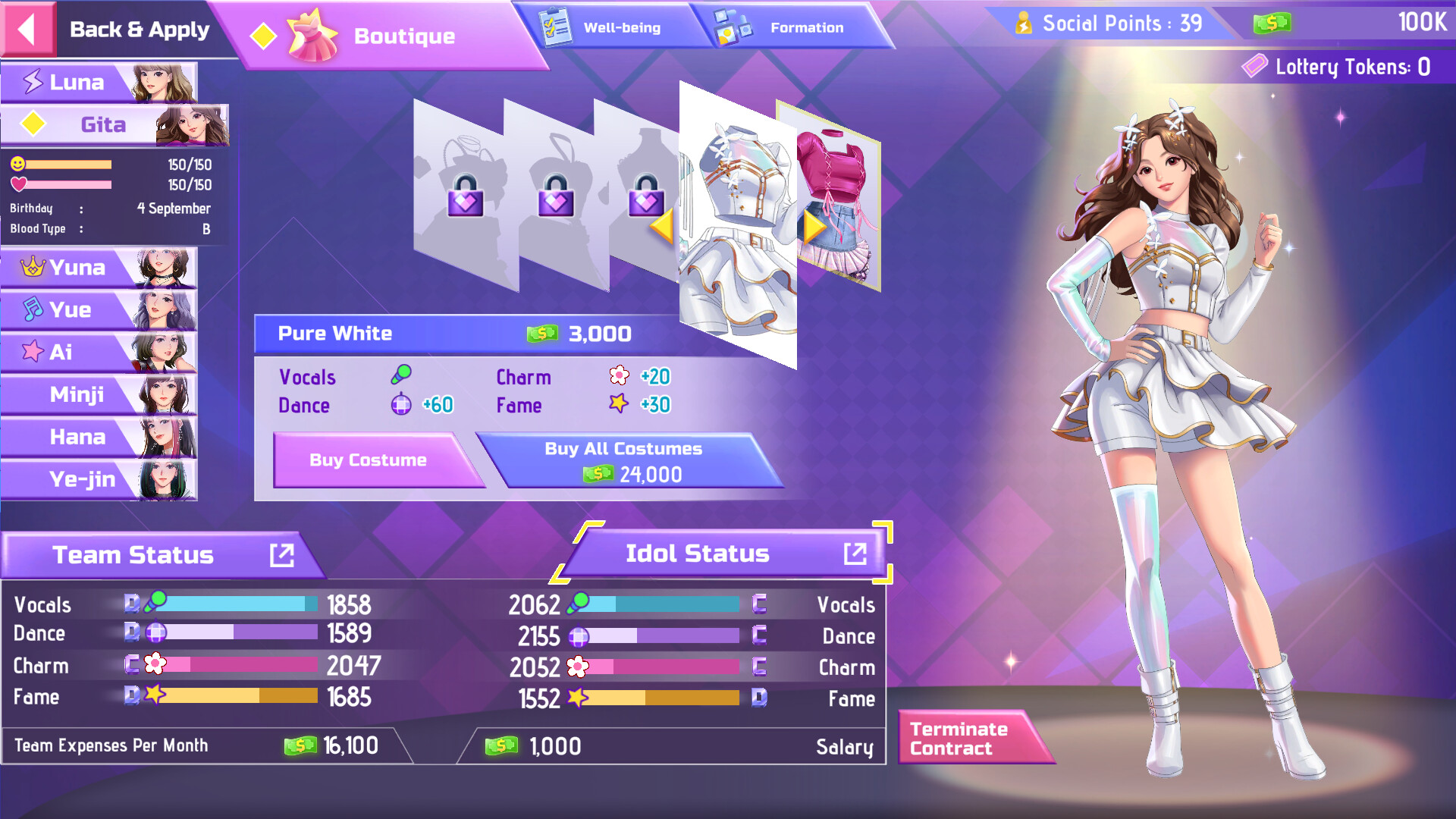
Recruitment is easily one of the strongest parts of the experience. There are eight prospective trainees, each possessing her own appearance, personality, strengths and personal struggles. You can create anything from a solo act to an eight-member group, although every additional trainee increases salaries, food bills and healthcare expenses.
Unfortunately, the illusion of building a completely original group does not last. There are only eight recruitable characters and no randomly generated trainees. Rejected candidates also return to the recruitment pool, while hairstyles, personalities and appearances cannot be comprehensively customized. The game understands the appeal of creating your dream K-pop group, but provides surprisingly limited tools for doing so.
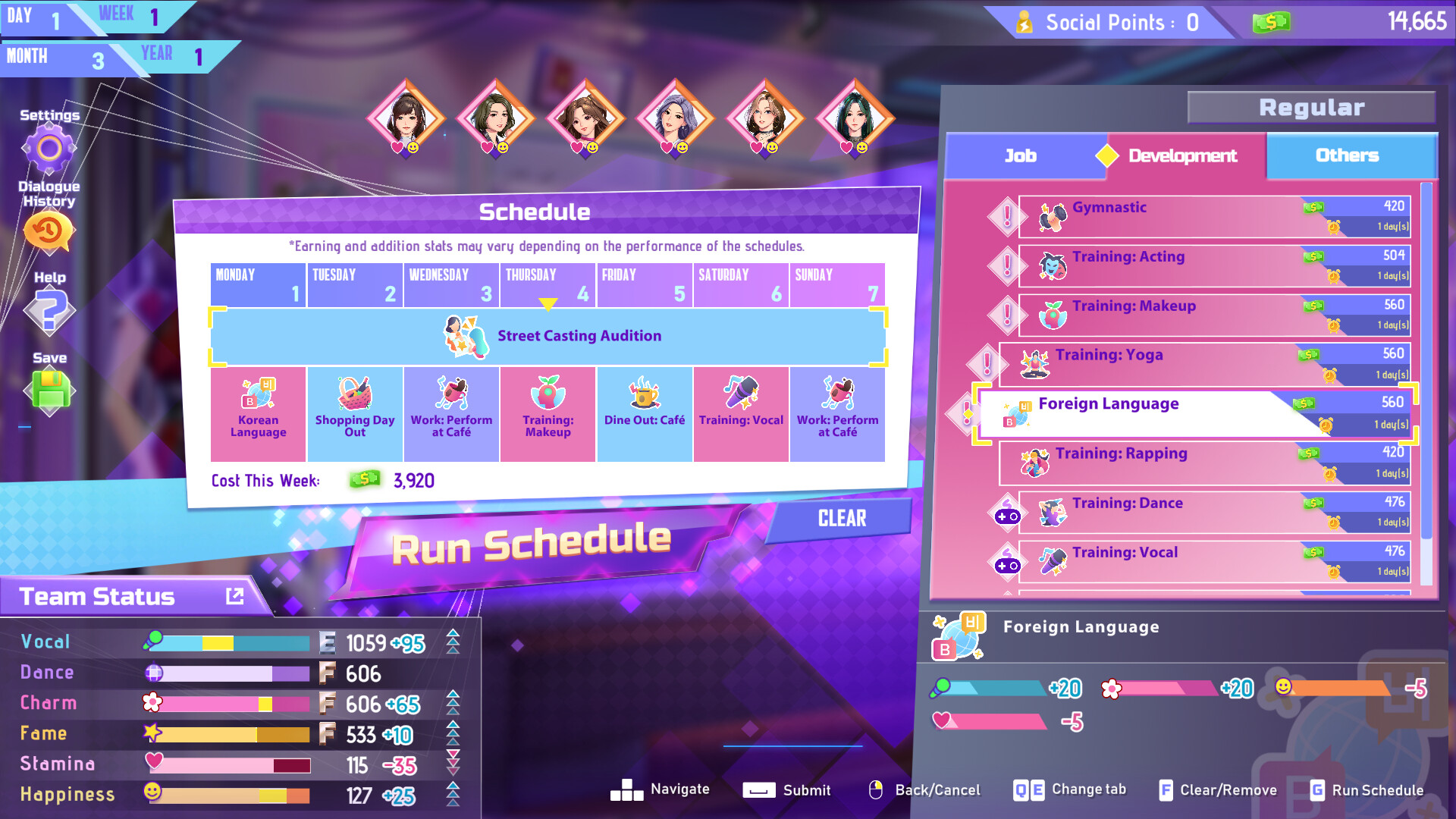
Every week is divided into schedule slots that can be filled with training, paid work, publicity or relaxation. Singing, dancing, charm and fame form the main progression statistics, while stamina and happiness determine how hard the trainees can be pushed.
This creates a satisfying balancing act. Intensive training prepares the group for evaluations but drains its energy. Shopping, coffee breaks, spas and days off restore morale but consume valuable time and money. Paid jobs improve your finances, although they may not develop the attributes your group currently needs.
Expenses continue accumulating through salaries, food, lessons, medical treatment and additional services. Progress eventually unlocks chauffeurs, insurance, bodyguards and better activities, but these advantages introduce further costs. Loans can rescue a struggling project, although excessive debt may bring the entire journey to an early conclusion.
The problem is that success depends too heavily on percentages. Activities can fail without adequately explaining why, while potentially valuable acting roles or media appearances sometimes begin with success rates around 10–20%. Even descriptive event text may contradict the displayed outcome.
More importantly, the main schedule applies to the entire group. You cannot create individual training plans to improve a weak dancer without also sending everyone else to dance practice. Limited social points and consumable items allow some targeted development, but they never provide the detailed control expected from a management simulator.
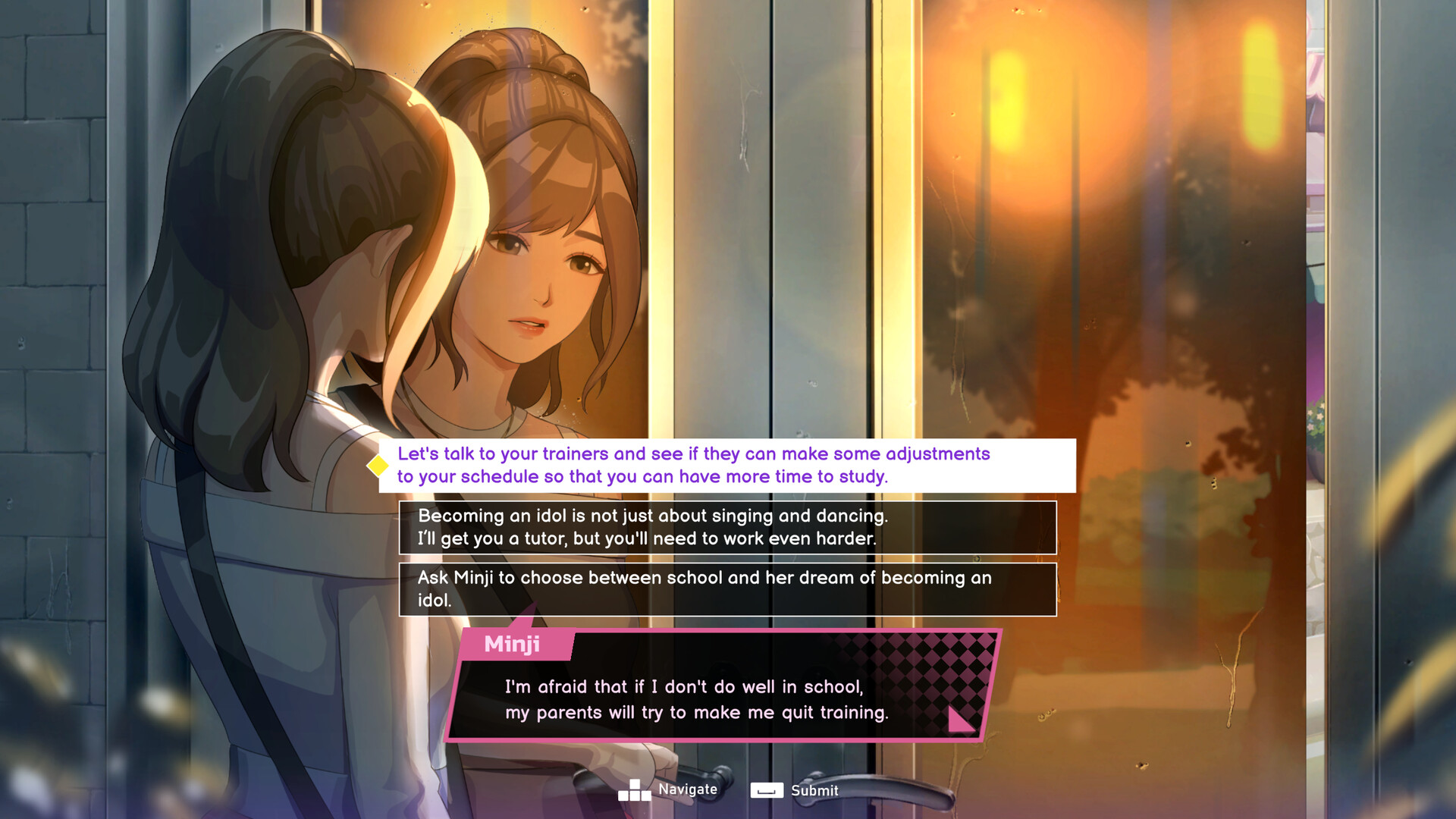
Two weekly social points can be spent meeting trainees, trainers and company employees. Developing these relationships reveals personal stories, unlocks activities and may provide access to acting roles, magazine appearances or other bonuses.
These conversations help turn the trainees into people rather than collections of statistics. Their stories address academic pressure, difficult parents, anxiety, injuries, rivalries, obsessive fans and the fear of becoming too old for the industry. The game maintains an optimistic tone but does not completely ignore K-pop’s more troubling elements.
However, personal events are infrequent and sometimes dependent on random triggers. Certain storylines develop into touching character moments, while others disappear or conclude before receiving adequate resolution. Focusing on one trainee can also prevent you from seeing another character’s story.
Worth mentioning is that this is not a romance game. Relationships primarily involve trust, friendship and mentorship. Dating appears more as an industry problem involving restrictions and public scrutiny than an opportunity for the manager to pursue dedicated romantic routes.
Dialogue choices can influence relationships, unlock encounters and determine how openly you communicate with trainees. Nevertheless, their exact effects are often unclear. Smaller scenes can change, but the central journey continues toward the same destination, making these choices feel more like variations within a linear story than genuinely transformative decisions.

The bright anime and manhwa-inspired artwork suits the subject wonderfully. Expressive character portraits make conversations lively, while cute chibi animations add personality to routine training. The interface is colorful and generally readable, although it becomes crowded as more activities are unlocked.
The original soundtrack is even better. Upbeat training themes and softer character music capture the intended mood, while the vocal tracks created for the group’s debut sound remarkably convincing. There is no voice acting, but the music compensates for some of that absence.
Unfortunately, the visual presentation fails during the moment that matters most. The debut performance offers little meaningful choreography, leaving the idols standing in place while the music and background video do most of the work. After spending hours developing their dance abilities, this static conclusion feels especially disappointing.
As its title openly indicates, K-pop Idol Stories: Road to Debut focuses entirely on reaching debut. The problem is that the campaign ends just when its management systems should become more interesting. There are no comebacks, tours, additional albums, solo careers, contract negotiations or long-term attempts to maintain the group’s popularity.
With a campaign lasting roughly four to six hours, the limited roster and mostly fixed destination also weaken New Game Plus. Different character events provide some incentive to return, but repeating the same recruitment pool, tutorials and management cycle is not particularly appealing.
There is plenty to admire here. Recruitment is enjoyable, financial management creates real pressure, the characters are likeable and the soundtrack understands exactly what K-pop fans want. Yet the experience ultimately resembles the opening chapter of a much larger simulator. Genre fans may enjoy its compact mixture of visual novel and scheduling mechanics, but anyone expecting to manage a complete K-pop career will be left waiting for an encore that never arrives.
K-pop Idol Stories: Road to Debut is a charming and accessible mixture of visual novel storytelling and light management mechanics. Its excellent soundtrack, appealing characters, enjoyable recruitment and convincing K-pop atmosphere make the journey toward debut entertaining. The problem is that the journey ends too soon. Limited customization, excessive randomness, group-wide scheduling and the absence of any post-debut career prevent its promising systems from developing into a deeper simulator.
Ending Thoughts
Review copy provided by the publisher
Hooded Horse keeps finding strategy games that know their audience, and Corsair Cove extends its impressive run of excellent city-builders.
Teeto is a warm, cozy, creative and highly enjoyable 3D platformer that understands why classic collectathons remain so appealing.

Turnip Mountain stands out for its combination of a unique control system and a minimalist approach.
Dystopicon is an imaginative and memorable narrative experiment with sharp social commentary, engaging world-building and several wonderfully absurd scenarios.
Maneki Mania is an incremental game centered around petting a lucky cat.
XeGrader Plus delivers colorful retro shooting, but basic mechanics, a short campaign and paid retro modes make its €20 price…
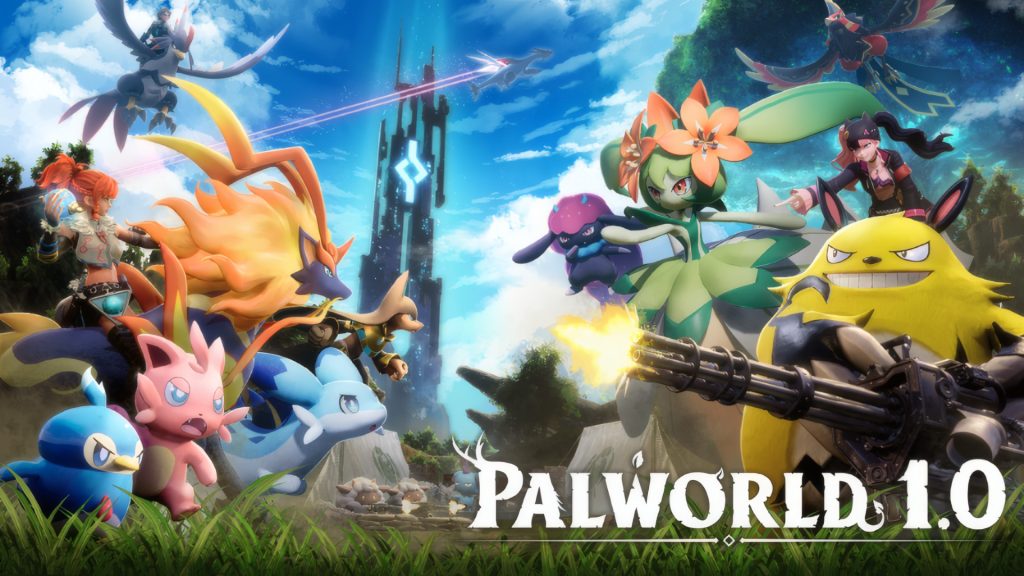
It has been roughly two and a half years since Palworld first entered Early Access, and quite a lot has…
![[EARLY ACCESS] The Last Caretaker – Survival Game I Cannot Stop Playing](https://www.indie-games.eu/wp-content/uploads/2026/07/The-last-Caretaker-Key-Art-1024x587.jpg)
The Last Caretaker is a compelling survival crafter with a flooded world and mobile base, but weak combat and performance…

Advent: Dawn is an intriguing science-fiction visual novel elevated by a likable cast and one of the most convenient flowchart…
![[EARLY ACCESS] Hell Maiden – Beautiful but Uneven Journey Through Hell](https://www.indie-games.eu/wp-content/uploads/2025/06/HMD_screenshot_019-1024x576.jpg)
Bullet heaven and rougelite game Hell Maiden lands between a polished Early Access release and a promising game that still…
![[PREVIEW] Dark Queen of Samobor – Promising Croatian Adventure Still in Need of Polish](https://www.indie-games.eu/wp-content/uploads/2026/07/Dark-Queen-of-Samobor-1024x587.jpg)
Dark Queen of Samobor is a promising 2.5D side-scrolling action-adventure that combines Croatian folklore with combat, puzzles and cinematic platforming.
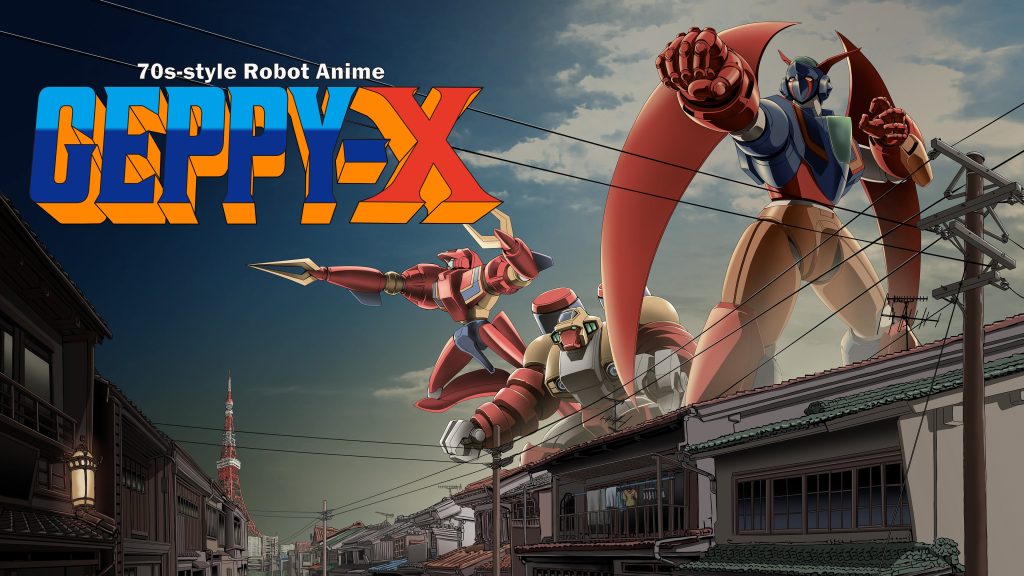
70s-style Robot Anime Geppy-X offers incredible animation, music and mecha nostalgia, but its average shooting make the €39 price difficult…

Denshattack! blends Tony Hawk, Jet Set Radio, and Japanese train culture into one of the year's most creative and unforgettable…
If you're looking for a game that takes an incredibly simple idea and somehow turns it into something addictive, KAZ…
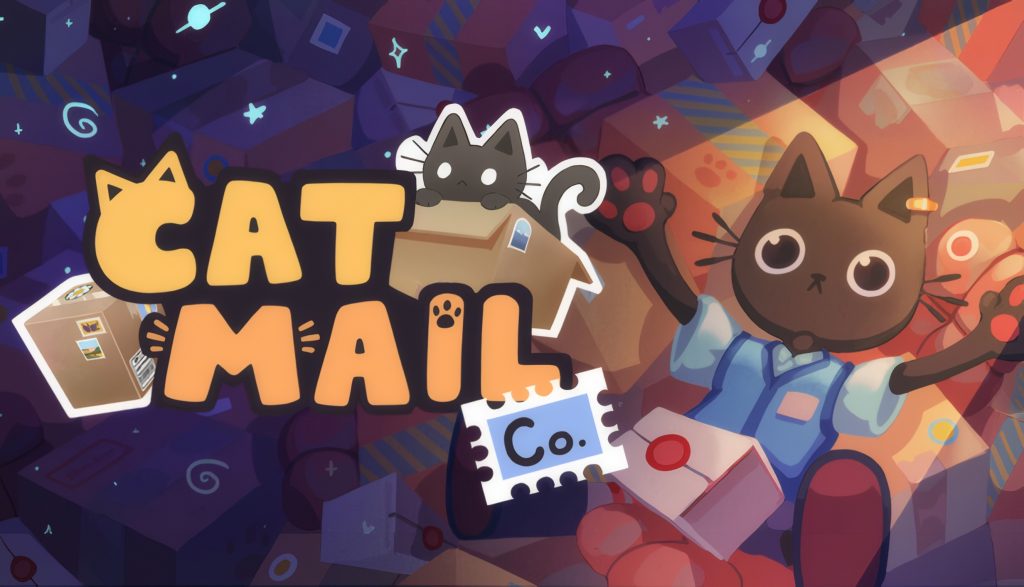
Cat Mail Co. charms with cozy visuals and satisfying mail sorting, but its full release doesn't quite live up to…

Forensics: Crime Scene Detective follows Aerosoft's familiar formula: an interesting simulation with decent visuals, weak optimization, and repetitive gameplay.

Foxy The First Steps is an excellent precision platformer that understands exactly what makes the genre enjoyable.

Tokyo Valkyries blends visual novel, roguelite deck-building, and fan service into a surprisingly enjoyable mix, despite few standout elements.
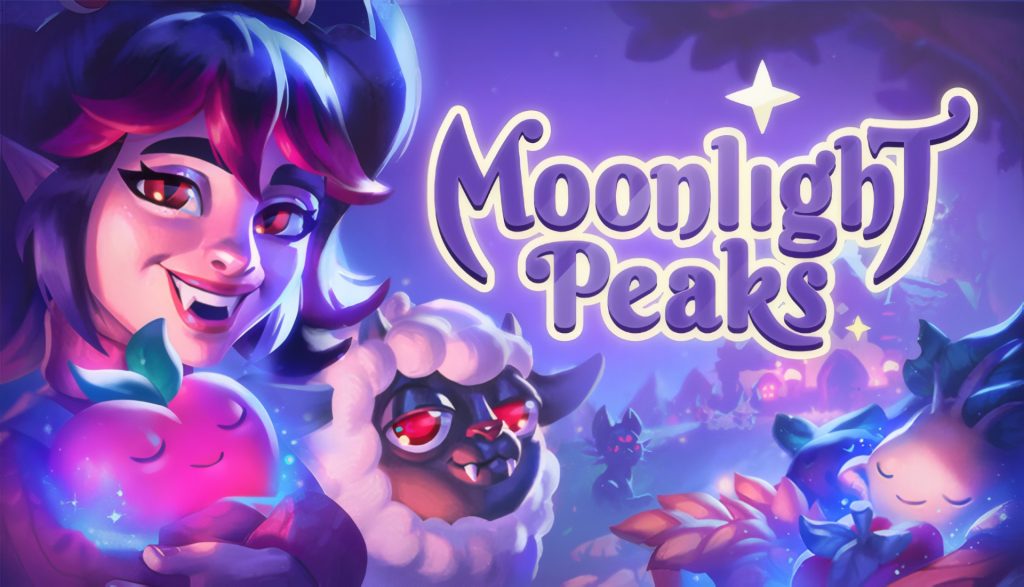
Moonlight Peaks refreshes the cozy farming formula with a more unique supernatural and magical approach while keeping the familiar mechanics…

The first thing that stands out about GRID 2 in 2026 has nothing to do with its handling, graphics, or…
