
Sister Other Paranoia – Everyone Has Something Ugly to Hide
Reading another person’s mind is often presented as a desirable superpower, but Sister Other Paranoia immediately understands why it could…

![[EARLY ACCESS] The Last Caretaker – Survival Game I Cannot Stop Playing](https://www.indie-games.eu/wp-content/uploads/2026/07/The-last-Caretaker-Key-Art.jpg)
If you enjoy independent indie game coverage, consider supporting Indie-Games.eu on Patreon. It helps keep the site independent.
The Last Caretaker is currently one of my favorite survival games on Steam. Yes, it is still in Early Access, it has several obvious problems and some of its systems need plenty of work. However, after spending roughly 70 hours sailing across its flooded world, I still find it incredibly difficult to stop playing.
Part of that comes from how different it feels from games such as ARK, Valheim and Enshrouded. The Last Caretaker has the familiar foundations of a survival-crafting game, but it replaces hunger and thirst with electricity, mechanical maintenance and careful resource management. More importantly, everything you do contributes to a much larger objective: restoring humanity.
Unfortunately, the current version also comes with repetitive locations, frustrating combat, awkward underwater exploration and serious technical problems. Despite all of that, its engineering systems, mobile base and constant sense of purpose make it one of the most interesting survival games I have played in a long time.
Earth has been almost completely swallowed by the ocean. You awaken centuries later as the final functioning Caretaker, a machine programmed to preserve the human species. Your mission is to explore the remains of civilization, restore the Lazarus Complex, recover viable human seeds and prepare the next generation for life in orbit.
This gives the game a clear objective beyond simply surviving for another day. You are not gathering resources just to build a larger house or fill storage boxes with materials you might never use. Almost every system contributes to preserving human history or creating humanity’s future.
Recovering a human seed is only the beginning. You must collect food, cultural objects, books and memory data before cultivating a new person. You can influence their lifespan and determine which profession they should specialize in, including roles such as engineer, teacher or leader. Eventually, you must prepare a rocket and send humanity into space.
Later progression expands this idea through orbital committees and Project Eden, allowing humanity’s progress to influence the flooded Earth below. It creates a satisfying response to your work and makes launching humans feel like part of a larger restoration process rather than a simple mission-complete screen.
The story itself is mostly quiet and lonely. Instead of constantly talking to traditional characters, you discover logs, holographic memories, personal objects and environmental details. Messages and recordings aboard your boat gradually reveal more about the old world. This approach fits the atmosphere perfectly because you genuinely feel like the last machine wandering through the remains of civilization.
The Last Caretaker constantly pushes you to leave your comfortable areas and explore. Without discovering new structures, collecting memorabilia and recovering important technology, you simply cannot complete your primary mission. The game’s central loop can essentially be summarized with three words: recycle, reconnect and rebuild. It sounds simple, but the physical nature of its systems makes the process far more satisfying than opening a menu and holding a button.
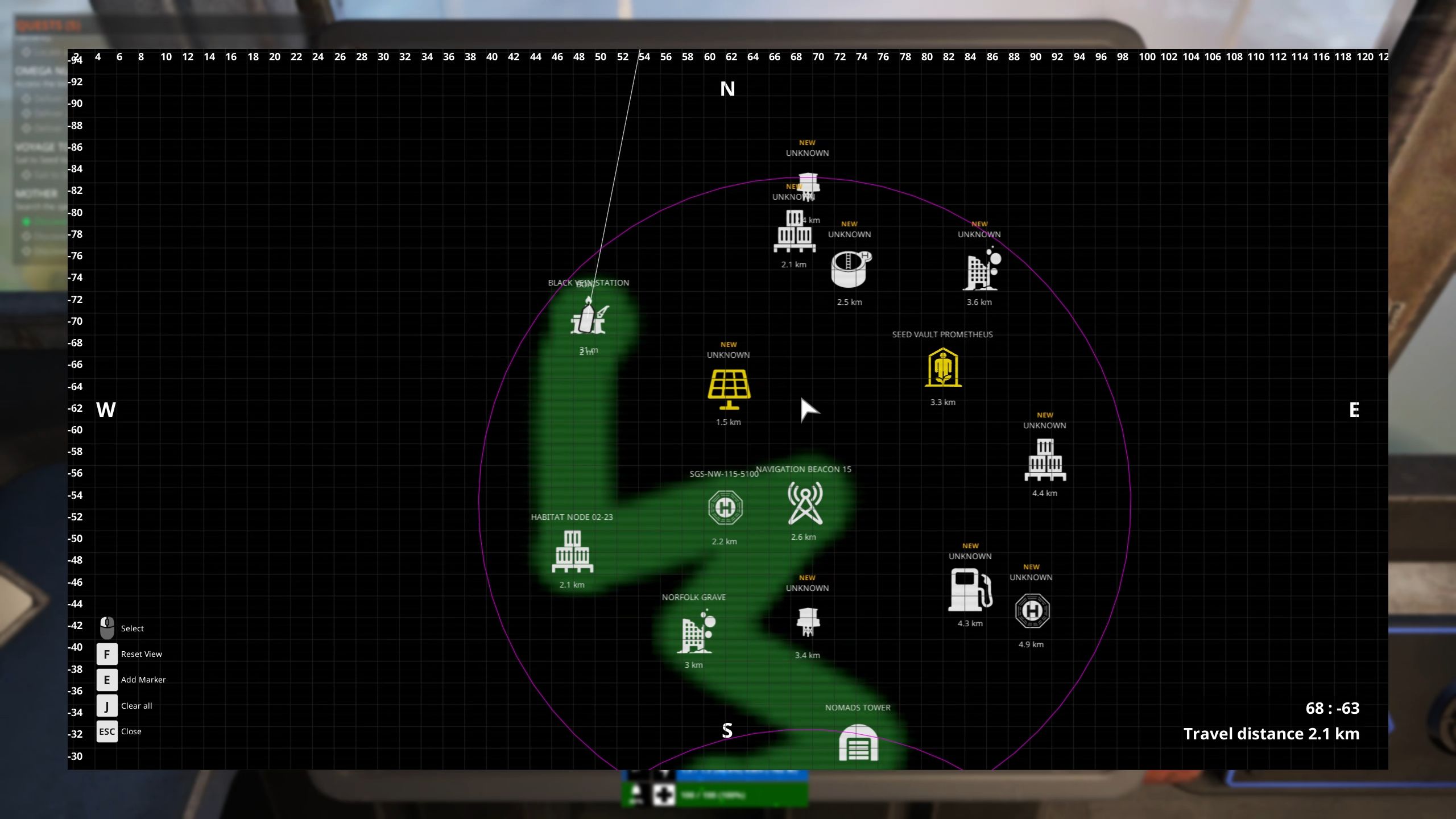
A typical expedition begins with selecting a distant beacon, vault, laboratory or quest location. Before leaving, you must prepare enough fuel, power, weapons, tools, storage space and emergency supplies. Once you arrive, you normally need to restore electricity, manipulate machinery, reconnect cables and find a physical route into the facility.
After gaining access, you fight or avoid hostile creatures, dismantle everything useful and transport the recovered materials back to your boat or the Lazarus Complex. Those materials can then be recycled into standardized resources and used to create better tools, weapons, generators, batteries and modules.
Doors must be pulled open, cables are connected manually and machinery occupies physical space. Even docking your boat requires you to consider its weight and momentum. You need to slow down, carefully use reverse thrust and line yourself up with the platform. That physicality makes restoring an abandoned facility feel convincing, even when the physics occasionally decide to fight against you.
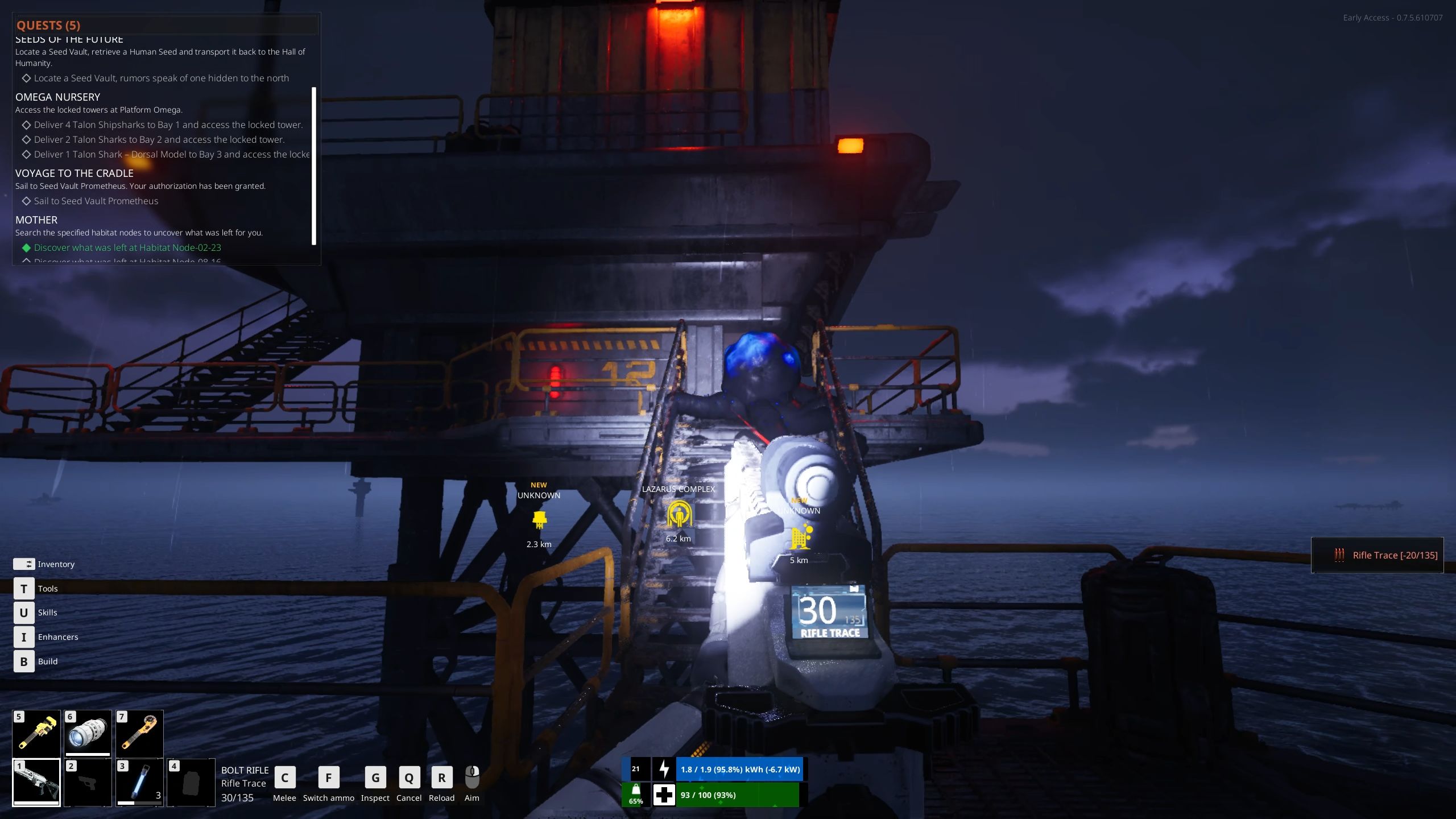
Your boat is not merely a vehicle used to travel between objectives. It becomes a floating workshop, power network, storage facility and mobile home. The boat itself remains the same throughout the game, but you can gradually cover it with machinery, containers, production equipment, batteries, solar panels and generators. You can also customize its appearance and organize the interior however you like. The longer you play, the more it begins to feel like something you personally constructed.
Power and fuel are always important. Solar panels depend on the weather and time of day, while generators require fuel. Biomass gathered from creatures can be converted into fuel, and certain locations contain refineries that provide another way to maintain your supply.
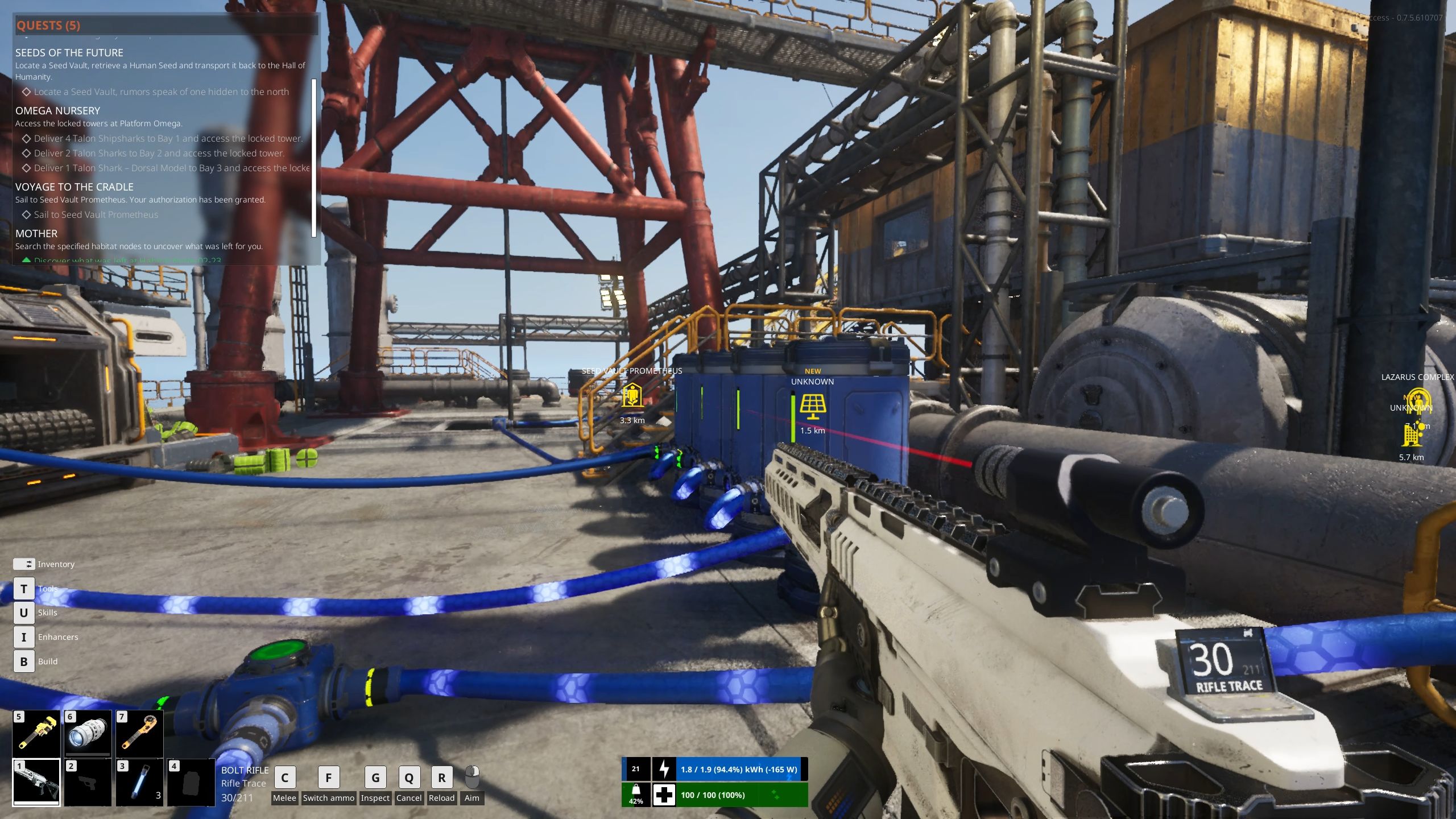
You must also think about how everything connects. Electricity, fuel, oxygen and water all require their own networks, especially once you begin preparing facilities for humans. Batteries, cables and generators cannot simply be placed randomly and forgotten. You must understand where the power is coming from, where it is going and whether your network can support everything attached to it.
This management aspect is probably my favorite part of the entire game. The systems are not especially difficult to understand, but they remain hands-on enough to make you feel involved. You are not pressing one button and watching the game solve everything for you. You have to inspect the machinery, connect the correct cables and work out what is missing.
Almost everything you discover can potentially become useful. You can dismantle furniture, containers, wreckage, machines and defeated robots. These objects provide materials such as plastic, fiber and high-tech electronics, which can then be recycled and used to manufacture more advanced equipment.
This makes abandoned locations feel like enormous salvage yards. A chair is not simply decoration when it contains materials you desperately need. However, you must still decide whether an object is worth carrying back because both storage space and weight are limited.
Progression is also supported by a level system that lets you unlock new technology and improve statistics such as carrying capacity, electricity storage and resistance to underwater pressure. Better equipment gradually allows you to enter more dangerous areas and remain underwater for longer.
The current version also offers a surprising amount of equipment and transportation. Alongside your boat, you can obtain vehicles such as a forklift, jet ski, and helicopter. Scanning and recovery tools let you reproduce furniture and decorate temporary homes, while deployable companions, drones, minigames and hidden areas provide smaller distractions between larger expeditions.
After approximately 70 hours, I still had reasons to keep exploring. The current build can easily provide around 60 hours for players who want to see most of its major content. That is impressive for an Early Access game, especially considering how much it has expanded since its original release.
The amount of content has grown considerably, but the world can still feel empty and repetitive. Long stretches of open water sometimes contain very little of interest, while many structures share similar layouts, resources and objectives. Unfortunately, too many locations eventually blend together. You arrive, restore the electricity, dismantle the furniture, collect the same categories of resources and return to your boat. The individual tasks remain enjoyable, but after dozens of hours, the repetition becomes difficult to ignore.
Underwater exploration is another weaker area. Managing pressure and power adds tension, but navigating some submerged locations feels awkward and unfinished. Collision problems, unclear routes and limited diving depth can make these sections frustrating rather than exciting.
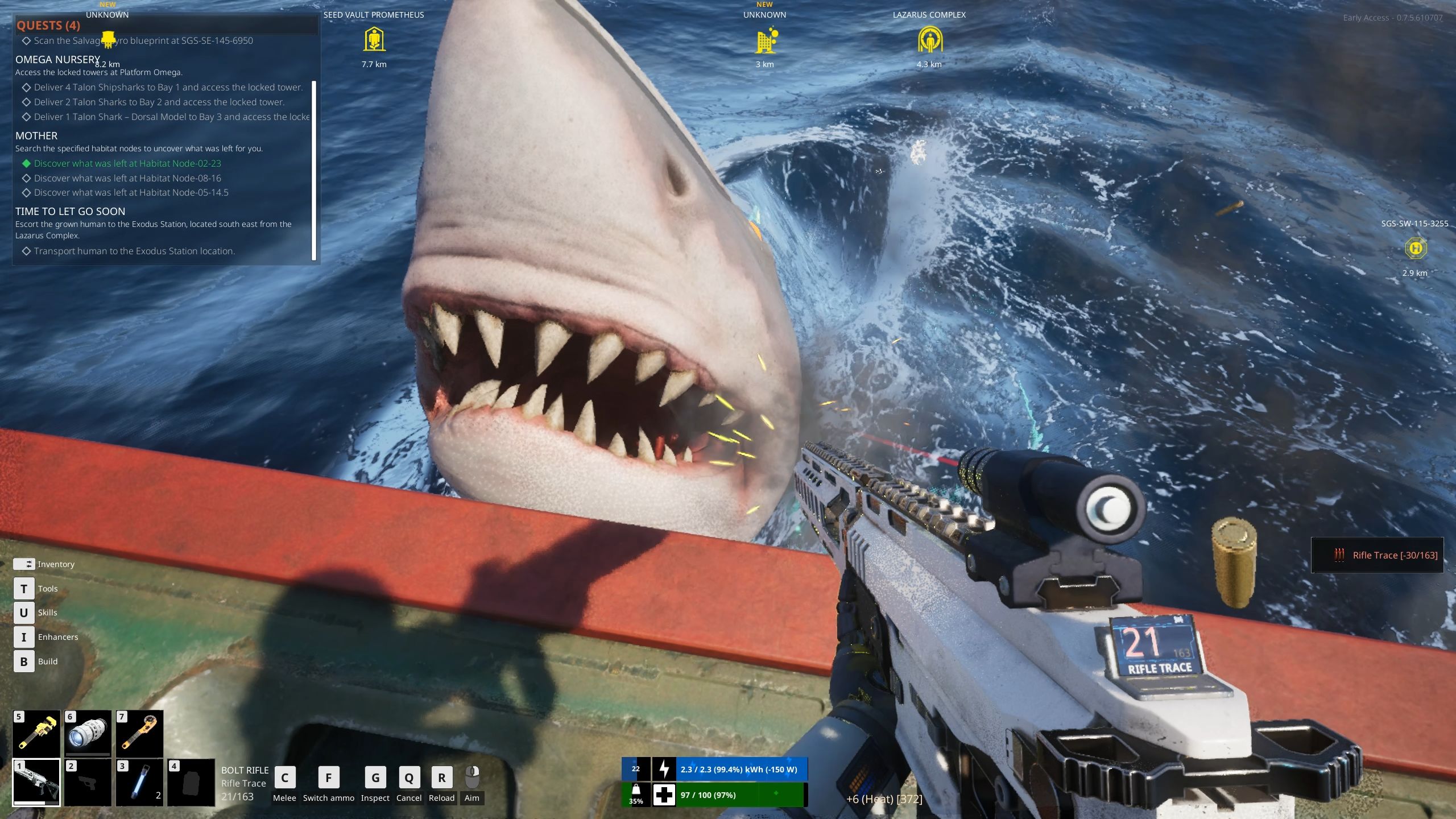
Combat is easily the weakest major system in The Last Caretaker. You fight biological creatures, rogue machines and mechanical sharks using melee weapons, firearms, electrical equipment and deployable companions. The ideas are not necessarily bad. Certain weapons work better against particular enemies, while powered firearms create an interesting choice between spending electricity on combat or preserving it for exploration and infrastructure.
The problem is how these encounters feel. Melee attacks lack impact, hit detection can be unreliable and firearms provide weak feedback. Enemies frequently behave like obstacles designed to waste ammunition rather than genuine threats. Large flying machines equipped with miniguns are especially frustrating. They deal enormous damage, force you to hide and require a ridiculous amount of ammunition to destroy. Enemy groups are rarely difficult in an interesting way. They are simply persistent, expensive and annoying to remove.
Technical problems make these encounters worse. The game still suffers from severe frame-rate drops, freezes and occasional crashes. I have also encountered collision and buoyancy problems, along with situations where I became trapped inside parts of the environment. Performance has improved, but the current build still requires considerably more optimization.
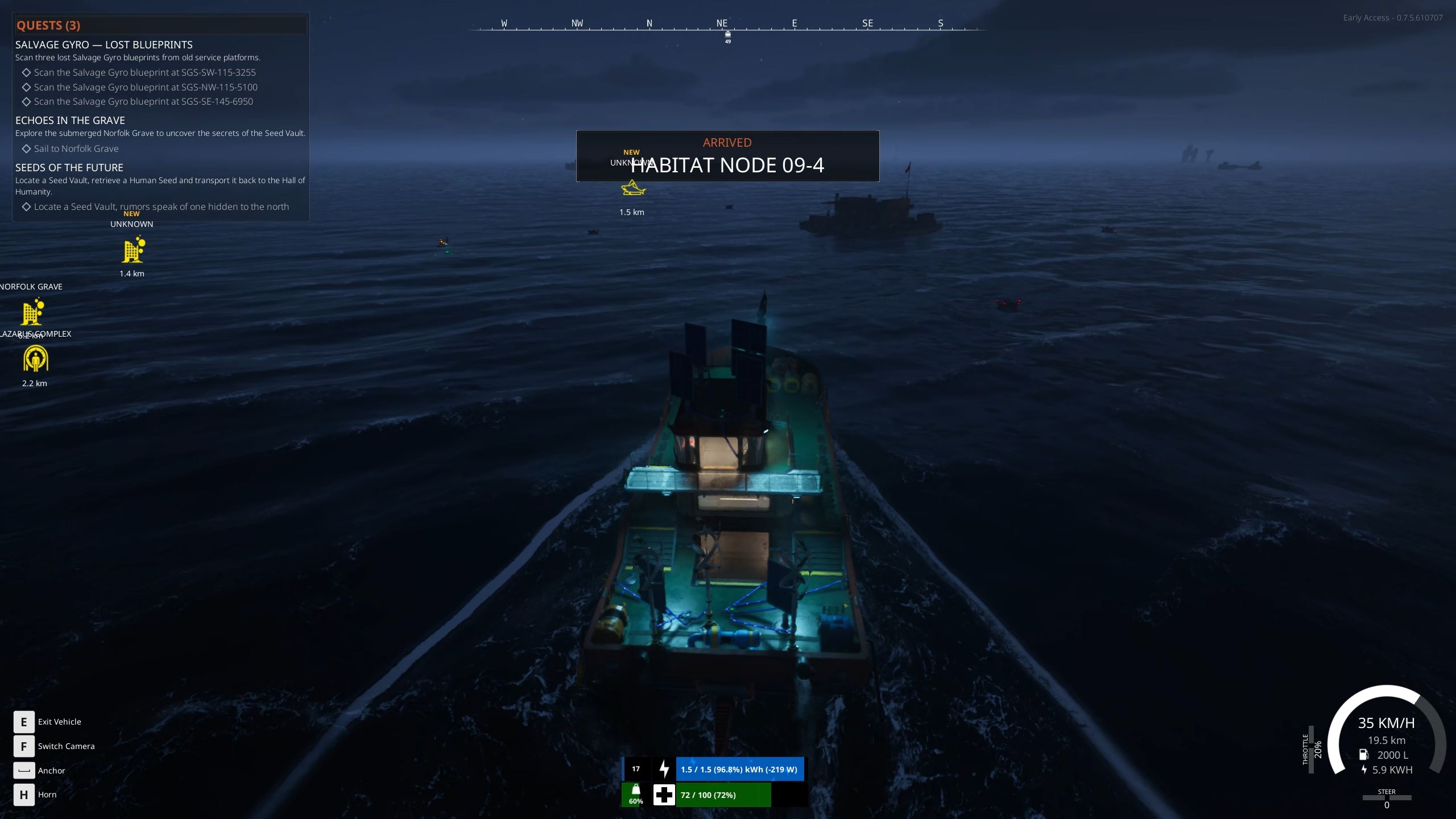
The Last Caretaker is repetitive, technically unstable and frequently frustrating. Its combat needs a substantial overhaul, the underwater sections require refinement and the world needs more distinctive locations to justify its enormous scale. However, its weaknesses somehow become less noticeable the longer I play. There is always another machine to restore, another cable network to improve or another expedition to prepare.
Players looking for polished combat or a completely finished survival experience should remember that this is still Early Access. However, if you enjoy engineering, exploration, resource management and physically interacting with machinery, there is already plenty here to justify giving it a chance. The Last Caretaker has its own identity and understands exactly what kind of survival game it wants to become. It still has a long journey ahead of it, but even after roughly 70 hours, I am not ready to leave its flooded world behind.
The Last Caretaker is one interesting survival and crafting game. Its flooded setting, mobile base, physical engineering systems and larger objective of rebuilding humanity give nearly every activity a meaningful purpose. Repetitive locations, weak combat and serious performance problems make it difficult to recommend without reservations, but its strengths are substantial enough to keep the experience addictive even after dozens of hours.
Ending Thoughts
Review copy provided by the publisher
Reading another person’s mind is often presented as a desirable superpower, but Sister Other Paranoia immediately understands why it could…
Forsaken Realms: Vahrin’s Call is exactly the kind of ambitious, slightly clumsy fantasy RPG that used to be far more…
![[Early Access] 2nd EVE – Sci-Fi Action RPG That Lacks a Sense of Stakes](https://www.indie-games.eu/wp-content/uploads/2026/08/2ND-EVE-1024x576.jpg)
2nd Eve is a space-set action RPG in which we strive to save humanity.
![[PREVIEW] Dreamcards – Strategic Exploration of Consciousness](https://www.indie-games.eu/wp-content/uploads/2026/08/Dreamcards_20260810_233631_0000-1024x576.jpg)
Dreamcards is a roguelike deckbuilder centered around dreams and nightmares.
![[Early Access] OFFBEAT – Incredibly Fun Way to Start a Music Career](https://www.indie-games.eu/wp-content/uploads/2026/08/Offbeat_20260808_201446_0000-1024x576.jpg)
In OFFBEAT, we play the role of a jobbing composer who is launching their music career.

HellSlave II retains the original’s oppressive atmosphere, morally grey world and striking art while adding a larger world, randomized loot…

Beast of Reincarnation is an ambitious but uneven action RPG elevated by satisfying parry combat, beautiful art direction and the…

K-pop Idol Stories: Road to Debut captures the pressure of building idol group, but its management systems never explore that…
Hooded Horse keeps finding strategy games that know their audience, and Corsair Cove extends its impressive run of excellent city-builders.

Teeto is a warm, cozy, creative and highly enjoyable 3D platformer that understands why classic collectathons remain so appealing.

Turnip Mountain stands out for its combination of a unique control system and a minimalist approach.
Dystopicon is an imaginative and memorable narrative experiment with sharp social commentary, engaging world-building and several wonderfully absurd scenarios.

Maneki Mania is an incremental game centered around petting a lucky cat.

XeGrader Plus delivers colorful retro shooting, but basic mechanics, a short campaign and paid retro modes make its €20 price…

It has been roughly two and a half years since Palworld first entered Early Access, and quite a lot has…

Advent: Dawn is an intriguing science-fiction visual novel elevated by a likable cast and one of the most convenient flowchart…
![[EARLY ACCESS] Hell Maiden – Beautiful but Uneven Journey Through Hell](https://www.indie-games.eu/wp-content/uploads/2025/06/HMD_screenshot_019-1024x576.jpg)
Bullet heaven and rougelite game Hell Maiden lands between a polished Early Access release and a promising game that still…
![[PREVIEW] Dark Queen of Samobor – Promising Croatian Adventure Still in Need of Polish](https://www.indie-games.eu/wp-content/uploads/2026/07/Dark-Queen-of-Samobor-1024x587.jpg)
Dark Queen of Samobor is a promising 2.5D side-scrolling action-adventure that combines Croatian folklore with combat, puzzles and cinematic platforming.

70s-style Robot Anime Geppy-X offers incredible animation, music and mecha nostalgia, but its average shooting make the €39 price difficult…

Denshattack! blends Tony Hawk, Jet Set Radio, and Japanese train culture into one of the year's most creative and unforgettable…
